组成图示
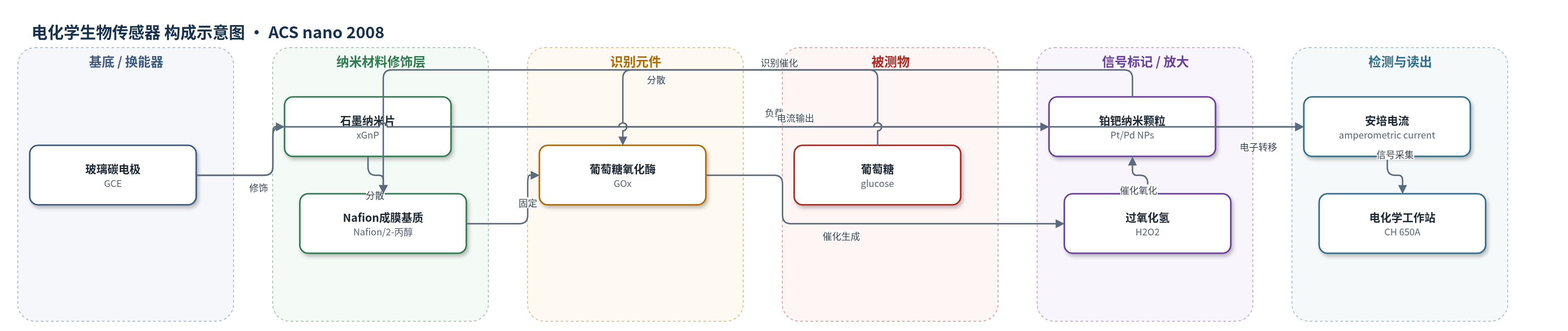
点击图片查看大图 · 依据论文自动绘制
传感器类型
电化学生物传感器
检测对象
葡萄糖(glucose);样品基质为 50 mM 磷酸盐缓冲液(PBS, pH 7.4),模拟生理血糖条件。
检测原理
葡萄糖扩散进入固定有葡萄糖氧化酶(GOx)的 Nafion-xGnP 复合膜,GOx 催化葡萄糖氧化为葡萄糖酸并产生过氧化氢(H2O2)。生成的 H2O2 扩散至 Pt 或 Pd 纳米颗粒修饰的 xGnP 界面,在 +0.7 V 工作电位下发生电催化氧化/还原,产生与 H2O2 浓度成正比的法拉第电流。xGnP 提供导电网络、增大电活性面积并促进电子转移;Pt/Pd 纳米颗粒降低 H2O2 检测过电位,提高灵敏度。Nafion 固定酶与纳米材料,并赋予一定离子选择性。葡萄糖浓度越高,酶反应生成 H2O2 越多,稳态安培电流越大。该体系未使用 HCR、RCA 或 CRISPR-Cas 等核酸放大策略,信号放大主要来自酶催化与贵金属纳米颗粒电催化。
检测灵敏度
Pt-xGnP: LOD: 1 μM (S/N=3);线性范围: 0–20 mM(原文:up to 20 mM);灵敏度: 61.5 ± 0.6 μA/(mM·cm2)。Pd-xGnP: LOD: 4.0 μM (S/N=3);线性范围: 0–10 mM(原文:up to 10 mM);灵敏度: 47.9 ± 3.2 μA/(mM·cm2)。
效应效果
Pt-xGnP 传感器在 4 mM 葡萄糖存在下,加入 0.1 mM 抗坏血酸(AA)或 0.2 mM 尿酸(UA)分别仅使信号增加 8.0% 和 18%,明显低于无 Pt 的 xGnP 传感器(AA 56.8%、UA 125%),表明 Pt 纳米颗粒提高了对 H2O2 的选择性;在 -50 mV 下可消除 AA/UA 干扰,但葡萄糖灵敏度下降。干法 4°C 储存时,响应在 1–2 天后达到最大并稳定约一周,1 个月后仍保持 70% 灵敏度,2 个月后保持 50%。其响应时间约 2 s,快于 Pt-MWCNT 溶胶-凝胶法(15 s)和碳糊法(30 s),灵敏度高于 Pt 修饰 MWCNT 葡萄糖传感器,作者认为兼具高性能与低成本,适合商业化。
传感器的构成
- 基底/换能器电极:玻璃碳电极(glassy carbon electrode, GCE),抛光后作为工作电极,提供导电基底与电子转移动力。
- 纳米材料修饰层:剥离石墨纳米片(exfoliated graphite nanoplatelets, xGnP)负载 Pt 或 Pd 纳米颗粒(Pt-xGnP/Pd-xGnP),增大电活性面积并催化 H2O2 电化学反应。
- 分散/成膜介质:Nafion(全氟磺酸聚合物)与 2-丙醇/水混合液(85 wt% 2-propanol),分散金属修饰 xGnP 并形成离子选择性成膜基质。
- 识别元件:葡萄糖氧化酶(glucose oxidase, GOx),固定于 Nafion-xGnP 复合膜中,催化葡萄糖氧化生成 H2O2。
- 信号催化层:Pt 或 Pd 纳米颗粒(Pt NPs/Pd NPs),催化 H2O2 在电极界面发生电化学反应,将酶反应产物转换为安培电流。
- 检测介质:50 mM 磷酸盐缓冲液(PBS, pH 7.4),提供酶反应与电化学测量环境。
中文摘要
本文报道了一种新型高灵敏、高选择性、快速响应且低成本的安培葡萄糖生物传感器的制备。该传感器采用铂(Pt)和钯(Pd)纳米颗粒修饰的剥离石墨纳米片(xGnP)作为换能材料,利用 Nafion 分散金属修饰石墨纳米片,并通过高含量有机溶剂(85 wt% 2-丙醇)的简单涂覆法制备。贵金属纳米颗粒的引入增大了电极电活性面积,显著降低了过氧化氢检测的过电位。Pt-xGnP 葡萄糖生物传感器灵敏度为 61.5 ± 0.6 μA/(mM·cm2),线性响应达 20 mM,响应时间为 2 s,检出限(S/N=3)为 1 μM。结果表明,Pt 纳米颗粒修饰的 xGnP 在传感性能与制备成本方面均处于已报道葡萄糖生物传感器的先进水平。此外,系统研究了金属纳米颗粒负载量和粒径对传感器性能的影响。
英文摘要
We report the novel fabrication of a highly sensitive, selective, fast responding, and affordable amperometric glucose biosensor using exfoliated graphite nanoplatelets (xGnPs) decorated with Pt and Pd nanoparticles. Nafion was used to solubilize metal-decorated graphite nanoplatelets, and a simple cast method with high content organic solvent (85 wt %) was used to prepare the biosensors. The addition of precious metal nanoparticles such as platinum (Pt) and palladium (Pd) to xGnP increased the electroactive area of the electrode and substantially decreased the overpotential in the detection of hydrogen peroxide. The Pt-xGnP glucose biosensor had a sensitivity of 61.5+/-0.6 microA/(mM x cm(2)) and gave a linear response up to 20 mM. The response time and detection limit (S/N=3) were determined to be 2 s and 1 microM, respectively. Therefore, this novel glucose biosensor based on the Pt nanoparticle coated xGnP is among the best reported to date in both sensing performance and production cost. In addition, the effects of metal nanoparticle loading and the particle size on the biosensor performance were systematically investigated.