组成图示
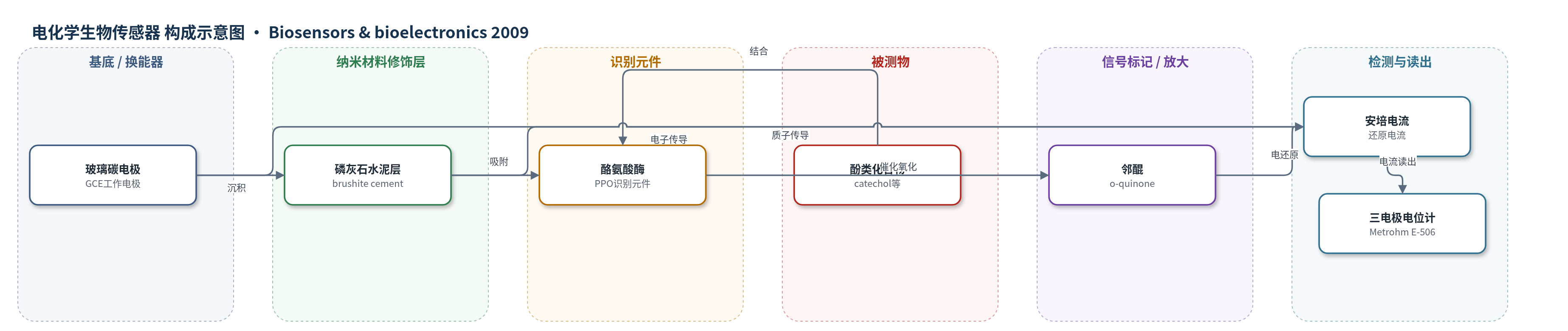
点击图片查看大图 · 依据论文自动绘制
传感器类型
电化学生物传感器
检测对象
酚类化合物(phenolic compounds),包括儿茶酚(catechol)、苯酚(phenol)、甲酚(m-/p-cresol)、氯苯酚(3-/4-chlorophenol);样品基质:磷酸盐缓冲液(PBS)、乙腈/PBS混合液、废水(橄榄油精炼厂废水)
检测原理
该传感器以玻璃碳电极为换能器,磷灰石水泥层作为生物相容性固体电解质和酶固定基质。酪氨酸酶(PPO)通过吸附并戊二醛交联固定于磷灰石表面。酚类底物进入酶层后,PPO催化单酚羟基化生成邻二酚,并进一步氧化为邻醌(o-quinone)。在−0.1 V(vs SCE)下,邻醌在电极表面发生电化学还原,产生与酚浓度成正比的安培电流。磷灰石水泥中的晶格水可发生质子迁移,改善界面传导;水泥原位结晶形成细小颗粒,有利于底物和产物扩散,从而提高灵敏度。
检测灵敏度
LOD: 1 nM;线性范围: 1.0 × 10⁻⁹–3.0 × 10⁻⁶ M;灵敏度: 46.6 A M−1 cm−2(PBS,catechol);LOD: 2 nM;线性范围: 0.007–2 μM;灵敏度: 28.6 A M−1 cm−2(acetonitrile/PBS);LOD: 3 nM;线性范围: 3.0 × 10⁻⁹–3.0 × 10⁻⁶ M;灵敏度: 42.6 A M−1 cm−2;R^2 = 0.9989 (n=25)(PPO/brushite cement/GA);LOD: 0.04 μM;线性范围: 4.0 × 10⁻⁸–7.0 × 10⁻⁶ M;灵敏度: 3.30 A M−1 cm−2;R^2 = 0.9982 (n=13)(acetonitrile/PBS 98.5/1.5)
效应效果
传感器响应时间为12 s,灵敏度较其他PPO无机基质体系高约6倍。重复性RSD在3 nM、0.5 μM和2 μM儿茶酚下分别为8.6%、2.6%和1.6%,低于Horwitz方程允许值。稳定性方面,水相中6 d保留90%初始电流,乙腈/缓冲液中3 d保留90%;9 d后降至40%。实际橄榄油精炼厂废水中,初级处理水酚类含量为40±1 μM(以苯酚计),加标40 μM苯酚后回收率为92–95%。
传感器的构成
- 工作电极基底:玻璃碳电极(GCE),提供导电换能界面
- 修饰层:磷灰石水泥(brushite cement,CaHPO4·2H2O)胶体沉积,作为生物相容性固体电解质与酶吸附基质
- 识别元件:酪氨酸酶(PPO,monophenol polyphenol oxidase),催化酚类羟基化与氧化
- 交联固定剂:戊二醛(GA)蒸气,交联固定PPO并减少酶流失
- 缓冲介质:0.1 M磷酸盐缓冲液(PBS,pH 6.0),维持酶活性与离子传导
- 测量电极:铂对电极(Pt)和饱和甘汞电极(SCE),构成三电极安培测量体系
中文摘要
brushite(磷灰石)是一种具有固体电解质特性的生物相容性磷酸钙矿物。本研究利用该特性,在玻璃碳电极表面沉积磷灰石水泥层,并将酪氨酸酶(PPO)吸附固定于其上,再用戊二醛(GA)蒸气交联,制备酶促安培生物传感器。系统优化了GA交联时间、PPO/磷灰石比例、磷灰石膜厚度以及pH、温度、施加电位等参数,并考察了二氧六环、乙腈和乙醇等有机溶剂对性能的影响。在PBS和乙腈/PBS体系中,传感器响应时间均为12 s,线性范围分别为0.001–3 μM和0.007–2 μM,检出限分别为1 nM和2 nM,灵敏度分别为46.6和28.6 A M−1 cm−2。该传感器成功用于实际样品中酚类化合物的检测。
英文摘要
Brushite is a biocompatible calcium phosphate mineral with properties of solid electrolyte. In this study we take advantage of this characteristic to develop an enzymatic amperometric biosensor based on brushite cement. The biosensor was prepared by immobilizing tyrosinase (PPO) on a brushite cement layer which was subsequently cross-linked with glutaraldehyde (GA) on the surface of a glassy carbon electrode. The system was optimized for the detection of phenolic compounds in both aqueous and non-aqueous solutions. Several variables involved in the enzyme immobilization method such as glutaraldehyde cross-linking time, PPO/brushite ratio and thickness of the brushite film were investigated. Furthermore, the effects of the pH, temperature and applied potential on the biosensor performance were also optimized. On the other hand, the biosensor analytical properties were studied in presence of different organic solvents: dioxane, acetonitrile and ethanol. In both, phosphate buffer solution (PBS) and acetonitrile/PBS solution, the biosensor exhibits a rapid response (12 s); a wide linear range (0.001-3 microM and 0.007-2 microM respectively); low detection limit (1 and 2 nM respectively); and high sensitivity (46.6 and 28.6 A M(-1) cm(-2) respectively). The performance of the biosensor in the analysis of phenols in real samples was successful.