组成图示
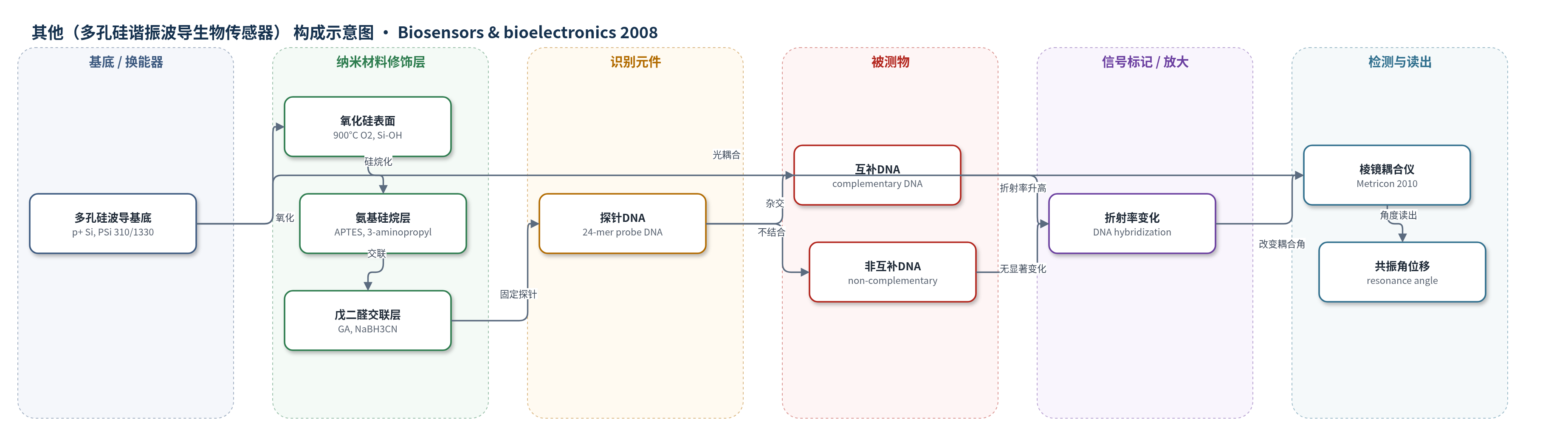
点击图片查看大图 · 依据论文自动绘制
传感器类型
其他(多孔硅谐振波导生物传感器)
检测对象
互补DNA(complementary DNA)、非互补DNA(non-complementary DNA),样品基质为HEPES缓冲液(20 mM HEPES、150 mM NaCl、pH 7.4)
检测原理
该传感器为无标记光学波导器件。p+硅片经电化学刻蚀形成低孔度与高孔度双层多孔硅波导,顶部空气隙增强模式限制。探针DNA通过APTES和戊二醛固定于约20 nm孔道内。当互补DNA进入孔内并与探针杂交时,孔壁生物分子量增加,使顶层PSi有效折射率和波导模式有效折射率升高。棱镜耦合的TE0模式共振耦合角随有效折射率变化而发生偏移,偏移量与结合量相关。非互补DNA不杂交,几乎不产生位移。强场限制和尖锐共振提高灵敏度。
检测灵敏度
LOD: 50 nM DNA浓度,相当于5 pg/mm2;共振角位移: 0.046°(50 μM complementary DNA);角分辨率: 0.002°;FWHM: 0.07°
效应效果
各功能化步骤均引起共振角偏移,证实表面修饰成功。暴露于50 μM互补DNA后,波导共振角位移0.046°;暴露于50 μM非互补DNA和缓冲液时位移可忽略,表明可区分互补与非互补DNA。棱镜耦合仪角分辨率为0.002°,共振半高宽为0.07°,作者认为最终检测限应远小于50 μM。模拟在50%探针覆盖下给出检测限50 nM,即5 pg/mm2。作者指出当前探针覆盖和杂交效率偏低,席夫碱不稳定、负电荷DNA腐蚀PSi以及DNA向低层扩散会限制灵敏度,后续拟优化固定与缓冲条件。
传感器的构成
- 基底/换能器:p+硅片(0.01 Ω cm),经HF电化学刻蚀形成多孔硅波导,作为光波导换能器。
- 低孔度PSi层:310 nm、56%孔隙率、n=2.08(1550 nm TE),承载识别层并限制波导模式。
- 高孔度PSi层:1330 nm、84%孔隙率、n=1.41(1550 nm TE),提供波导支撑与模式结构。
- 空气间隙:低孔度层上方空气隙,提供顶部界面模式限制。
- 氧化预处理:900 °C O2氧化10 min,降低波导损耗并生成可功能化表面。
- 氨基硅烷层:3-aminopropyltriethoxysilane(APTES),提供氨基用于连接戊二醛。
- 交联层:glutaraldehyde(GA)与sodium cyanoborohydride稳定席夫碱,连接APTES氨基与probe DNA。
- 识别元件:24-mer probe DNA(5′-TAGCTATGGAATTCCTCGTAGGCC-3′),固定于孔壁,与complementary DNA杂交。
- 封闭剂:3 M ethanolamine(EA,pH 9.0),封闭未反应醛基,减少非特异结合。
中文摘要
多孔硅(PSi)因具有大比表面积和分子尺寸选择性,是生物传感的优良材料。本文报道了一种无标记纳米多孔硅谐振波导生物传感器的实验演示。该PSi波导由平均孔径约20 nm的孔道构成,采用标准氨基硅烷和戊二醛化学方法将DNA固定于孔内。分子结合通过光学方式检测,表现为波导共振角发生偏移;共振偏移量与结合在孔壁上的生物分子数量直接相关。该PSi波导传感器能够选择性地区分互补DNA和非互补DNA。其优势在于强场限制和尖锐共振特征,可实现高灵敏度测量和较低检测限。模拟结果表明,该传感器对DNA的检测限为50 nM,相当于5 pg/mm2。
英文摘要
Porous silicon (PSi) is an excellent material for biosensing due to its large surface area and its capability for molecular size selectivity. In this work, we report the experimental demonstration of a label-free nanoscale PSi resonant waveguide biosensor. The PSi waveguide consists of pores with an average diameter of 20nm. DNA is attached inside the pores using standard amino-silane and glutaraldehyde chemistry. Molecular binding in the PSi is detected optically based on a shift of the waveguide resonance angle. The magnitude of the resonance shift is directly related to the quantity of biomolecules attached to the pore walls. The PSi waveguide sensor can selectively discriminate between complementary and non-complementary DNA. The advantages of the PSi waveguide biosensor include strong field confinement and a sharp resonance feature, which allow for high sensitivity measurements with a low detection limit. Simulations indicate that the sensor has a detection limit of 50nM DNA concentration or equivalently, 5pg/mm2.