组成图示
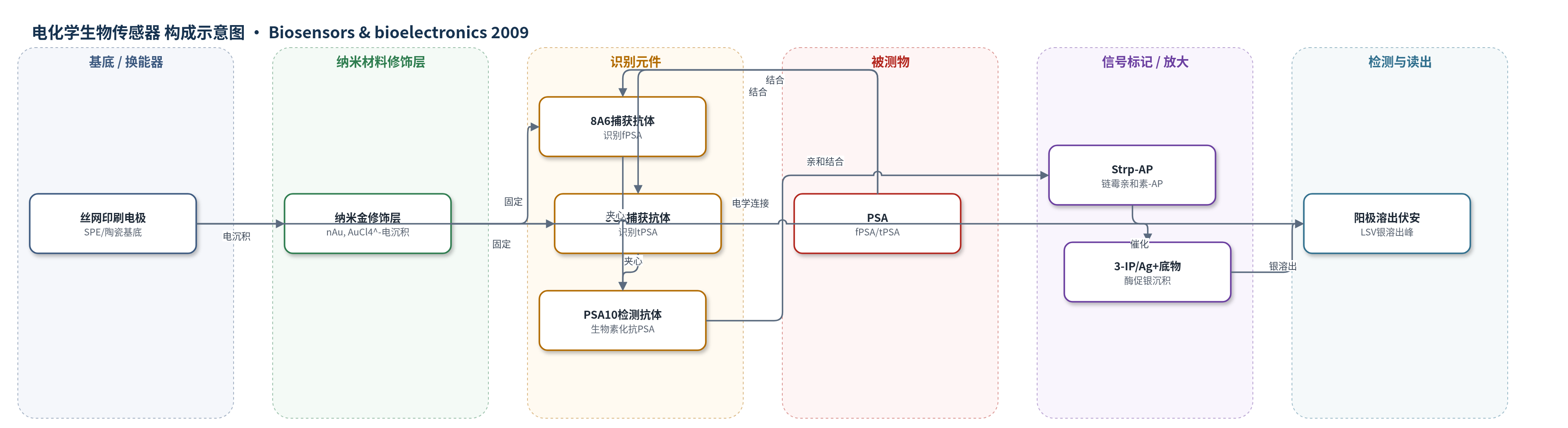
点击图片查看大图 · 依据论文自动绘制
传感器类型
电化学生物传感器
检测对象
游离前列腺特异性抗原(free PSA, fPSA)、总前列腺特异性抗原(total PSA, tPSA);样品基质:人雄激素敏感LNCaP前列腺肿瘤细胞培养上清/血清样品(稀释1/2)
检测原理
传感器采用双工作电极免疫识别:8A6抗体识别fPSA的隐藏表位,5G6抗体识别tPSA的暴露表位,使同一器件分别响应游离和总PSA。样品中的PSA被捕获后,加入生物素化抗PSA抗体PSA10形成夹心复合物,再与链霉亲和素-碱性磷酸酶(Strp-AP)结合。加入3-IP/Ag+底物后,AP催化水解3-IP生成indoxyl中间体;indoxyl可被氧氧化为indigo blue,同时作为还原剂将Ag+还原为金属银并沉积在对应工作电极表面。由于银颗粒只沉积在产生它的电极上,避免双电极间扩散干扰。最后用线性扫描伏安进行阳极溶出,银溶出峰电流随PSA浓度增加而增大,实现fPSA和tPSA的同时定量。
检测灵敏度
LOD: 1 ng/mL;线性范围: 1–10 ng/mL;SPC-nAu-E斜率: tPSA 12.300 μA/(ng/mL), fPSA 6.081 μA/(ng/mL);R^2: 0.994 (tPSA), 0.992 (fPSA);Dualsensor-nAu斜率: tPSA 4.40 μA/(ng/mL), fPSA 2.53 μA/(ng/mL);R^2: 0.999 (tPSA), 0.991 (fPSA);FBS加标校准斜率: tPSA 4.21 μA/(ng/mL), fPSA 1.61 μA/(ng/mL);R^2: 0.990 (tPSA), 0.990 (fPSA)
效应效果
纳米金修饰丝网印刷碳电极表现最佳,LOD为1 ng/mL,5 ng/mL fPSA的RSD为7.0%(n=6,ip=27.53 μA),覆盖临床1–10 ng/mL范围。Dualsensor-nAu可在一枚器件上同时获得fPSA和tPSA信号,性能与单电极SPC-nAu-E相当;酶促沉积的金属银只留在对应电极表面,避免双电极间扩散造成假信号。实际样品中,用FBS培养基加标PSA建立校准曲线,tPSA和fPSA的R^2均为0.990,无明显基质效应。三种LNCaP细胞培养上清中,FBSCH-ST组PSA低于CON组,DHT组高于CON组,且检测到的是fPSA。作者认为该双传感器可替代Western Blot,加速前列腺癌研究。
传感器的构成
- 基底/换能器:陶瓷基底上丝网印刷碳工作电极、碳对电极和银伪参比电极(SPE/Dualsensor-nAu),提供电化学界面
- 纳米材料修饰层:AuCl4^-在碳工作电极上电还原形成纳米金(nAu)修饰层,增强抗体固定与信号
- 识别元件:8A6单克隆抗体固定于一个工作电极,识别游离PSA(fPSA)
- 识别元件:5G6单克隆抗体固定于另一个工作电极,识别总PSA(tPSA)
- 封闭剂:2% casein封闭非特异吸附位点
- 检测抗体:生物素化抗PSA抗体PSA10,与捕获的PSA形成夹心复合物
- 信号标记物:链霉亲和素-碱性磷酸酶(Strp-AP),结合生物素化PSA10
- 底物/放大层:5.6 mM 3-IP与0.4 mM AgNO3混合底物,AP催化生成indoxyl并还原Ag+为金属银
- 读出层:Autolab PGSTAT 10 (bi)potentiostat,线性扫描伏安(LSV)阳极溶出银峰
中文摘要
本文报道了一种基于丝网印刷电极的伏安酶双生物传感器,用于同时测定游离前列腺特异性抗原(fPSA)和总前列腺特异性抗原(tPSA)。以碱性磷酸酶(AP)为酶标记,3-吲哚酚磷酸盐(3-IP)与银离子混合液为底物;分别将特异性识别fPSA的8A6抗体和识别tPSA的5G6抗体固定于丝网印刷碳电极、丝网印刷金电极及纳米金修饰丝网印刷碳电极上,以筛选最佳传感表面。结果表明,纳米金修饰丝网印刷碳电极具有最佳分析性能和重复性,因此用于构建Dualsensor-nAu双传感器:一个工作电极固定8A6,另一个固定5G6,滴加抗体溶液后4℃过夜。检测采用生物素化抗PSA抗体PSA10和链霉亲和素-AP偶联物,形成夹心免疫反应。该传感器据作者所知是首个同时电化学检测fPSA和tPSA的生物传感器,并用于监测三种人雄激素敏感LNCaP前列腺肿瘤细胞培养体系中PSA的产生。
英文摘要
Voltammetric enzyme dual sensors for simultaneous determination of free and total prostate specific antigen (fPSA and tPSA) are described. Alkaline Phosphatase (AP) and a mixture solution of 3-indoxyl phosphate and silver ions were used as the enzymatic label and substrate, respectively. 8A6 or 5G6 antibodies specific for free and total PSA, respectively, were immobilized on different screen-printed electrodes (SPEs)--screen-printed carbon electrodes, screen-printed gold electrodes and screen-printed carbon electrodes modified with nanogold--in order to be able to select one of the surfaces as the most adequate one to develop the dual sensor. Screen-printed carbon electrodes modified with nanogold were the SPEs with the best analytical characteristics and lead to the most repeatable bioelectrodes, so they were selected for the development of the dual sensor. On Dualsensor-nAu electrodes, 8A6 antibody was immobilized on one working electrode and 5G6 antibody was immobilized on the other one by deposition of a drop of solution of each antibody and left overnight at 4 degrees C. Biotinylated anti-PSA antibody and streptavidin-AP conjugate were used as detection reagents, giving rise, to our knowledge, to the first simultaneous electrochemical biosensor for free and total PSA. The PSA dual sensor was used to monitor PSA production from three different cultures of human androgen-sensitive prostate tumor cells.