组成图示
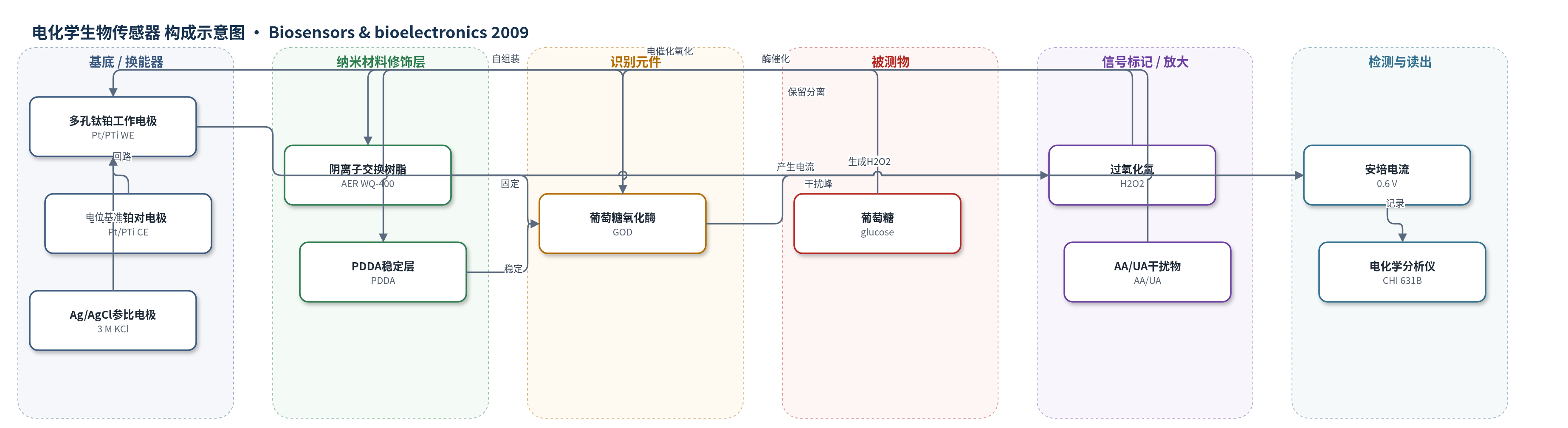
点击图片查看大图 · 依据论文自动绘制
传感器类型
电化学生物传感器
检测对象
葡萄糖(glucose);样品基质:人血清(human serum)、PBS 缓冲液
检测原理
该传感器基于葡萄糖氧化酶(GOD)催化反应与安培检测。样品在流动注射系统中进入填充 PDDA/GOD/AER 的安培池,GOD 催化葡萄糖与氧气反应生成葡萄糖酸和过氧化氢(H2O2)。H2O2 在 0.6 V 下于铂修饰多孔钛(Pt/PTi)工作电极发生电催化氧化,产生与葡萄糖浓度成正比的安培电流。AER 带正电荷,可保留样品中负电性的抗坏血酸(AA)和尿酸(UA),使中性的葡萄糖和 H2O2 先到达电极,从而降低干扰;多孔电极增大有效面积并提高响应。整体通过酶促产物电化学氧化实现定量。
检测灵敏度
LOD: 0.8 μmol L−1 (S/N=3);线性范围: 1 μmol L−1–2 mmol L−1;灵敏度: 22.4 μA cm−2 mM−1;校准方程: ip (μA)=6.33cglucose (mmol L−1);R² = 0.9954
效应效果
传感器在 0.4 mL/min 下对 AA/UA 干扰具有良好抗干扰能力,AA 干扰在低流速下可忽略,梯度洗脱可缩短分析时间。重现性良好:连续 6 次注入 2 mmol/L 葡萄糖 RSD 为 3.5%,批内和批间 RSD 分别为 4.3% 和 5.7%。4℃ 保存 10 天灵敏度无下降,45 天后保留 80% 初始响应。人血清葡萄糖测定结果为 5.77±0.05 mmol/L,与 Beckman CX5 临床分析仪 5.54 mmol/L 相比相对误差 4.2%,RSD 0.87%。与平面 Pt 电极相比响应提高 8.3 倍;与 Dionex ED50 安培池组合相比灵敏度提高 7.97 倍,检出限低约一个数量级。
传感器的构成
- 工作电极:铂修饰多孔钛电极(Pt/PTi),大有效面积,电催化氧化 H2O2 产生安培电流
- 对电极:铂修饰多孔钛电极(Pt/PTi),与 WE 相对,完成电化学回路
- 参比电极:自制 Ag/AgCl(3 mol L−1 KCl),提供稳定电位基准
- 酶载体/抗干扰层:阴离子交换树脂(AER, WQ-400, 200–400 mesh),固定 GOD 并保留 AA/UA
- 识别元件:葡萄糖氧化酶(GOD),催化葡萄糖氧化生成 H2O2
- 稳定/封闭层:聚二烯丙基二甲基氯化铵(PDDA),静电自组装于 GOD 外,减少酶泄漏
- 密封与过滤层:特氟龙膜(TM)和微孔滤膜(MFM),防止漏液并避免树脂堵塞 WE
中文摘要
本研究通过静电自组装策略,在阴离子交换树脂(AER)表面依次修饰葡萄糖氧化酶(GOD)和聚二烯丙基二甲基氯化铵(PDDA),制备 PDDA/GOD/AER 复合填料,并将其填充于自制安培检测池中用于流动注射分析(FIA)葡萄糖。该设计将酶反应器集成到安培池中,简化了装置;AER 兼具酶载体和抗干扰介质功能,可保留抗坏血酸(AA)和尿酸(UA)。池内采用铂修饰多孔钛(Pt/PTi)工作电极,其大有效面积使响应较平面纯铂电极提高 8.3 倍。传感器对葡萄糖定量灵敏度高,灵敏度为 22.4 μA cm−2 mM−1,线性范围为 1 μmol L−1 至 2 mmol L−1,检出限为 0.8 μmol L−1。该传感器用于血清葡萄糖测定,结果令人满意,可为其他酶促 FIA 生物传感器提供安培池设计参考。
英文摘要
In this work, the anion exchange resin (AER) was modified with a layer of glucose oxidase (GOD) and poly(diallyldimethylammonium chloride) (PDDA), respectively, via layer-by-layer electrostatic self-assembling strategy. The PDDA and GOD modified AER (PDDA/GOD/AER) was then packed into a home-made amperometric cell for flow injection analysis (FIA) of glucose. This design simplified the setup by integrating the enzyme reactor into the amperometric cell. And the AER in the cell behaved bifunctional, it was not only the support of enzymes, but also an anti-interference tool due to its retention effect toward ascorbic acid (AA) and uric acid (UA). A platinum modified porous titanium (Pt/PTi) electrode was utilized in the cell as the working electrode (WE), due to its large effective surface area it could increase the response by 8.3 times as compared with the planar pure platinum electrode. The proposed biosensor was very sensitive (22.4 microA cm(-2) mM(-1)) in glucose quantification, and the linear range was from 1 micromol L(-1) to 2 mmol L(-1) with the detection limit of 0.8 micromol L(-1). The biosensor was used for serum glucose determination, and the result obtained was satisfying. This work may have provided a reference design of the amperometric cell which could be adopted in other enzymatic-FIA biosensors.