组成图示
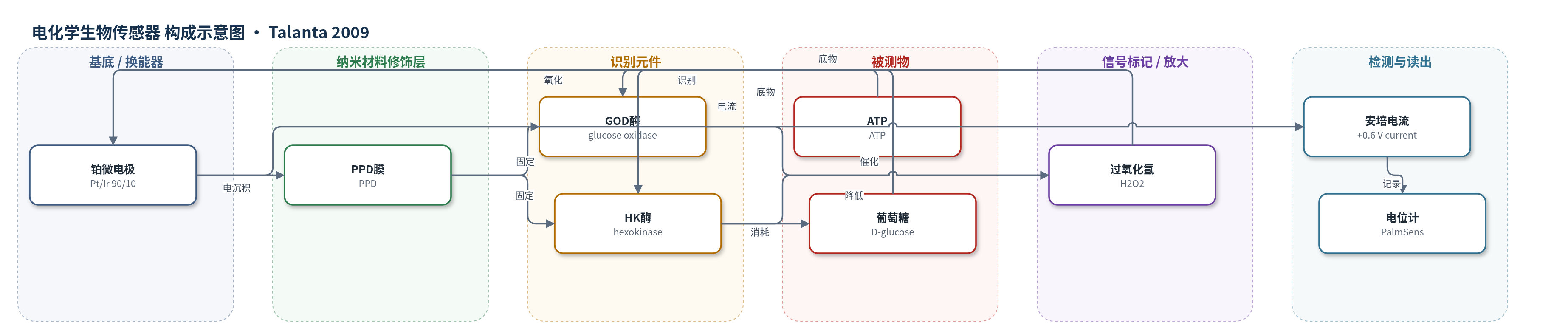
点击图片查看大图 · 依据论文自动绘制
传感器类型
电化学生物传感器
检测对象
三磷酸腺苷(ATP);样品基质:体外HEPES缓冲液(含Mg2+、NaCl、KCl),作者称可用于生物样品但需双传感器校正葡萄糖
检测原理
该传感器采用双酶竞争底物机制。GOD催化葡萄糖氧化生成H2O2,H2O2在+0.6 V铂电极上氧化产生安培电流。HK在Mg2+存在下催化葡萄糖与ATP反应生成葡萄糖-6-磷酸和ADP,与GOD竞争葡萄糖。当样品中存在ATP时,HK消耗葡萄糖,使GOD产生的H2O2减少,电极电流下降;电流下降幅度与ATP浓度成正比。PPD膜阻挡电活性干扰物,提高选择性。由于响应同时依赖葡萄糖和ATP,体外检测需保持葡萄糖恒定;若生物样品葡萄糖未知,需联用GOD葡萄糖传感器与GOD/HK ATP传感器进行校正。
检测灵敏度
LOD: 2.5 μM
效应效果
选择性较好:PPD膜可基本排除抗坏血酸、尿酸、L-半胱氨酸、多巴胺、对乙酰氨基酚等电活性干扰物,连续工作6 h内选择性稳定;对500 μM的ADP、AMP、GTP和UTP几乎无响应。25 ℃连续工作8.5 h响应变化小,4个传感器重现性较好,但未报告RSD。-20 ℃干燥保存至少3个月响应不变。22 ℃升至37 ℃响应约增2倍,45–60 ℃时ATP响应降至近零,说明HK较GOD不稳定。未报告实际样品回收率及与ELISA、HPLC、qPCR对比。作者认为可用于微体积体外ATP动力学、食品微生物污染检测和激酶抑制剂药物设计。
传感器的构成
- 基底/换能器电极:铂微电极(platinum microelectrode,Pt/Ir 90/10,直径25 μm),作为安培工作电极
- 修饰层:聚间苯二胺(poly-m-phenylenediamine, PPD)电沉积膜,阻挡电活性干扰物并允许H2O2到达电极
- 识别元件:葡萄糖氧化酶(glucose oxidase, GOD)与己糖激酶(hexokinase, HK)共固定酶膜,GOD氧化葡萄糖产生H2O2,HK利用ATP竞争消耗葡萄糖
- 固定/稳定剂:戊二醛(glutaraldehyde, GA)交联酶,牛血清白蛋白(BSA)填充稳定,甘油(glycerol)防干并改善粘附
中文摘要
腺苷三磷酸(ATP)参与多种重要生物过程,其浓度检测具有重要意义。本文报道了一种基于圆柱形铂微电极的安培微生物传感器,电极表面先电沉积聚间苯二胺(PPD)膜,再共固定葡萄糖氧化酶(GOD)和己糖激酶(HK)。作者优化了体外检测ATP的pH、Mg2+和底物浓度,并研究了灵敏度、选择性、重现性和储存稳定性。在最佳条件下,该传感器可在约15 s内响应,ATP检出限为2.5 μM。PPD膜可基本排除生物胺及其代谢物、抗坏血酸、尿酸和L-半胱氨酸等电活性干扰物的影响;传感器对ADP、AMP、GTP和UTP等ATP类似物不敏感。该传感器可用于体外研究消耗或产生高能三磷酸分子的反应动力学,也可用于食品工业中微生物污染检测以及针对激酶等靶标酶抑制剂的药物设计。
英文摘要
ATP determination is of great importance since this compound is involved in a number of vital biological processes. To monitor ATP concentration levels, we have developed a microbiosensor based on cylindrical platinum microelectrode, covered with a layer of poly-m-phenylendiamine (PPD), and layer of co-immobilised glucose oxidase and hexokinase. Conditions for biosensor measurement of ATP (pH, Mg(2+) and substrates concentration) in vitro and microbiosensor characteristics such as sensitivity, selectivity, reproducibility, storage stability were studied and optimized. Under optimal conditions the microbiosensor can measure ATP concentrations down to a 2.5 microM detection limit with response time about 15 s. Interferences by electroactive compounds like biogenic amines and their metabolites, ascorbic acid, uric acid and L-cystein are rejected in general by the PPD layer. The microbiosensor developed is insensitive to ATP analogues (or substances with similar structure), such as ADP, AMP, GTP and UTP, too. It can be used for ATP analysis in vitro in the reactions consuming or producing macroergic triphosphate molecules to study kinetics of the process and in drug design concerning development of inhibitors specific to target kinases and others target enzymes.