组成图示
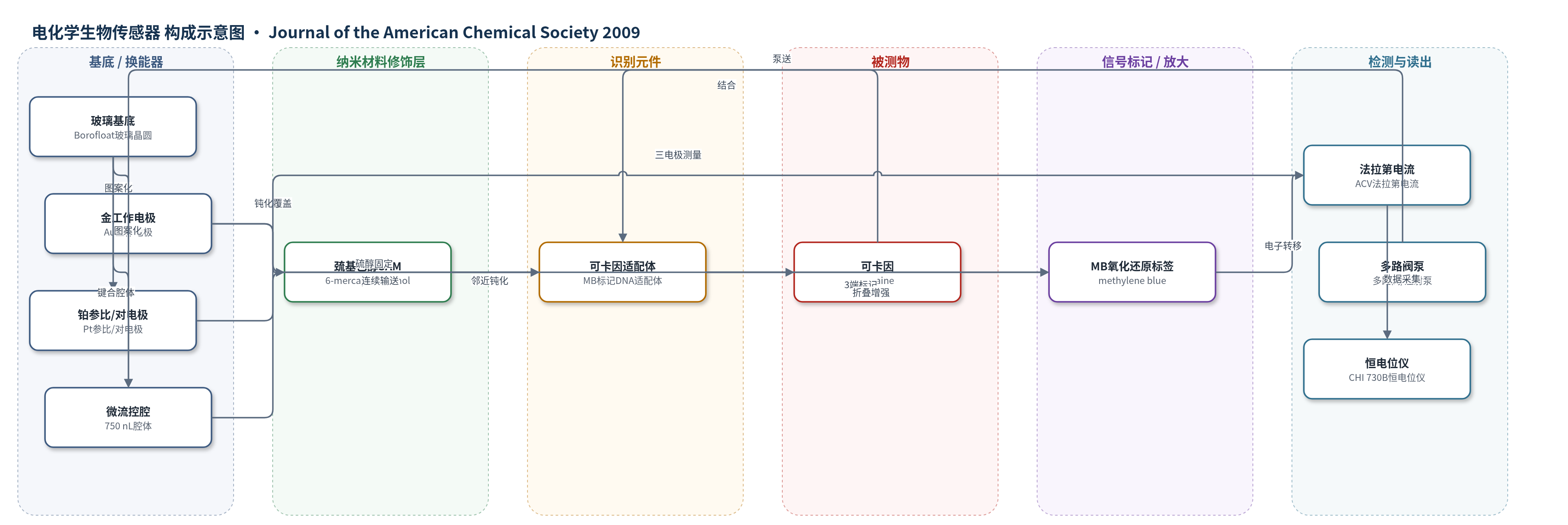
点击图片查看大图 · 依据论文自动绘制
传感器类型
电化学生物传感器
检测对象
可卡因(cocaine);样品基质:未稀释、未处理血血清(undiluted, unmodified blood serum;实验中使用胎牛血清)
检测原理
传感器采用折叠型电化学适配体(E-AB)机制。5′端巯基将MB标记的可卡因DNA适配体固定于Au工作电极,未结合目标时适配体处于部分展开态,MB与电极距离较远,电子转移效率低,法拉第还原电流较低。当可卡因进入微流控腔并与适配体结合后,适配体折叠为结合构象,使3′端MB标签靠近电极,电子转移效率提高,产生可测量的法拉第电流增加。采用交流伏安(ACV)在-0.25至-0.65 V、10 Hz、25 mV下读取MB还原峰电流,以相对电流变化反映可卡因浓度。微流控腔体积750 nL,流动血清4.5 s充满,提高传质并实现连续实时监测;无酶或核酸扩增放大,信号来自适配体构象变化引起的电子转移增强。
检测灵敏度
原文未报告LOD、线性范围、灵敏度斜率或相关系数;报告解离常数: 100 ± 9 µM
效应效果
传感器在未稀释血清中对可卡因快速选择性响应:250 µM加标使法拉第电流较基线提高约38%;10 µM和100 µM流动血清分别使电流增加6%和26%,Kd为100 ± 9 µM,与溶液值一致。无目标血清冲洗后信号恢复至97%,10 µM下可重复使用3次以上,平均恢复率>96%。连续流动血清暴露60 min(约800个腔体体积)后基线稳定;3 h以上暴露有信号损失,6 M Guanadine HCl冲洗后几乎完全恢复,仅9.7%损失。上升时间1–2 min,时间分辨率约1 min,适合即时连续监测。
传感器的构成
- 基底:Borofloat玻璃晶圆(Borofloat glass wafer),承载微流控腔与电极图案。
- 换能器电极:金工作电极(Au working electrodes,3×800 µm²)、铂参比电极(Pt reference electrode,1300 µm²)和铂对电极(Pt counter electrode,3200 µm²),用于适配体固定与三电极交流伏安检测。
- 识别元件:5′-巯基、3′-亚甲基蓝(MB)标记的可卡因结合DNA适配体(cocaine-binding DNA aptamer,32 nt),经Au-S键固定于Au工作电极,结合可卡因后折叠。
- 信号标记物:亚甲基蓝(methylene blue, MB)氧化还原标签,位于适配体3′端,折叠后增强电子向电极转移并产生法拉第电流。
- 封闭/钝化层:6-巯基己醇(6-mercaptohexanol)自组装单分子层(SAM),覆盖裸露Au表面,钝化电极并减少血清蛋白非特异吸附。
- 微流控腔体:玻璃键合形成的750 nL检测腔及Tygon tubing进样口,实现未稀释血清连续流动与快速样品置换。
中文摘要
开发能够在复杂、未处理水样中直接对小分子分析物进行连续实时测量的生物传感系统一直是重大挑战,目前仅少数目标实现。作为通用解决方案,本文报道了微流控电化学适配体传感器(MECAS)芯片,将可响应分析物并结合后发生折叠、从而产生电化学信号的目标特异性DNA适配体与微流控检测系统集成。以可卡因为模型,作者实现了在未稀释、未修饰血血清中,对近生理低微摩尔浓度可卡因的连续实时检测,时间分辨率约1分钟。作者认为,将折叠型电化学传感器与微型化检测系统相结合的策略,可为多种分子目标的实时、即时检测奠定基础。
英文摘要
The development of a biosensor system capable of continuous, real-time measurement of small-molecule analytes directly in complex, unprocessed aqueous samples has been a significant challenge, and successful implementation has been achieved for only a limited number of targets. Toward a general solution to this problem, we report here the Microfluidic Electrochemical Aptamer-based Sensor (MECAS) chip wherein we integrate target-specific DNA aptamers that fold, and thus generate an electrochemical signal, in response to the analyte with a microfluidic detection system. As a model, we demonstrate the continuous, real-time (approximately 1 min time resolution) detection of the small-molecule drug cocaine at near physiological, low micromolar concentrations directly in undiluted, otherwise unmodified blood serum. We believe our approach of integrating folding-based electrochemical sensors with miniaturized detection systems may lay the groundwork for the real-time, point-of-care detection of a wide variety of molecular targets.