组成图示
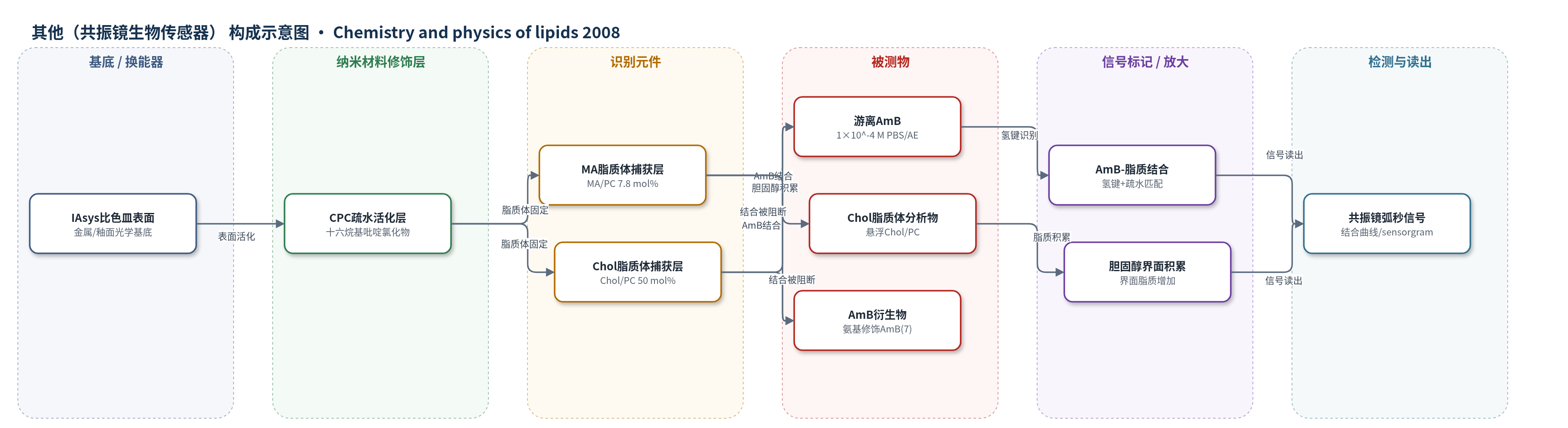
点击图片查看大图 · 依据论文自动绘制
传感器类型
其他(共振镜生物传感器)
检测对象
分枝菌酸(mycolic acids, MA)、胆固醇(cholesterol, Chol)、两性霉素B(Amphotericin B, AmB);样品基质为PBS/AE缓冲液及脂质体悬浮液(ELISA部分为人血清)
检测原理
IAsys共振镜生物传感器利用光在比色皿表面/溶液界面形成驻波,表面质量或折射率变化会改变共振条件,以弧秒读出。先用CPC活化比色皿表面形成疏水层,使含PC和MA或Chol的脂质体吸附固定。当AmB流过时,其氨基糖基团与MA或Chol的羟基形成氢键,同时疏水链间范德华作用匹配,结合到固定化脂质体,使界面质量增加,共振镜信号上升;AmB氨基被异烟肼衍生物修饰后氢键供体被阻断,结合消失,证明识别依赖特定氢键与疏水拓扑。加入Chol/PC脂质体时,固定化MA表面从悬浮脂质体捕获胆固醇,界面脂质积累导致信号上升;甲基酯或乙酰化α-MA因不能形成折叠构象和氢键而信号低。该法无酶放大,信号直接反映脂质-配体结合。
检测灵敏度
原文未报告LOD、线性范围、灵敏度斜率或相关系数。
效应效果
ELISA中,11例结核阳性血清对MA平均吸光度0.76,5例结核阴性为0.37(P<0.1);对合成乙酰化α-MA甲基酯(α-AMAME)结合可忽略(P<0.0001),而MA与Chol信号差异不显著(P>0.25),提示交叉反应。共振镜实验中每组n=5,固定化脂质体结合至少2000弧秒后加AmB或衍生物;AmB对Chol和MA脂质体均产生结合曲线,对空PC和α-AMAME无结合,AmB衍生物使结合消失。Chol脂质体向MA表面积累显著高于甲基酯和α-AMAME(P<0.001),甲基酯与α-AMAME间无显著差异(P>0.1)。未报告RSD、稳定性或回收率。
传感器的构成
- 基底/换能器:IAsys共振镜生物传感器比色皿表面(金属/釉面),提供光学共振检测界面
- 表面活化层:十六烷基吡啶氯化物(CPC,0.02 mg/mL PBS/AE),使表面疏水化并促进脂质体吸附
- 捕获/识别层:磷脂酰胆碱(PC)脂质体,含分枝菌酸(MA,7.8 mol%)或胆固醇(Chol,50 mol%),作为固定化脂质抗原
- 分析物/配体:两性霉素B(AmB,1×10^-4 M PBS/AE),识别固醇样羟基与疏水表面
- 阴性对照配体:AmB衍生物(7,异烟肼-对苯二甲醛修饰AmB),阻断氨基氢键
- 分析物/脂质体:胆固醇脂质体(Chol/PC,50 mol%),检测向固定化MA表面的胆固醇积累
- 缓冲/清洗介质:PBS/AE(含1 mM EDTA、0.025%叠氮钠),维持pH 7.4并清洗表面
- 再生处理:95%乙醇、12.5 M KOH及PBS/AE,用于去除结合物并恢复表面
中文摘要
分枝菌酸(MAs)是结核分枝杆菌及相关菌细胞壁的主要成分,为β-烷基-γ-羟基长链脂肪酸,具有免疫学意义。作者此前发现胆固醇与分枝菌酸的相互作用可能降低以游离分枝菌酸为抗原的ELISA结核血清诊断准确性。本研究旨在考察该相互作用是否源于分枝菌酸与胆固醇在结构性质上的相似性。ELISA结果显示,结核患者血清与分枝菌酸和胆固醇均发生交叉反应,提示两种分子可能以相似结构取向呈现相关功能。分枝菌酸与已知结合麦角固醇和胆固醇的两性霉素B(AmB)的相互作用进一步支持这一关系。利用共振镜生物传感器观察到AmB同时识别胆固醇和分枝菌酸;此外,生物传感器还检测到胆固醇从悬浮脂质体向固定化分枝菌酸脂质体积累,表明两者间存在特异性吸引。综合结果提示,分枝菌酸可采取类似固醇的三维构象,需暴露羟基并使链结构刚性化,以形成与胆固醇匹配的疏水表面拓扑。
英文摘要
Mycolic acids (MAs) are a major component of the cell walls of Mycobacterium tuberculosis and related organisms. These alpha-alkyl beta-hydroxy long fatty acids have been the subject of numerous studies for their immunological properties. We previously reported that an interaction between cholesterol and mycolic acids could be responsible for the low accuracy in the serodiagnosis of TB when using free mycolic acid in an ELISA assay. The aim of this work was to investigate if this interaction could be due to a similarity in the structural properties between mycolic acids and cholesterol. The investigation revealed that patient sera cross-reacted with mycolic acids and cholesterol in an ELISA experiment suggesting that both molecules may present related functionality in a similar structural orientation. This relation was further supported by the interaction of mycolic acids with Amphotericin B (AmB), a known binding agent to ergosterol and cholesterol. Using a resonant mirror biosensor, we observed that AmB recognised both cholesterol and mycolic acids. In addition, a specific attraction was observed between mycolic acid and cholesterol by the accumulation of cholesterol from liposomes in suspension onto immobilized mycolic acids containing liposomes, detected with a biosensor technique. Combined, these results suggest that mycolic acids can assume a three-dimensional conformation similar to a sterol. This requires that mycolic acid exposes its hydroxyl group and assumes rigidity in its chain structure to generate a hydrophobic surface topology matching that of cholesterol. A particular folded conformation would be required for this, of which a few different types have already been proven to exist in monolayers of mycolic acids.