组成图示
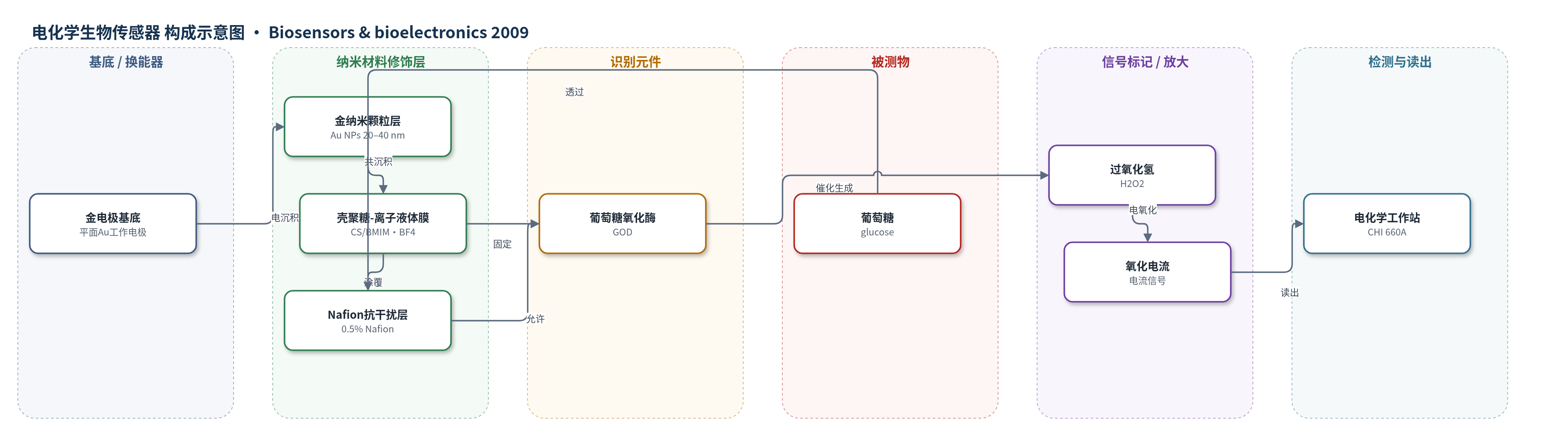
点击图片查看大图 · 依据论文自动绘制
传感器类型
电化学生物传感器
检测对象
葡萄糖(glucose);样品基质:0.05 M PBS(pH 7.0)和人血清
检测原理
该传感器采用酶催化-安培换能机制。固定于壳聚糖-离子液体膜中的葡萄糖氧化酶(GOD)特异性催化葡萄糖氧化:酶中 FAD 被葡萄糖还原为 FADH2,随后 FADH2 被 O2 再氧化并生成 H2O2。在 +0.6 V 施加电位下,H2O2 在纳米金电极表面发生电化学氧化,释放电子形成与葡萄糖浓度成正比的氧化电流。纳米金层增大电极有效面积并降低电荷转移电阻,壳聚糖提供生物相容固定基质,离子液体提高导电性与酶稳定性,Nafion 外层阻挡带负电干扰物。因此,葡萄糖浓度越高,酶催化产生的 H2O2 越多,安培电流越大。
检测灵敏度
LOD: 1.5 μM;线性范围: 3.0 μM–9.0 mM;灵敏度: 14.33 μA mM−1 cm−2 (0.45 μA mM−1);R^2 = 0.997
效应效果
该传感器响应时间小于5 s,灵敏度为平面金电极的2.8倍,检出限降低20倍,表观米氏常数 Kapp_m 为7.8 mM,低于溶胶-凝胶壳聚糖膜(21 mM)和壳聚糖-纳米金-GOD铂电极(10.5 mM)。对0.5 mM葡萄糖连续10次测定RSD为3.2%,6个电极批间RSD为4.5%;4 ℃ PBS中储存30天后响应保持90%以上。生理浓度抗坏血酸(0.1 mM)、尿酸(0.5 mM)和对乙酰氨基酚(0.1 mM)干扰电流比分别为1.03、1.01和1.05。人血清加标回收率为94%–102%,与医院生化分析仪结果一致,适用于血糖监测。
传感器的构成
- 基底电极:平面金电极(Au),直径2 mm,作为工作电极与电子换能器
- 纳米修饰层:电沉积金纳米颗粒(Au NPs,20–40 nm),增大有效表面积并降低电荷转移电阻
- 酶固定基质:壳聚糖(CS)水凝胶,由对苯醌(BQ)电还原诱导沉积,用于固定 GOD 并维持酶活性
- 识别/催化元件:葡萄糖氧化酶(GOD),特异性催化葡萄糖氧化并产生 H2O2
- 离子液体介质:1-丁基-3-甲基咪唑四氟硼酸盐(BMIM·BF4,IL),与 CS 共沉积,提高导电性、稳定性和酶构象保护
- 抗干扰封闭层:Nafion(0.5% 溶液涂覆 5 μL),阻挡带负电干扰物接近电极
中文摘要
本研究通过电沉积壳聚糖–离子液体–葡萄糖氧化酶生物复合膜于纳米金电极上,构建了一种高灵敏葡萄糖生物传感器。首先,在平面金电极表面电化学沉积金纳米颗粒,制备纳米金电极;随后将纳米金电极浸入含对苯醌(BQ)、壳聚糖(CS)、葡萄糖氧化酶(GOD)和离子液体(IL)的沉积液中,进行酶电极电沉积。BQ 电还原过程中消耗质子,使电极表面局部溶液 pH 升高,从而诱导 CS 水凝胶沉积,并实现 GOD 与 IL 的共沉积。该传感器对葡萄糖具有快速安培响应(<5 s)。在最优条件下,其电流灵敏度为 14.33 μA mM−1 cm−2,是平面金电极上 CS–IL–GOD 传感器的 2.8 倍;葡萄糖检出限为 1.5 μM,比平面金电极传感器低 20 倍;线性范围为 3.0 μM–9.0 mM。此外,该传感器具有较高重现性、长期储存稳定性和良好抗干扰能力,并评价了其在血清样品分析中的应用。
英文摘要
A sensitive glucose biosensor was fabricated by electrodepositing chitosan-ionic liquid-glucose oxidase biocomposite onto nano-gold electrode. First, nano-gold electrode was constructed by electrochemically depositing gold nanoparticles onto a flat gold electrode surface. Then the nano-gold electrode was immersed in the bath containing p-benzoquinone (BQ), chitosan (CS), glucose oxidase (GOD) and ionic liquid (IL) for electrodeposition of enzymatic electrode. The proton consumption during electroreduction of BQ increased the local solution pH near the electrode surface and led to the deposition of CS hydrogel on the electrode surface. Co-deposition of GOD and IL with the CS hydrogel was achieved. The proposed biosensor exhibited a fast amperometric response (<5 s) to glucose. Under the optimal conditions, the proposed biosensor exhibited a high current sensitivity (14.33 microA mM(-1) cm(-2)), which was 2.8 times of the biosensor prepared by electrodepositing CS-IL-GOD biocomposite on flat gold electrode. The detection limit for glucose was 1.5 microM, which was 20-fold lower compared to the biosensor prepared on flat gold electrode. The linear range for glucose detection was wide from 3.0 microM to 9.0 mM. Moreover, the proposed biosensor exhibited high reproducibility, long-time storage stability and satisfactory anti-interference ability. The applicability of the proposed biosensor to serum samples analysis was also evaluated.