组成图示
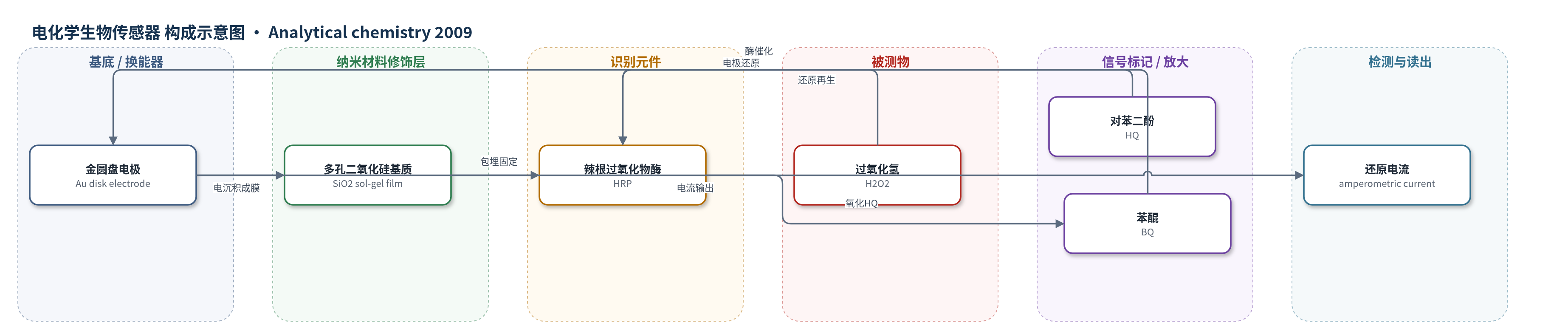
点击图片查看大图 · 依据论文自动绘制
传感器类型
电化学生物传感器
检测对象
过氧化氢(H2O2);样品基质:PBS(磷酸盐缓冲液,pH 7.4)
检测原理
HRP被包埋于电化学诱导形成的多孔SiO2基质中,H2O2从PBS扩散进入互连孔道并与HRP作用。HRP还原中心催化H2O2还原为水,自身被氧化为HRP(Ox);HQ作为电子中介体将HRP(Ox)还原再生,同时被氧化为BQ。BQ在金电极表面接受电子还原为HQ,形成HQ/BQ循环,使电子转移被放大并产生还原电流。随着H2O2浓度升高,酶促反应速率增加,电流响应增大,整体符合Michaelis-Menten动力学。无醇溶胶-凝胶过程和H2气泡模板形成无裂纹多孔结构,降低扩散阻力,提高响应速度和稳定性。
检测灵敏度
LOD: 3 µM(信噪比3);线性范围: 0.02–0.20 mM;R^2 = 0.9934;表观 Michaelis-Menten 常数: 0.88 mM
效应效果
传感器在-0.2 V下对H2O2响应迅速,5 s内达到稳态,多孔SiO2结构有利于传质。SECM显示HRP在基质中均匀分布,HRP-SiO2电极的催化电流约为纯SiO2电极的30倍。稳定性方面,4 °C PBS中储存480 h后仍保留70%初始响应,而物理吸附HRP仅保留46%;pH 4.5下包埋HRP保留72%活性,物理吸附HRP仅43%。表观Michaelis-Menten常数为0.88 mM,高于游离HRP但低于其他溶胶-凝胶方法,说明包埋酶保持较高催化活性。无醇一步法简单快速,适用于生物传感器、生物电子和生物燃料电池。
传感器的构成
- 基底/换能器电极:金圆盘电极(Au disk electrode,半径3.0 mm),经氧化铝抛光和电化学预处理,提供电子传导基底。
- 前驱体电解质:0.15 M六氟硅酸铵((NH4)2SiF6)与醋酸铵/NH4Cl缓冲液(pH 7.0),提供硅源并在阴极电流下生成OH-引发溶胶-凝胶。
- 酶识别/催化元件:辣根过氧化物酶(HRP,0.17 mg/mL),与硅前驱体混合后原位包埋于多孔SiO2基质,催化H2O2还原。
- 多孔修饰层:电化学诱导三维多孔二氧化硅(SiO2)溶胶-凝胶基质,由H2气泡动态模板形成互连网络孔道,固定HRP并促进传质。
- 电子中介体:对苯二酚(HQ,测试中2 mM或0.2 mM),在HRP氧化态与电极间穿梭电子,氧化为苯醌(BQ)后在电极还原再生,实现信号放大。
- 检测介质:磷酸盐缓冲液(PBS,pH 7.4,含0.1 M KCl),提供稳定pH和离子强度,溶解H2O2与HQ。
- 参考/辅助电极:饱和甘汞电极(SCE)和铂丝辅助电极,用于三电极电化学测量。
中文摘要
本文报道了一种无醇溶胶-凝胶法,通过一步电沉积将辣根过氧化物酶(HRP)包埋于电化学诱导形成的三维多孔二氧化硅基质中。在阴极电流作用下,金电极表面水分子被还原生成氢氧根离子和氢气气泡;氢氧根离子催化六氟硅酸铵水解生成硅酸并缩合为二氧化硅,氢气气泡作为动态模板形成互连网络状多孔结构。由于全过程不含乙醇,HRP的生物活性得以有效保留。扫描电镜显示所得二氧化硅基质具有无裂纹的互连多孔结构,有利于传质和长期稳定;扫描电化学显微镜表明HRP在基质中均匀分布。所构建的HRP电化学生物传感器对过氧化氢(H2O2)响应迅速(5 s内),在0.02–0.20 mM范围内线性良好(相关系数0.9934),检出限为3 µM,表观Michaelis-Menten常数为0.88 mM。该方法简单、快速、低成本,可用于生物传感器、生物电子器件和生物燃料电池的构建。
英文摘要
We developed an alcohol-free sol-gel approach to encapsulate biomolecules such as horseradish peroxidase (HRP) in an electrochemically induced three-dimensional porous silica matrix by a one-step process. In this sol-gel process, the electrochemically generated hydroxyl ions at the electrode surface by applying cathodic current promote the hydrolysis of ammonium fluorosilicate to produce silica, and simultaneously the generated hydrogen bubbles play an important role in forming porous silica matrix. If HRP is mixed with ammonium fluorosilicate solution, it can be encapsulated in the forming silica matrix. Since there is no ethanol involved in the entire procedure, bioactivities of the encapsulated HRP can be effectively retained. As revealed by scanning electron microscopy (SEM) characterization, the resultant silica matrix has interconnected and network-like porous structures. Macroporous holes induced by hydrogen bubbles scattering on the relatively flat areas of porous structure can be observed. Such structure free from cracks provides effective mass transport and long-term stability. Scanning electrochemical microscope (SECM) characterization shows that the immobilized HRP molecules uniformly distribute in the silica matrix. The present HRP electrochemical biosensor exhibits a quick response (within 5 s) to H(2)O(2) in the concentration range from 0.02 to 0.20 mM (correlation coefficient of 0.9934) with a detection limit of 3 microM. The apparent Michaelis-Menten constant is 0.88 mM. The present alcohol-free sol-gel approach is effective for biomolecule encapsulation and is promising for the construction of biosensors, bioelectronics, and biofuel cells.