组成图示
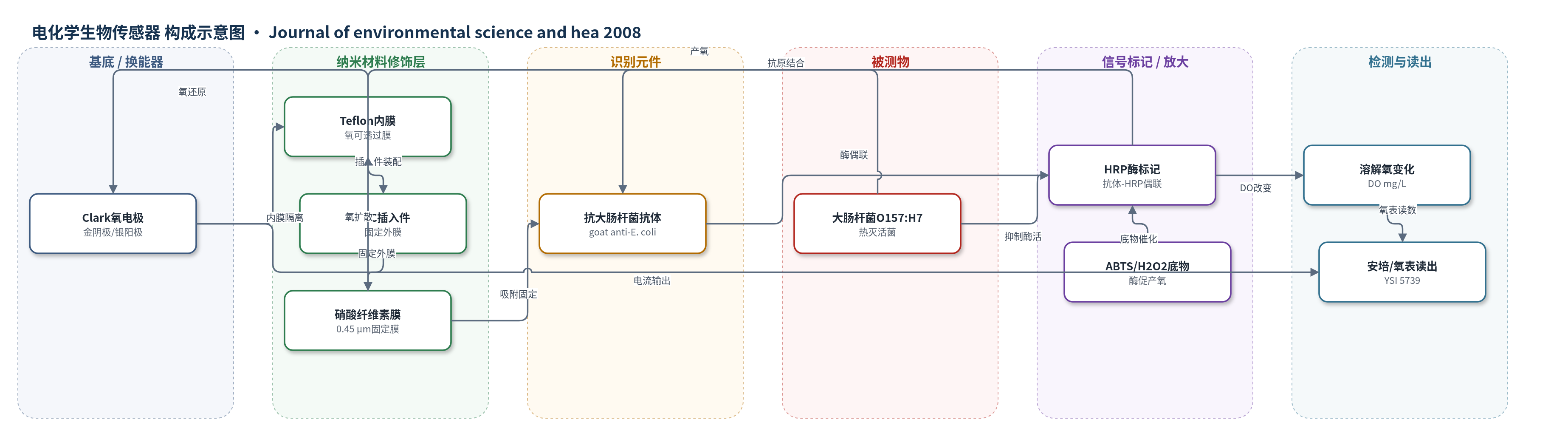
点击图片查看大图 · 依据论文自动绘制
传感器类型
电化学生物传感器
检测对象
大肠杆菌O157:H7(Escherichia coli O157:H7);样品基质:水样(Tris缓冲蒸馏水/环境水样)
检测原理
传感器以固定于硝酸纤维素膜上的抗体-HRP偶联物为识别与信号单元。当水样中的大肠杆菌O157:H7与抗大肠杆菌抗体结合时,细菌体积造成空间位阻并可能引起抗体构象变化,使HRP活性降低。HRP原本催化H2O2与ABTS反应生成O2,菌结合后产氧速率下降,导致样品中溶解氧变化减小。Clark型氧电极在0.7 V下将透过Teflon内膜的O2还原为OH-,产生与溶解氧浓度相关的电流;溶解氧表或安培计读出该变化。ABTS作为产氧增强剂,定制偶联提高HRP:抗体摩尔比,从而放大信号。无细胞时产氧高,菌浓度升高时DO变化降低,实现定性检测。
检测灵敏度
LOD: 50 cells/mL;测试范围(非严格线性): 0–5000 cells/mL;双膜校准: y = 0.8773x + 0.2178,R^2 = 0.976;DO响应与菌浓度 R^2 = 0.88;比色验证 R^2 = 0.93
效应效果
该传感器主要用于定性检测,未报告选择性、抗干扰、稳定性、RSD或实际水样加标回收率。双膜探头与未修饰探头在0–8 mg/L溶解氧范围内校准良好,线性拟合 y=0.8773x+0.2178,R^2=0.976,说明外膜和PVC插入件不显著影响氧透过。搅拌可避免膜表面局部缺氧,对信号稳定必要。定制抗体-HRP偶联提高酶:抗体摩尔比(最高约25:1),使4×10^-8 M HRP即可产生约6 mg/L溶解氧变化。检测流程约17 min,其中10 min信号生成;50 cells/mL时DO变化2.52±0.37 mg/L,无细胞为6.26±0.64 mg/L。比色TMB验证与DO趋势一致,R^2=0.93,优于DO的0.88。作者认为其低成本、便携、易用,可集成到现有水质监测站。
传感器的构成
- 换能器电极:Clark型溶解氧电极,含金阴极与银/氯化银阳极,在0.7 V下还原O2产生安培电流
- 内选择性膜:Teflon(聚四氟乙烯)膜,氧可透过,隔离电解液并允许O2扩散
- 外固定膜:硝酸纤维素膜(nitrocellulose membrane,0.45 μm),疏水吸附固定抗体-HRP偶联物,允许小分子通过
- 识别元件:山羊抗大肠杆菌O157:H7抗体(goat anti-E. coli O157:H7 antibody),特异性识别并结合细菌
- 信号标记物:辣根过氧化物酶(HRP)与抗体偶联,催化H2O2与ABTS反应产氧,结合后酶活性受抑制
- 机械固定件:PVC(聚氯乙烯)插入件与O形圈,固定外膜并保持内外膜间距
- 反应底物:ABTS与H2O2,作为HRP催化产氧的底物,增强溶解氧变化信号
中文摘要
本文报道一种基于常见溶解氧探头构建的单抗体安培生物传感器,用于水中大肠杆菌O157:H7的定性检测。抗大肠杆菌O157:H7抗体与辣根过氧化物酶(HRP)偶联后,固定于硝酸纤维素膜上,并通过自制聚氯乙烯(PVC)插入件覆盖在氧探头的聚四氟乙烯(Teflon)膜外。当细菌结合到固定抗体时,酶活性因空间位阻或抗体构象变化而降低,导致氧浓度变化,由Clark型氧电极检测。验证实验考察了外膜和插入件对Clark电极性能、线性及搅拌对传感器响应的影响。对热灭活大肠杆菌O157:H7水样进行稀释检测,约20分钟内可检出50 cells/mL;测试0–5000 cells/mL,50 cells/mL产生2.52±0.37 mg/L氧当量,无细胞时为6.26±0.64 mg/L。该传感器易用、低成本、便携,可集成到现有水质监测站。
英文摘要
Design and performance of an amperometric biosensor for E. coli O157:H7 that is based on a common dissolved oxygen probe is discussed. Anti-E. coli O157:H7 antibody was conjugated to horseradish peroxidase and immobilized on a nitrocellulose membrane that was placed over the oxygen probe membrane using a custom-fabricated polyvinyl chloride (PVC) insert. Upon bacterial cell binding, a decrease in enzyme activity resulted in a change in oxygen concentration that was detected with a Clark-type oxygen electrode probe. Validation experiments determined the effect of the outer membrane and insert on the Clarke electrode performance and linearity, and the effects of stirring on sensor response. The mechanism of enzymatic disruption is presumably steric hindrance due to binding of the bacterial cell and conformational change in antibody structure. Sampling various dilutions of heat-sterilized E. coli O157:H7 cells in water, as little as 50 bacterial cells/mL could be detected in approximately 20 minutes of sampling and processing procedures. Bacterial concentrations from 0 to 5000 cells/mL were tested, with 2.52 mg/L +/- 0.37 mg/L equivalents of oxygen produced from as few as 50 cells/mL, versus 6.26 +/- 0.64 mg/L when no cells were present in solution. Overall, the developed amperometric biosensor technology offered an efficient means of detection primarily due to its ease of use, cost-effectiveness, portability, and amenability to incorporation at existing water quality gaging stations.