组成图示
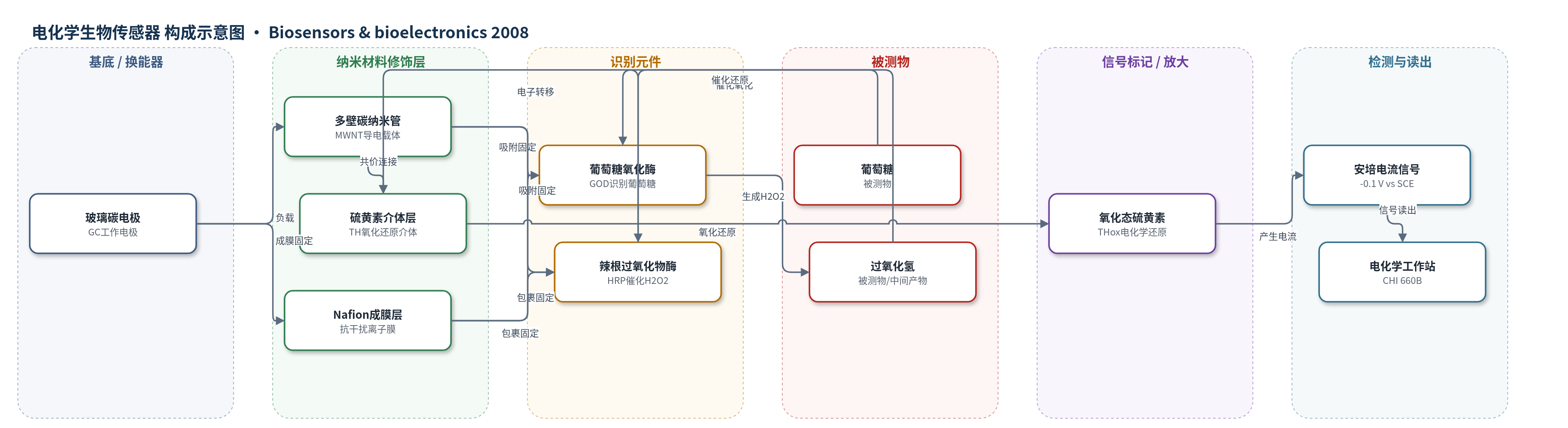
点击图片查看大图 · 依据论文自动绘制
传感器类型
电化学生物传感器
检测对象
葡萄糖(glucose)、过氧化氢(hydrogen peroxide, H2O2);样品基质:磷酸盐缓冲液(PBS)、人血清、药物样品
检测原理
葡萄糖在 GOD 催化下被 O2 氧化为葡萄糖酸内酯并生成 H2O2;H2O2 进一步氧化 HRP 血红素 Fe3+ 形成 HRP-I/HRP-II 中间体。共价连接在 MWNT 上的 TH 作为氧化还原介体,将电子从电极经 MWNT 传递至 HRP,使 HRP 中间体逐步还原再生,同时 TH 被氧化为 THox;THox 在 -0.1 V(vs. SCE)电极表面被电化学还原,产生与 H2O2 浓度成正比的阴极电流。由于 GOD 产生的 H2O2 量随葡萄糖浓度增加,葡萄糖检测表现为安培/差分脉冲电流增强。MWNT 提供高比表面积和分子导线作用,Nafion 成膜固定酶并抗干扰,双酶级联与介体电子转移共同实现低电位、低噪声检测。
检测灵敏度
葡萄糖: LOD: 3 nM;线性范围: 10 nM–10 mM;灵敏度斜率: 0.52(I(A)=0.52[glucose]+4);R^2=0.9998。过氧化氢: LOD: 6 nM;线性范围: 17 nM–56 mM(安培稳态: 17 nM–50 mM);灵敏度斜率: 0.5777(I(A)=0.5777[H2O2]+5.256);R^2=0.9992。
效应效果
该传感器响应快,葡萄糖和 H2O2 达到 95% 稳态电流分别需 2 s 和小于 2 s;标准溶液重复性 RSD 分别为 2.3% 和 2.4%。在 0.1 mM 分析物条件下,半胱氨酸、酪氨酸、果糖、半乳糖、抗坏血酸、尿酸、对乙酰氨基酚等干扰物相对误差均小于 3%,Nafion 膜进一步抑制电活性干扰。传感器在 pH 7.4 响应最佳,60 °C 以下热稳定性良好,连续使用或储存 90 天后保持 >90% 最大响应。人血清葡萄糖(10 倍稀释)测定值为 7.12±0.091、6.79±0.063、6.51±0.047 mM,与医院标称值一致;药物样品 H2O2 加标回收率为 98.2%–102.5%。含 TH 的传感器对 H2O2 灵敏度比无介体电极高 500 倍。
传感器的构成
- 基底/换能器电极:玻璃碳电极(GC electrode),作为工作电极和电子换能器
- 纳米材料修饰层:多壁碳纳米管(MWNTs),经 HNO3 氧化引入羧基,作为导电纳米载体和分子导线
- 介体功能化层:硫黄素(thionin, TH),经 EDC/NHS 共价连接至 MWNT,作为氧化还原介体促进电子转移
- 识别/催化元件:葡萄糖氧化酶(GOD)和辣根过氧化物酶(HRP),共固定于 TH-MWNTs,分别催化葡萄糖氧化和 H2O2 还原
- 成膜/抗干扰层:Nafion(0.5 wt%),将酶-MWNT 复合物分散成膜,固定生物元件并作为离子选择性膜
中文摘要
氧化酶/过氧化物酶介导型生物传感器因应用范围广而备受关注。本文提出一种基于硫黄素(TH)功能化多壁碳纳米管(MWNTs)的新型双酶纳米生物复合电极制备方法,用于评估其作为安培型换能器传感元件的能力。通过法拉第阻抗谱和循环伏安法研究电极电化学行为。结果表明,葡萄糖氧化酶(GOD)和辣根过氧化物酶(HRP)强烈吸附于 TH 功能化 MWNTs 表面,并在 Nafion 膜中经功能化 MWNTs 与电极之间实现便捷电子转移。功能化碳纳米管作为分子导线,促进电极与酶氧化还原中心之间经 TH 的电子传递。葡萄糖和过氧化氢的线性范围分别为 10 nM–10 mM 和 17 nM–56 mM,检出限分别为 3 nM 和 6 nM。该双酶电极可在极低施加电位下测定葡萄糖和过氧化氢,此时噪声和电活性干扰物影响最小。作者还评估了响应时间、检出限、选择性、温度、pH 以及操作和储存稳定性。
英文摘要
Mediated biosensors consisting of an oxidase and peroxidase (POx) have attracted increasing attention because of their wider applicability. This work presents a novel approach to fabricate nanobiocomposite bienzymatic biosensor based on functionalized multiwalled carbon nanotubes (MWNTs) with the aim of evaluating their ability as sensing elements in amperometric transducers. Electrochemical behavior of the bienzymatic nanobiocomposite biosensor is investigated by Faradaic impedance spectroscopy and cyclic voltammetry. The results indicate that glucose oxidase (GOD) and horseradish peroxidase (HRP) are strongly adsorbed on the surface of the thionin (TH) functionalized MWNTs and demonstrate a facile electron transfer between immobilized GOD/HRP and the electrode via the functionalized MWNTs in a Nafion film. The functionalized carbon nanotubes act as molecular wires to allow efficient electron transfer between the underlying electrode and the redox centres of enzymes through TH. Linear ranges for these electrodes are from 10nM to 10mM for glucose and 17nM to 56mM for hydrogen peroxide with the detection limit of 3 and 6nM, respectively. A remarkable feature of the bienzyme electrode is the possibility to determine glucose and hydrogen peroxide at a very low applied potential where the noise level and interferences from other electroactive compounds are minimal. Performance of the biosensor is evaluated with respect to response time, detection limit, selectivity, temperature and pH as well as operating and storage stability.