组成图示
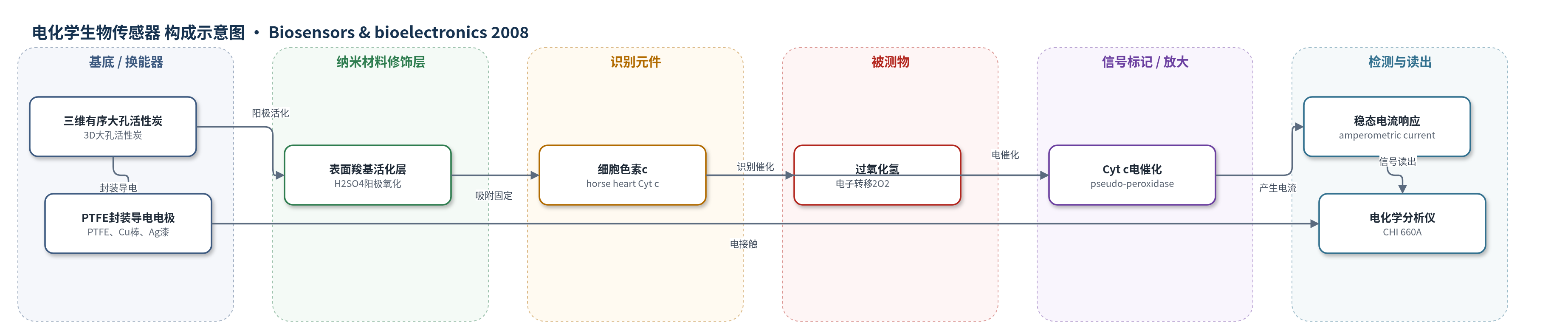
点击图片查看大图 · 依据论文自动绘制
传感器类型
电化学生物传感器
检测对象
过氧化氢(Hydrogen peroxide, H2O2),样品基质为磷酸盐缓冲液(PBS, pH 6.8)
检测原理
三维有序大孔活性炭经硫酸阳极氧化后表面引入羧基,带负电;马心脏Cyt c在pH 6.8下带正电,通过静电作用和插层作用吸附/固定于碳表面及孔内,保持血红素活性中心可及。Cyt c与电极之间发生直接电子转移,循环伏安法显示近可逆氧化还原波。加入H2O2后,固定Cyt c表现类似过氧化物酶活性,催化H2O2还原,使Cyt c还原峰电流增大、氧化峰消失。在固定电位下,H2O2浓度越高,催化还原产生的稳态电流越大,从而通过安培电流响应定量H2O2。该体系未使用额外信号放大,但大孔结构提高了Cyt c负载量,表面覆盖约为理论单层的16倍。
检测灵敏度
LOD: 1.46 × 10⁻⁵ mol l−1;线性范围: 2.0 × 10⁻⁵–2.4 × 10⁻⁴ mol l−1;灵敏度斜率: 0.045 μA/μmol l−1;R^2 = 0.999
效应效果
该传感器在5.0×10⁻⁵ mol/L H2O2中连续11次测量相对标准偏差为3.6%,重现性良好。电极在pH 6.8 PBS中4°C保存时,第1天信号下降约2.7%,2周内下降约11%,1个月内下降约14%,稳定性较高。加入20 μmol/L H2O2后,电流由0.51 μA变为−1.25 μA,响应时间小于10 s。裸MPCE对H2O2无明显直接还原电流,而Cyt c/MPCE出现明显催化还原响应,说明信号主要来自固定Cyt c的类过氧化物酶活性。论文未报告实际样品加标回收率或与ELISA、HPLC、qPCR等方法的对比,但作者认为该电极可用于H2O2检测。
传感器的构成
- 基底/换能器电极:三维有序大孔活性炭(3D ordered macroporous active carbon, MPCE),提供导电通道和大孔空间。
- 电极封装与导电连接:聚四氟乙烯(PTFE)薄膜管、铜棒和银导电漆,用于封装碳盘并建立电接触。
- 表面活化层:硫酸阳极氧化产生的羧基等含氧官能团,用于增强Cyt c吸附和电子转移。
- 识别元件:马心脏细胞色素c(horse heart cytochrome c, Cyt c),通过静电作用和插层作用吸附/固定于MPCE表面及孔内,作为识别与电催化元件。
- 电解液/介质:磷酸盐缓冲液(PBS, pH 6.8),提供离子导电环境。
中文摘要
本文制备了三维有序大孔活性炭,并将其用作马心脏细胞色素c(Cyt c)直接电化学的电极基底。固定于有序大孔活性炭表面的Cyt c在pH 6.8磷酸盐缓冲液中呈现一对清晰且近可逆的氧化还原波,形式电位为−0.033 V。Cyt c与三维大孔活性炭之间的相互作用使其形式电位较溶液中Cyt c发生负移。作者采用光谱和电化学方法研究了Cyt c与多孔活性炭的相互作用。固定后的Cyt c保持生物活性,表现出表面控制的电极过程,电子转移速率常数ks为17.6 s−1,电荷转移系数α为0.52,并显示出类似过氧化物酶的电催化还原过氧化氢(H2O2)活性。基于该Cyt c固定多孔碳电极的H2O2生物传感器性能得到考察:稳态电流响应在H2O2浓度2.0×10⁻⁵–2.4×10⁻⁴ mol/L范围内线性增加,检测限(3σ)为1.46×10−5 mol/L。
英文摘要
Three-dimensionally (3D) ordered macroporous active carbon has been fabricated and used as electrode substrate for the direct electrochemistry of horse heart cytochrome c (Cyt c). The Cyt c immobilized on the surface of the ordered macroporous active carbon shows a pair of well-defined and nearly reversible redox waves at the formal potential of -0.033V in pH 6.8 phosphate buffer solution. The interaction between Cyt c and the 3D macroporous active carbon makes the formal potential shift negatively compared to that of Cyt c in solution. Spectrophotometric and electrochemical methods have been used to investigate the interaction between Cyt c and the porous active carbon. The immobilized Cyt c maintains its biological activity, and shows a surface controlled electrode process with the electron-transfer rate constant (k(s)) of 17.6s(-1) and the charge-transfer coefficient (a) of 0.52, and displays the features of a peroxidase in the electrocatalytic reduction of hydrogen peroxide (H(2)O(2)). A potential application of the Cyt c-immobilized porous carbon electrode as a biosensor to monitor H(2)O(2) has been investigated. The steady-state current response increases linearly with H(2)O(2) concentration from 2.0x10(-5) to 2.4x10(-4)moll(-1). The detection limit (3sigma) for determination of H(2)O(2) has been found to be 1.46x10(-5)moll(-1).