组成图示
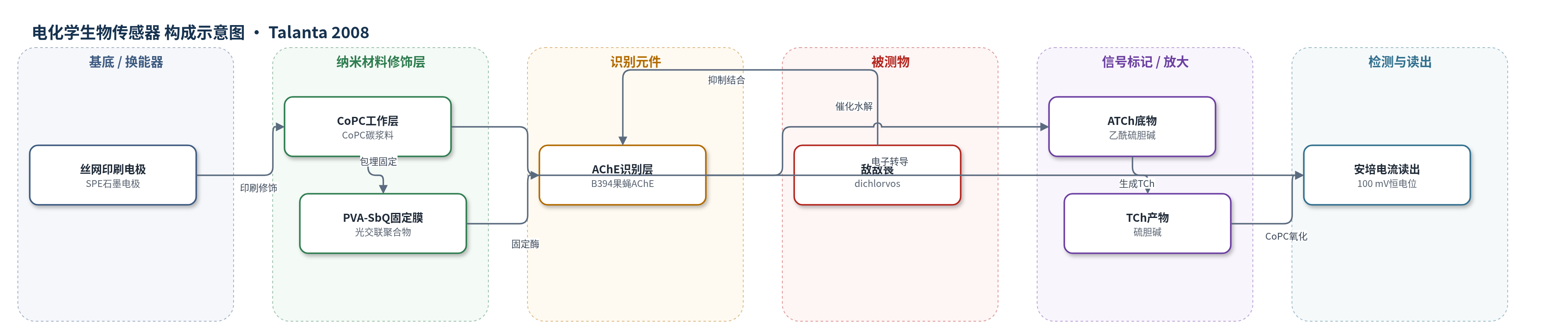
点击图片查看大图 · 依据论文自动绘制
传感器类型
电化学生物传感器
检测对象
敌敌畏(dichlorvos);样品基质:苹果皮乙腈提取液(5% 乙腈/PBS)
检测原理
该传感器以 AChE 为识别元件,敌敌畏进入含 5% 乙腈的 PBS 介质后,磷酸化 AChE 活性位点丝氨酸,使其催化活性不可逆下降。未受抑制的 AChE 催化 ATCh 水解生成 TCh;TCh 在 CoPC 介导下于 100 mV(vs Ag/AgCl)发生阳极氧化,产生与酶活成正比的安培电流。先测初始电流 I0,再经敌敌畏孵育 10 min 后测残余电流 I1,以抑制率 I%=(I0-I1)/I0 表征农药浓度。该体系未采用额外核酸或酶催化沉积放大,主要依靠酶催化产 TCh 与 CoPC 低电位介导;基因工程 B394 AChE 对敌敌畏抑制常数更低,因而灵敏度显著提高。
检测灵敏度
LOD: 7 × 10⁻¹¹ M(B394 Dm AChE);LOD: 1 × 10⁻⁸ M(B1 Dm AChE);LOD: 6 × 10⁻⁷ M(Ee AChE)
效应效果
传感器在 5% 乙腈中孵育 10 min 后酶活无显著损失,10% 乙腈使残余活性下降约 30%;100 mV 低电位有助于减少干扰。B394 传感器对敌敌畏的 Ki 为 224 μM−1 min−1,LOD 7×10⁻¹¹ M,较 B1 低 142 倍、较 Ee 低 8570 倍。作者以三次重复测试操作稳定性,但未报告 RSD。苹果皮加标样品测得 63% 抑制,与空白参考 65% 一致,对应敌敌畏浓度 2.3×10⁻⁹ M(参考 2.6×10⁻⁹ M)。相比 GC/HPLC,该一次性 SPE 传感器具有快速、低成本、可微型化和适合现场检测的优势。
传感器的构成
- 基底/换能器:丝网印刷石墨电极(SPE),提供电极基底与安培检测界面
- 工作电极/电子介体:钴酞菁碳基浆料(CoPC carbon paste),构成工作电极并介导 TCh 在 100 mV 下氧化
- 固定膜:光交联 PVA-SbQ 聚合物膜,包埋并固定 AChE
- 识别元件:乙酰胆碱酯酶(AChE),优选果蝇基因工程 B394 AChE,催化 ATCh 水解并被敌敌畏抑制
- 底物:乙酰硫胆碱(ATCh),酶解生成硫胆碱(TCh)
- 反应介质:磷酸盐缓冲液(PBS)含 5% 乙腈,维持酶活并兼容苹果皮提取液
中文摘要
本文报道了一种用于高灵敏检测有机磷杀虫剂敌敌畏(dichlorvos)的安培生物传感器,其原理基于乙酰胆碱酯酶(AChE)被敌敌畏抑制。作者比较了三种来源的 AChE:电鳗(Ee)AChE、果蝇(Dm)野生型(B1)和基因工程突变型(B394)。酶通过包埋于光交联 PVA-SbQ 聚合物膜中固定在丝网印刷石墨电极上。在 100 mV(vs Ag/AgCl)下,以钴酞菁(CoPC)为电子介体,安培检测 AChE 水解乙酰硫胆碱(ATCh)生成的硫胆碱(TCh)。该传感器可在含 5% 乙腈的介质中保持酶活,用于苹果皮乙腈提取液中敌敌畏的定量。其中 B394 传感器灵敏度最高,检出限为 7×10⁻¹¹ M,显著优于 B1(1×10⁻⁸ M)和 Ee(6×10⁻⁷ M)。
英文摘要
This paper presents the construction of an amperometric biosensor for the highly sensitive detection of the organophosphorus insecticide dichlorvos, based on the inhibition of acetylcholinesterase (AChE). The sensitivity of three AChEs from different sources were tested and compared: AChEs from Electric eel (Ee) and genetically engineered (B394) and wild type (B1) from Drosophila melanogaster (Dm). The enzymes were immobilized by entrapment in a photocrosslinkable PVA-SbQ polymer on a screen printed graphite electrode. The enzyme activity was estimated amperometrically at 100mV versus Ag/AgCl by measuring the thiocholine produced by the enzymatic hydrolysis of the acetylthiocholine substrate using cobalt phthalocyanine as electron mediator. The pesticide was measured in the presence of 5% acetonitrile without loss of enzyme activity. The best sensitivity was achieved with the Dm mutant B394 with a detection limit of 7x10(-11)M as compared to 1x10(-8)M with the B1 Dm and 6x10(-7)M with the Ee. The B394 biosensor was used to quantify dichlorvos in a sample of skin apple after extraction with acetonitrile.