组成图示
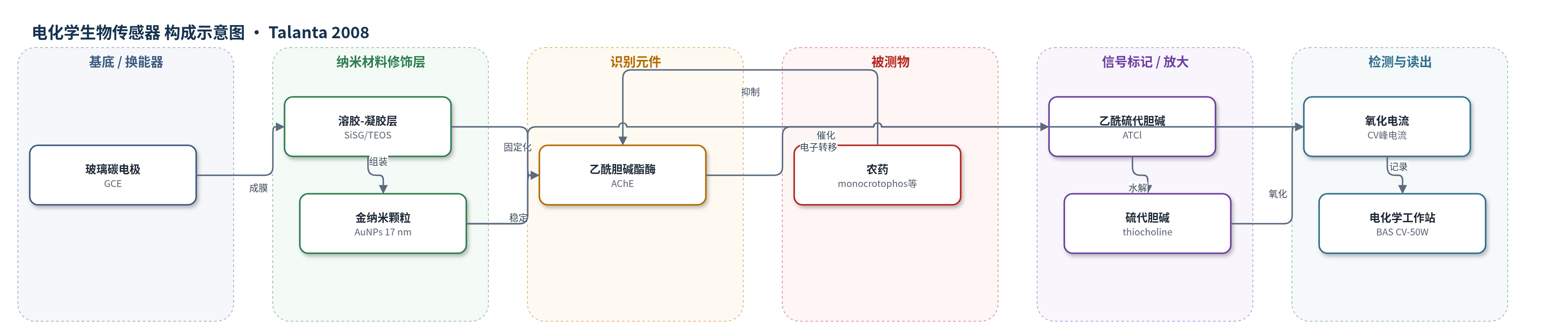
点击图片查看大图 · 依据论文自动绘制
传感器类型
电化学生物传感器
检测对象
灭多磷(monocrotophos)、对氧乐果(methyl parathion)、西维因(carbaryl);样品基质为 PBS 标准溶液
检测原理
农药与固定化乙酰胆碱酯酶(AChE)的催化活性丝氨酸发生不可逆结合,抑制其催化乙酰硫代胆碱氯化物(ATCl)水解的能力。AChE 活性越高,ATCl 水解生成的电活性产物硫代胆碱(thiocholine)越多;thiocholine 在玻璃碳电极上发生不可逆氧化,产生循环伏安峰电流。金纳米颗粒(AuNPs)嵌入溶胶-凝胶(SiSG)网络中形成导电通道,促进 thiocholine 向电极的电子转移,使氧化峰电位负移、电流增强。随着农药浓度或孵育时间增加,AChE 活性下降,thiocholine 生成减少,氧化峰电流降低。抑制率按(对照峰电流-实验峰电流)/对照峰电流×100%计算,从而反映农药对酶的抑制敏感性。
检测灵敏度
原文未报告
效应效果
该传感器在 0.1 μg/mL 和 5.0 μg/mL 灭多磷标准溶液中的批间精密度分别为 2.3% 和 1.7%(CV,n=6),1.0 mM ATCl 的批内精密度 RSD 为 0.8%。4 ℃ 保存 3 周无明显衰减,30 天后仍保持初始电流响应的 90%。三种农药的最大抑制率约为灭多磷 90%、西维因 80%、对氧乐果 70%,抑制顺序为灭多磷>西维因>对氧乐果,与模型预测一致。电化学法所得抑制曲线与紫外分光光度法良好吻合,仅因条件和步骤不同存在轻微差异。原文未报告实际样品加标回收率和抗干扰实验。作者认为该方法灵敏、准确、低成本、操作简便,可用于筛选高效酶抑制剂和评价毒性化合物。
传感器的构成
- 基底/换能器电极:玻璃碳电极(GCE),经电化学活化形成亲水氧化层,作为工作电极
- 纳米材料修饰层:溶胶-凝胶硅酸盐网络(SiSG,由四乙氧基硅烷 TEOS 形成)负载金纳米颗粒(AuNPs,17 nm),提供多孔生物相容微环境、导电通道和固定化位点
- 识别元件:乙酰胆碱酯酶(AChE,电鳗来源,Type C3389),催化底物水解并受农药抑制
- 信号前体/底物:乙酰硫代胆碱氯化物(ATCl),被AChE水解生成电活性硫代胆碱(thiocholine)
- 信号放大/电子转移元件:金纳米颗粒(AuNPs),促进电子转移并降低氧化电位
- 缓冲介质:磷酸盐缓冲液(PBS,pH 7.0),维持酶活性和电化学测量环境
- 电化学测量电极:饱和甘汞电极(SCE)作参比电极,铂丝作辅助电极
中文摘要
本文基于农药诱导的酶促电化学行为变化,开发了一种利用乙酰胆碱酯酶(AChE)生物传感器进行农药敏感性测试的电化学方法。由溶胶-凝胶硅酸盐网络负载金纳米颗粒(AuNPs-SiSG)构成复合修饰层,为酶分子提供生物相容微环境,稳定其生物活性并防止酶从界面泄漏。原子力显微镜表征表明该复合层化学洁净、多孔且均一。金纳米颗粒促进电子转移,使电化学反应在较低电位下发生。选用灭多磷、对氧乐果和西维因等典型农药进行敏感性测试。由于农药对AChE的抑制作用,传感器上底物的电化学响应显著下降。所得抑制曲线与紫外分光光度法结果良好吻合。该方法具有较高灵敏度、良好准确性、低成本和操作简便等优点,可发展为筛选高效酶抑制剂和评价毒性化合物对酶作用的常规方法。
英文摘要
Based on the change in electrochemical behavior of enzymatic activity induced by pesticide, a novel electrochemical method for investigation of pesticide sensitivity using acetylcholinesterase (AChE) biosensor was developed. The sol-gel-derived silicate network assembling gold nanoparticles (AuNPs-SiSG) provided a biocompatible microenvironment around the enzyme molecule to stabilize its biological activity and prevented them from leaking out of the interface. The composite was characterized using atomic force microscopy and proved to be chemically clean, porous and homogeneous. AuNPs promoted a conductive pathway for electron transfer and improved electrochemical reactions at a lower potential. Typical pesticides such as monocrotophos, methyl parathion and carbaryl were selected for pesticide sensitivity tests. Due to the inhibitions of pesticides, the electrochemical responses of substrate on AChE-sensors decreased greatly. The inhibition curves showed good correspondence with the results by UV spectrophotometry assay. The proposed electrochemical pesticide sensitivity test exhibited high sensitivity, desirable accuracy, low cost and simplified procedures. This method could be developed as a conventional method to select efficient enzyme inhibitors and investigate toxic compounds against to enzyme.