组成图示
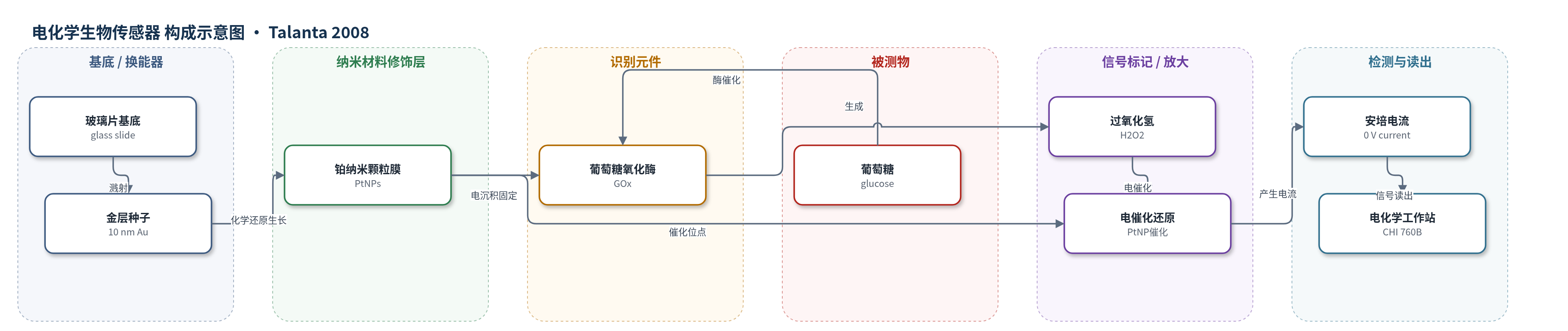
点击图片查看大图 · 依据论文自动绘制
传感器类型
电化学生物传感器
检测对象
葡萄糖(glucose, Glc);过氧化氢(H2O2,用于电极性能验证),样品基质:血清(serum)、磷酸盐缓冲液(PB)
检测原理
该传感器基于酶催化与铂纳米颗粒电催化耦合。葡萄糖氧化酶(GOx)固定于铂纳米颗粒(PtNPs)修饰玻璃片表面,识别并催化葡萄糖氧化,生成过氧化氢(H2O2)。PtNPs膜具有良好导电性和对H2O2的电催化活性,使H2O2在0 V附近发生电催化还原,产生与H2O2浓度成正比的安培电流。由于葡萄糖浓度越高,GOx催化生成的H2O2越多,电极电流随之增大,从而实现定量检测。该体系依靠PtNPs直接催化H2O2还原,并通过低电位检测降低抗坏血酸、尿酸等干扰。
检测灵敏度
LOD: 1 × 10⁻⁶ M (S/N = 3);线性范围: 5 × 10⁻⁶ to 2 × 10⁻² M
效应效果
传感器响应时间小于10 s,对0.5 mM葡萄糖连续测定6次的相对标准偏差为5.1%,6个不同传感器对0.5 mM葡萄糖的响应重现性RSD为6.5%。在0 V检测时,0.1 mM抗坏血酸、尿酸和对乙酰氨基酚的干扰电流相对1 mM葡萄糖可忽略,选择性良好。4 ℃保存1个月后仍保留80%初始响应。血清样品测定结果与医院方法接近:5个样本分别为7.89/8.01、8.65/8.94、10.32/10.88、11.23/11.78、12.67/13.13 mM。作者认为该方法简单、方便,适合生物传感器批量制备。
传感器的构成
- 基底/换能器电极:玻璃片(glass slide)溅射约10 nm金层(Au),提供导电通道与成核种子,并用导电银环氧树脂连接铜线作为工作电极
- 纳米材料修饰层:铂纳米颗粒(PtNPs)由氯铂酸(H2PtCl4)与抗坏血酸(AA)原位化学还原生长,形成致密催化膜,提供电子传递与H2O2电催化活性
- 识别元件:葡萄糖氧化酶(GOx)通过恒电位电沉积固定于PtNP膜表面,催化葡萄糖氧化生成H2O2
- 固定助剂:Triton 100 与磷酸盐缓冲液(PB)辅助 GOx 电沉积,形成均匀、致密且具生物活性的酶膜
- 信号标记物:无外源标记物;葡萄糖氧化产生的H2O2在PtNP表面被电催化还原,产生安培电流
中文摘要
本文报道了一种在玻璃片表面原位化学还原生长铂纳米颗粒(PtNPs)的简单方法。首先将约10 nm金层均匀溅射到玻璃片表面,作为后续PtNPs生长的“种子”;随后将玻璃片浸入含氯铂酸(H2PtCl4)和抗坏血酸的溶液中,使PtNPs直接在金层上生长,形成高密度PtNP修饰膜。对照实验表明,无金层时玻璃片上几乎不能稳定形成PtNPs,说明金层种子对成核和附着至关重要。作者以过氧化氢(H2O2)电催化检测考察了PtNP膜的电化学性能,并将葡萄糖氧化酶(GOx)直接电沉积到PtNP修饰表面,构建葡萄糖生物传感器。该传感器响应时间小于10 s,线性范围为5×10⁻⁶至2×10⁻² M。该方法简单、方便,可用于生物传感器的批量制备,也可推广到其他金属纳米颗粒修饰膜的电化学与光学应用。
英文摘要
Platinum nanoparticles (PtNPs) attached to glass slide surface was successfully prepared by using a simple in situ chemical reduction method. In this method, a approximately 10nm gold layer was first sputtered uniformly onto the glass slide surface, PtNPs could be grown directly on the gold layer by immersing the glass slide into the grown solution containing H(2)PtCl(4) and ascorbic acid. The gold layer sputtered uniformly serves as "seed" for the following growth of PtNPs and high dense of PtNP modified film can be prepared. Control experiment without the gold layer found no obvious formation of PtNPs indicating the importance of the "seed". The electrocatalytic effect of the PtNP film was investigated with the detection of hydrogen peroxide and for the fabrication of biosensors. Glucose oxidase was selected and directly electrodeposited onto the PtNPs modified surface. The resulting biosensor has a fast response time (<10s) with wide linear range (5x10(-6) to 2x10(-2)). The fabrication method is simple, convenient and can be used for the mass fabrication of biosensors. The present preparation method of PtNPs modified film could be used for the preparation of other metal nanoparticle and find electrochemical applications as well as for optical uses.