组成图示
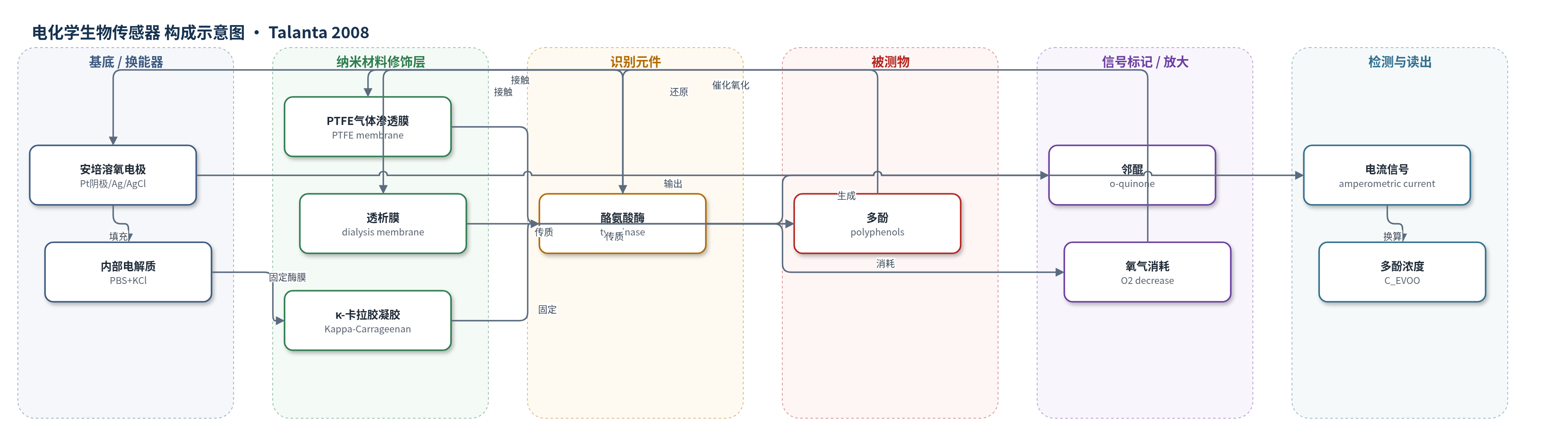
点击图片查看大图 · 依据论文自动绘制
传感器类型
电化学生物传感器
检测对象
多酚(polyphenols,以苯酚 phenol 计);样品基质:特级初榨橄榄油(EVOO)、甘油三油酸酯(glyceryl trioleate)中的合成多酚混合物(SM)
检测原理
橄榄油样品经正己烷稀释后,多酚扩散穿过PTFE气体渗透膜和透析膜,进入κ-卡拉胶固定的酪氨酸酶层。酪氨酸酶催化酚类与溶解氧反应生成邻醌和水,使酶膜附近O2浓度下降。安培型溶氧电极的Pt阴极将O2还原,电流随O2浓度降低而减小;电流变化幅度与样品中多酚浓度成正比。测定时先加入苯酚标准液获得参考信号,再加入稀释橄榄油样品,根据信号差和稀释倍数计算总多酚浓度(以苯酚计)。该过程无化学放大,主要依靠酶催化和溶氧消耗实现信号转换。
检测灵敏度
原文未报告LOD、线性范围、灵敏度斜率或传感器校准相关系数。
效应效果
该酪氨酸酶有机相酶电极测定仅需数分钟,优于Folin-Ciocalteu法,并避免油样水相溶解度低造成的误差。正己烷log p=3.5、介电常数1.89,有利于保持酶活性。浓度数据S.D.≤0.04×10⁻³ mol L−1,回归转化率R.S.D.≤2%。合成多酚混合物与EVOO降解趋势相近,可代表真实油样。MacCallum法得EVOO活化能38.8±0.8 kJ mol−1,模型拟合法得36±4 kJ mol−1;SM为33.8±0.1和38±6/38±5 kJ mol−1。98 °C下多酚约60 h完全消失、半衰期约50 min,180 °C约6 h完全消失、半衰期约6 min,180 °C速率常数约为98 °C的20倍。
传感器的构成
- 换能器电极:Pt阴极与Ag/AgCl内参比电极,构成安培型溶氧电极,检测O2还原电流
- 内部电解质:0.067 mol L−1磷酸盐缓冲液(PBS,pH 6.6)和0.1 mol L−1 KCl,维持酶活性并提供离子导电
- 识别/催化元件:蘑菇酪氨酸酶(tyrosinase,EC 1.14.18.1),催化酚类氧化为邻醌并消耗O2
- 固定化基质:κ-卡拉胶(Kappa-Carrageenan)凝胶,固定酪氨酸酶形成酶膜
- 气体渗透膜:PTFE(聚四氟乙烯)气体渗透膜,允许O2和酚类传递并隔离内部溶液
- 透析膜:透析膜(dialysis membrane),限制酶/大分子泄漏并辅助传质
- 密封外壳:PTFE O形圈、Teflon帽和玻璃绝缘体,固定膜盘并绝缘电极
- 检测介质:正己烷(n-hexane)有机相,溶解1:4稀释的橄榄油样品,使多酚接触酶膜
中文摘要
本研究针对特级初榨橄榄油(EVOO)在氧化气氛中加热导致的人工酸败过程,建立了实际动力学模型并监测其中多酚的热氧化降解。实验在98、120、140、160和180 °C等温条件下,采用硅油浴和恒定空气流进行强制热氧化,操作遵循AOM程序。多酚浓度随时间的变化使用工作在正己烷有机相中的酪氨酸酶生物传感器测定。该传感器基于酪氨酸酶催化酚类氧化为邻醌并消耗溶解氧,通过安培型溶氧电极记录电流变化。采用MacCallum法计算多酚降解活化能,结果表明其在过程大部分范围内基本恒定;进一步用模型拟合法确定各温度下的特征速率常数,并验证活化能及最佳拟合动力学模型。研究还给出了98–180 °C下多酚半衰期等参数,为评估橄榄油热稳定性和安全使用温度提供了依据。
英文摘要
The process of artificial rancidification of extra-virgin olive oil due to heating in an oxidizing atmosphere was studied by testing an actual kinetic model of the process and monitoring the thermal oxidative degradation of the polyphenols contained in it. To this end, a series of oxidative degradation experiments were carried out on extra-virgin olive oil samples under isothermal conditions at 98, 120, 140, 160, and 180 degrees C using a thermostatic silicon oil bath. The experimental procedure used in this study carefully followed the recommendations regarding the study of olive oil rancidification set out in the AOM procedure. The change in polyphenol concentration with time was monitored at selected temperatures using a tyrosinase biosensor operating in an organic phase (n-hexane). The activation energy for the polyphenol degradation process determined using the MacCallum method was found to be practically constant throughout most of the process. Furthermore, the application of the so-called "model-fitting" method to this process enabled the specific constant rates to be determined at the above-mentioned selected temperatures. In addition, a confirmation of the activation energy value was obtained by the "model-fitting" method and the algorithm of the kinetic model equation best-fitting the experimental curve representing the whole process was checked. Finally, further very interesting observations were made, for instance, the half-life concentration values of polyphenols at selected temperatures between 98 and 180 degrees C.