组成图示
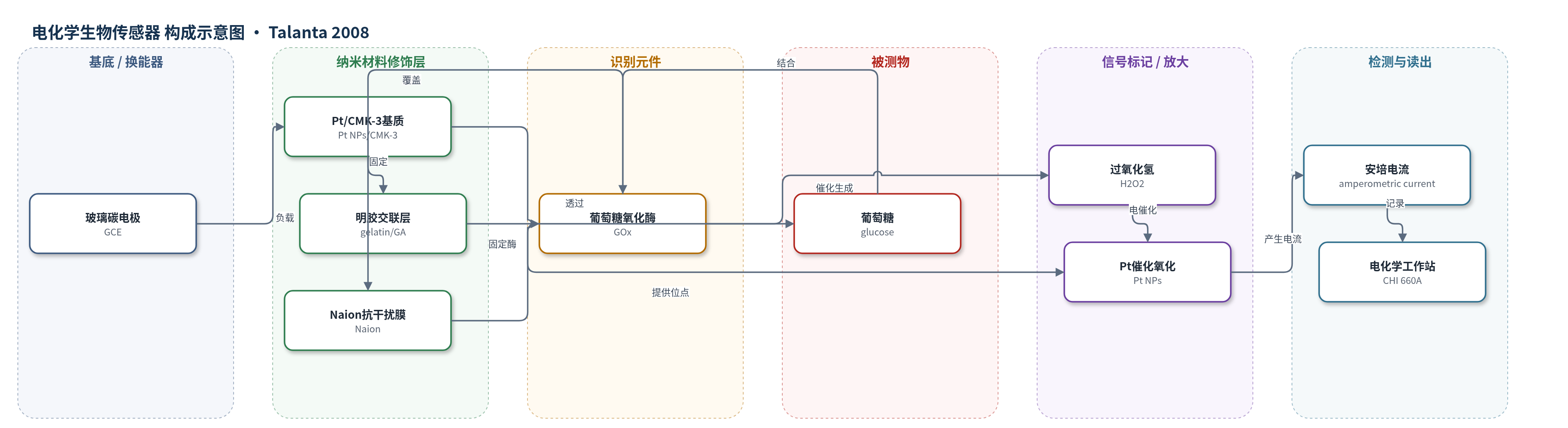
点击图片查看大图 · 依据论文自动绘制
传感器类型
电化学生物传感器
检测对象
葡萄糖(glucose);样品基质:血清(serum)、PBS 缓冲液
检测原理
葡萄糖在葡萄糖氧化酶(GOx)催化下被氧化为葡萄糖酸,同时 GOx 被还原并消耗 O2 生成 H2O2。生成的 H2O2 扩散至 Pt/CMK-3 基质中的铂纳米颗粒表面,在 0.6 V(vs. SCE)下发生电催化氧化,释放电子并形成安培电流。由于 Pt 纳米颗粒高度分散且负载量大,可显著降低 H2O2 氧化过电位并放大电流响应,使电流随葡萄糖浓度升高而增大。明胶/戊二醛交联网络固定 GOx 并维持其构象,Naion 膜则选择性阻挡干扰物,使传感器可用于血清葡萄糖检测。
检测灵敏度
LOD: 1 μM (S/N = 3);线性范围: 0.04–12.2 mM;R = 0.996 (n = 10);回归方程: I = 5.53×10⁻⁷ cglucose + 1.79×10⁻³ (A, M);Kapp_m: 10.8 mM;imax: 908 μA cm−2;t95: 15 s;Ea: 22.54 kJ mol−1;Naion 覆盖后线性范围: 0.02–16.9 mM;R = 0.993
效应效果
传感器响应快速,t95 为 15 s。未加 Naion 时,抗坏血酸(0.1 mM)、对乙酰氨基酚(0.05 mM)、尿酸(0.5 mM)偏差分别为 0.44%、4.69%、13.2%;覆盖 Naion 后偏差在 ±10% 内,但 1 mM 葡萄糖响应降低 21%。10 个电极 RSD 为 8.1%,连续 10 次测定 RSD 为 4.2%,4 °C 储存 30 天保留 95.1%。与 Pt/CNT 体系相比储存稳定性更好。血清样品与医院 Hitachi 7080 酶法相对误差为 −3.03%、−0.72%、4.88%、7.21%,1–3 mM 葡萄糖回收率 94.4%–98.3%,具实际监测血清葡萄糖潜力。
传感器的构成
- 基底/换能器电极:玻璃碳电极(GCE),抛光后作为工作电极,提供电子传导与信号读出基础
- 纳米材料修饰层:铂纳米颗粒/介孔碳 CMK-3 复合基质(Pt/CMK-3),负载 GOx 并提供 H2O2 电催化氧化位点
- 识别元件:葡萄糖氧化酶(GOx),催化葡萄糖氧化并生成 H2O2
- 结合/交联层:明胶(gelatin)与戊二醛(glutaraldehyde),固定 GOx 和 Pt/CMK-3,形成三维网络以增强稳定性
- 抗干扰膜:Naion 膜,覆盖电极表面,阻挡抗坏血酸、对乙酰氨基酚、尿酸等干扰物
中文摘要
将铂纳米颗粒负载于介孔碳材料 CMK-3 上,形成 Pt/CMK-3 复合基质;将葡萄糖氧化酶(GOx)固定于该基质中,并以明胶为结合剂涂覆于玻璃碳电极(GCE)表面,经戊二醛交联后制得葡萄糖生物传感器。该传感器在 0.6 V(vs. SCE)下对葡萄糖表现出良好的安培响应,响应电流在 0.04–12.2 mM 范围内与葡萄糖浓度呈线性关系。响应时间(达到最大电流 95% 的时间)为 15 s,检出限(S/N=3)为 1 μM。表观 Michaelis–Menten 常数(Kapp_m)和最大电流密度(imax)分别为 10.8 mM 和 908 μA cm−2,酶促反应活化能约为 22.54 kJ mol−1。传感器具有良好稳定性,在约 52 °C 时响应最大,储存 30 天后仍保留初始响应的 95.1%。文中还优化了制备与操作参数,并在表面覆盖 Naion 膜以提高抗干扰能力后,用于血清葡萄糖检测,结果令人满意。
英文摘要
Pt nanoparticles were deposited on mesoporous carbon material CMK-3. Glucose oxidase (GOx) was immobilized in the resulting Pt nanoparticles/mesoporous carbon (Pt/CMK-3) matrix, and then the mixture was cast on a glassy carbon electrode (GCE) using gelatin as a binder. The glucose biosensor exhibited excellent current response to glucose after cross-linking with glutaraldehyde. At 0.6V (vs. SCE) the response current was linear to glucose concentration in the range of 0.04-12.2mM. The response time (time for achieving 95% of the maximum current) was 15s and the detection limit (S/N=3) was 1 microM. The Michaelis-Menten constant (K(m)(app)) and the maximum current density (i(max)) were 10.8 mM and 908 microAcm(-2), respectively. The activation energy of the enzymatic reaction was estimated to be 22.54 kJ mol(-1). The biosensor showed good stability. It achieved the maximum response current at about 52 degrees C and retained 95.1% of its initial response current after being stored for 30 days. In addition, some fabrication and operation parameters for the biosensor were optimized in this work. The biosensor was used to monitor the glucose levels of serum samples after being covered with an extra Nafion film to improve its anti-interferent ability and satisfied results were obtained.