组成图示
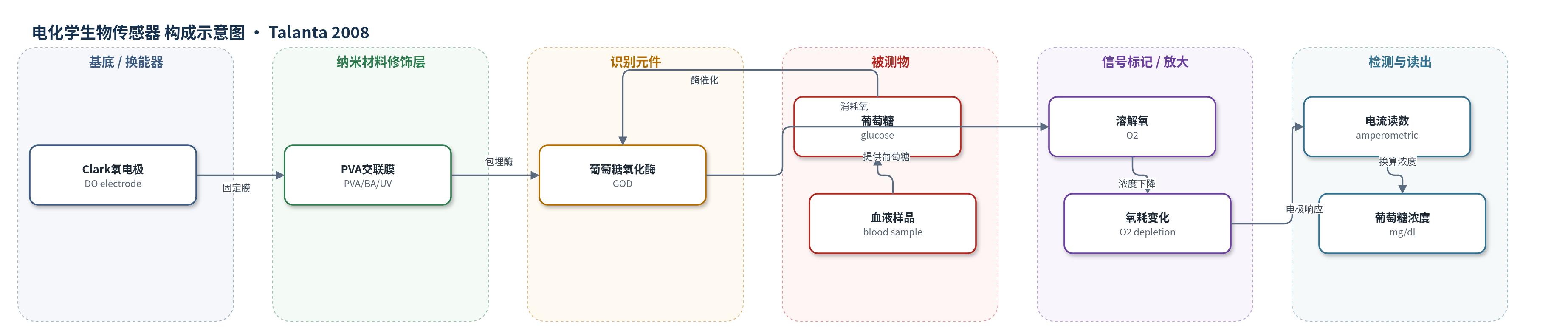
点击图片查看大图 · 依据论文自动绘制
传感器类型
电化学生物传感器
检测对象
葡萄糖(glucose);样品基质:标准葡萄糖溶液、血液
检测原理
该传感器以葡萄糖氧化酶(GOD)为识别元件,以Clark型溶解氧电极为换能器。样品中的葡萄糖扩散进入GOD-PVA膜,在GOD催化下发生氧化反应:葡萄糖与溶解氧反应生成葡萄糖内酯和过氧化氢,同时消耗溶解氧。随着葡萄糖浓度升高,膜内氧消耗速率增大,电极表面溶解氧浓度下降,Clark型氧电极的电流/读数发生相应变化。系统通过校准曲线将氧耗变化换算为葡萄糖浓度,线性范围为0.9–225 mg/dl。该过程无需外加电子供体或化学标记物,信号放大主要依赖酶催化反应对氧的持续消耗。
检测灵敏度
LOD: 0.6 mg/dl;线性范围: 0.9–225 mg/dl;斜率: 0.52;R^2 = 0.989
效应效果
该膜在32次重复使用中活性无明显损失,4 ℃保存30 d后仍保留约90%活性。对90 mg/dl葡萄糖的重复测定相对标准偏差为2.8×10−2(均值46.2×10−2 ppm,n=6),不同实验间相对标准偏差为3.1×10⁻²(均值46.78×10⁻² ppm),重现性良好。响应时间约为2 min。与医院检测值比较,血液样品中葡萄糖测定的线性拟合斜率为0.979,R^2=0.992,表明血液中的其他成分未造成明显干扰。检测范围与市售葡萄糖生物传感器相当,作者认为该GOD-PVA膜可用于实际血液葡萄糖检测。
传感器的构成
- 换能器电极:Clark型溶解氧电极(DO probe/electrode),内含1 M KCl溶液,用于检测溶解氧浓度变化
- 固定膜层:PVA膜,由12% LDOP PVA、8% HDOP PVA、2% BA溶于含20%丙酮的50 mM磷酸钠缓冲液(pH 6.0)制备,UV交联,用于包埋GOD并降低溶胀
- 识别元件:葡萄糖氧化酶(GOD,2000 units/ml),包埋于PVA膜中,催化葡萄糖氧化
- 反应底物:葡萄糖(glucose)与溶解氧(O2),葡萄糖为被测物,O2为酶反应底物
- 信号介质:溶解氧(O2),其被GOD催化消耗后引起DO电极电流/读数变化
- 固定密封层:O-ring与cheesecloth,将GOD-PVA膜紧贴在DO电极表面
- 反应介质:50 mM磷酸钠缓冲液(pH 6.0),提供酶反应环境并稀释样品
中文摘要
本文报道了一种用于固定葡萄糖氧化酶(GOD)的聚乙烯醇(PVA)膜及其葡萄糖生物传感器。膜由低聚合度(LDOP)和高聚合度(HDOP)PVA、苯甲酸(BA)及丙酮配制,并经紫外(UV)交联。以溶胀指数优化膜组成,含12% LDOP PVA、8% HDOP PVA和2% BA、溶于含20%丙酮的缓冲液并经UV处理的膜溶胀指数最低。傅里叶变换红外光谱显示,在苯甲酸存在下UV交联使膜出现约2337 cm−1强吸收带;扫描电镜显示UV交联膜表面更光滑。将GOD-PVA膜与Clark型溶解氧(DO)电极结合,利用固定GOD催化葡萄糖氧化为葡萄糖内酯并消耗溶解氧,通过氧耗变化检测葡萄糖。校准曲线线性范围给出0.9–225 mg/dl的检测范围。膜可重复使用32次而活性无明显损失,4 ℃保存30 d后仍保留约90%活性,并用于真实血液样品检测。
英文摘要
A membrane was prepared using polyvinyl alcohol (PVA) with low and high degree of polymerization (DOP), acetone, benzoic acid (BA) and was cross-linked by UV treatment. Membrane composition was optimized on the basis of swelling index. Membrane prepared with 12% low DOP and 8% high DOP of PVA, 2% BA, dissolved in buffer containing 20% acetone and cross-linked with UV treatment exhibited lower swelling index. Fourier transform infrared (FTIR) study of the membranes showed appearance of a strong band at approximately 2337 cm(-1) when UV was used for cross-linking in the presence of benzoic acid. Scanning electron microscope (SEM) study revealed that membrane cross-linked with UV treatment was smoother. Glucose oxidase (GOD)-PVA membrane was associated with the dissolved oxygen (DO) probe for biosensor reading. Glucose was detected on the basis of depletion of oxygen, when immobilized GOD oxidizes glucose to gluconolactone. A wide detection range, 0.9-225 mg/dl was estimated from the linear range of calibration plot of biosensor reading. Membranes were reused for 32 reactions without significant loss of activity and stored for 30 days (approximately 90% activity) at 4 degrees C. Membranes were also used with real blood samples.