组成图示
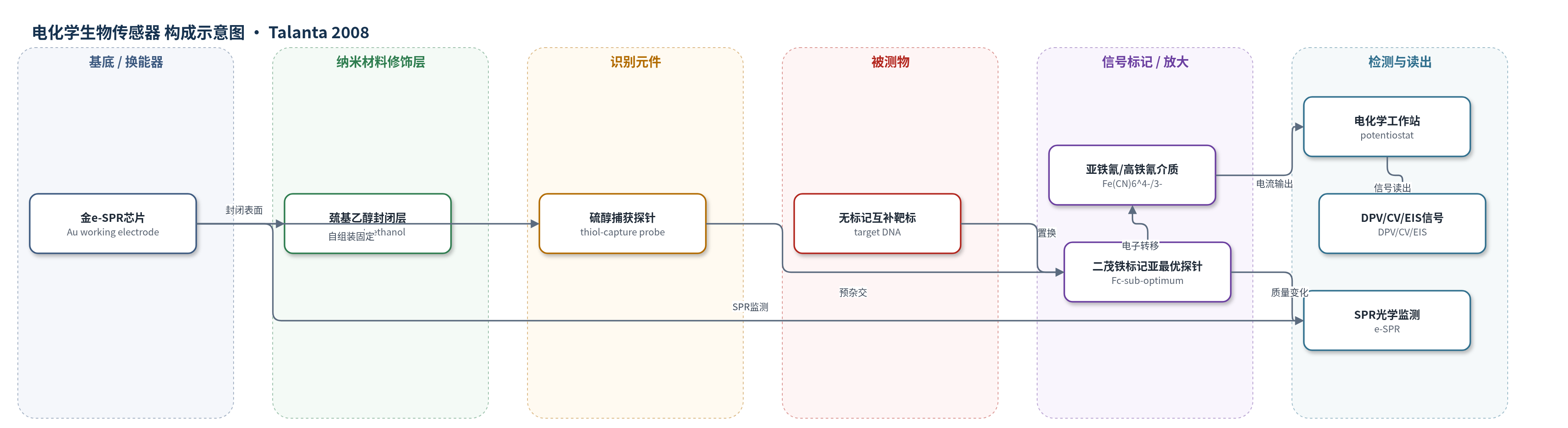
点击图片查看大图 · 依据论文自动绘制
传感器类型
电化学生物传感器
检测对象
无标记互补寡核苷酸靶标(target DNA,囊性纤维化基因相关15-mer序列);样品基质:杂交缓冲液/寡核苷酸溶液
检测原理
传感器先以硫醇捕获探针固定于金表面,再与带二茂铁标记的亚最优突变寡核苷酸预杂交。该亚最优序列含错配且与捕获探针部分错位,形成不稳定双链。加入完全互补的无标记靶标DNA后,靶标通过链置换结合捕获探针,使二茂铁标记探针脱离电极表面。二茂铁数量减少导致其氧化还原电流下降,DPV/CV峰高降低,EIS中电子转移电阻和异质电子转移速率常数变化,从而反映靶标浓度。引入亚铁氰/高铁氰介质后,二茂铁与高铁氰根发生氧化还原循环,电极反复还原二茂铁,产生电催化放大,提高信号。置换比例随靶标浓度增加而增加,低于1.2 µM时与背景难以区分。
检测灵敏度
LOD: 1.2 µM(原文:below 1.2 µM of target the displacement cannot be differentiated from the non-specific displacement by the buffer);检测限范围: µM(原文:detection limit in the range of µM)
效应效果
在优化条件下,差分脉冲伏安法(DPV)给出最高灵敏度和最短检测时间。预杂交后DPV峰高为9.9±0.5 µA(n=5),置换后为4.5±0.7 µA(n=5),重现性为5–15%。特异性测试中,互补靶标置换32.6%信号,缓冲液背景置换18.7%,非互补寡核苷酸置换13.9%,净特异置换约14%。信号置换比例随靶标浓度升高而增加,但低于1.2 µM时无法与背景区分。加入亚铁氰/高铁氰介质可提高电流,但使系统不再无试剂。作者认为该无标记电化学DNA传感器是首个用于囊性纤维化基因检测的此类平台,可推广至任意DNA靶标检测,但仍需降低非特异置换、优化杂交严格度并验证稳定性与批量重现性。
传感器的构成
- 基底/换能器电极:金e-SPR芯片/金工作电极(Au),提供导电界面与SPR光学监测表面
- 识别元件:硫醇标记15-mer捕获探针(thiol-capture probe,5'-ACACCAAAGATGATA-C6-thiol-3'),自组装固定并识别靶标
- 封闭剂:1 mM巯基乙醇(mercaptoethanol),封闭未被捕获探针占据的金表面
- 信号标记/预杂交探针:二茂铁标记亚最优突变寡核苷酸(ferrocene-sub-optimum,5'-AATATCATTGGTGTT-3',5'端二茂铁),与捕获探针预杂交,提供可置换氧化还原信号
- 被测物:无标记15-mer互补靶标寡核苷酸(target DNA,5'-TATCATCTTTGGTGT-3'),置换二茂铁标记探针
- 电子供体/介质:1 mM亚铁氰/高铁氰(ferrocyanide/ferricyanide,Fe(CN)6^4-/3-),介导电子转移并电催化放大二茂铁信号
- 检测介质:10 mM Tris-HCl、1 mM EDTA、0.3× SSC、2× Denhard's、pH 7.5并含1 M NaCl的杂交缓冲液;10 mM PBS、150 mM NaCl、pH 7.5检测缓冲液,维持杂交、置换与电化学环境
中文摘要
本文报道了一种靶标无标记、无试剂且易于使用的电化学DNA生物传感器。该传感器以金e-SPR芯片为工作电极,将硫醇标记的15-mer捕获探针自组装固定于金表面,并用巯基乙醇封闭剩余金表面。随后,将二茂铁标记的亚最优突变寡核苷酸与捕获探针预杂交,形成可置换双链。当加入与捕获探针完全互补的无标记靶标DNA时,由于靶标亲和力更高,二茂铁标记的亚最优序列被置换,导致二茂铁氧化还原信号下降,信号下降程度与靶标浓度成正比。作者采用循环伏安、差分脉冲伏安和阻抗谱进行电化学读出,并用表面等离子共振监测表面过程。引入亚铁氰/高铁氰介质可介导电子转移并产生电催化放大,提高灵敏度。该平台响应稳定、特异且可重复(5–15%),检测限在微摩尔范围,是首个用于囊性纤维化基因检测的此类传感器,也可推广至其他DNA靶标检测。
英文摘要
One of the most time consuming and complex steps in the detection of DNA target with a biosensor is the previous labeling of the target. In this paper, a novel target label-free, reagentless and easy to use DNA biosensor is reported. Electrochemical transduction (cyclic voltammetry, differential pulse voltammetry and impedance spectroscopy) and optical red out by surface plasmon resonance were chosen for the platform optimization. This target label-free DNA detection method is based on displacement of sub-optimum labeled oligonucleotide. This strategy requires the pre-hybridization of the capture probe immobilized on the electrode surface with a sub-optimum mutated oligonucleotide pre-labeled with an electrochemically active ferrocene moiety. Due to the higher affinity of the target that is fully complementary to the capture probe, the sub-optimum ferrocene-labeled sequence is displaced when the fully complementary target is introduced into the system. The decrease of the electrochemical signal from the ferrocene verifies the presence of the target, which is proportional to the target concentration. A variation of this strategy was employed to enhance the ferrocene signal. A diffusional mediator, ferrocyanide, was introduced in the system to help in this purpose. This platform attains a stable, specific and reproducible response (5-15%), with a detection limit in the range of microM. This electrochemical sensor is the first example of this kind of sensor to detect cystic fibrosis, however, this configuration could be generically applied to any application where the detection of a DNA target is involved.