组成图示
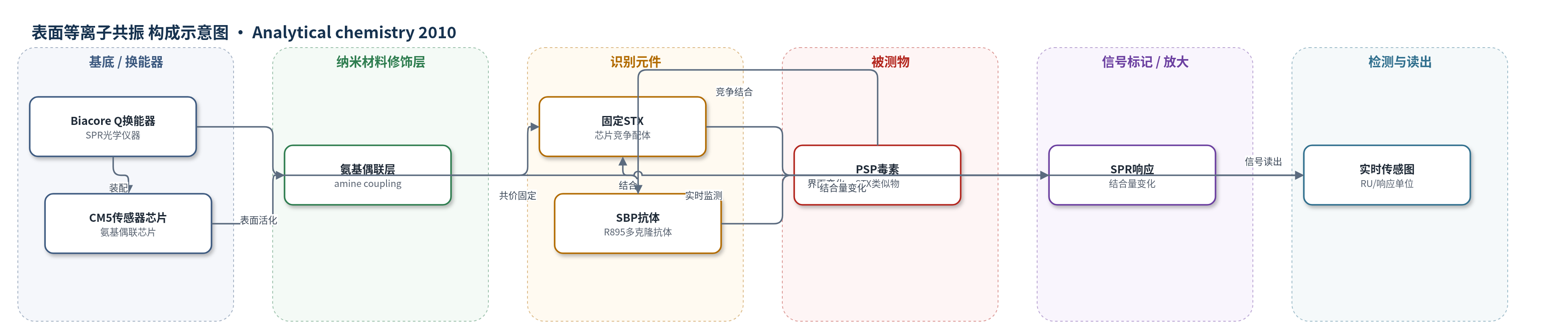
点击图片查看大图 · 依据论文自动绘制
传感器类型
表面等离子共振(SPR)生物传感器
检测对象
麻痹性贝类毒素(paralytic shellfish poisoning toxins, PSP toxins),包括河鲀毒素(saxitoxin, STX)、新河鲀毒素(neosaxitoxin, NEO)、gonyautoxins(GTX1/4、GTX2/3、GTX5)、去羰基河鲀毒素(dcSTX、dcNEO、dcGTX2/3)及C1/C2等类似物;样品基质为贝类肉匀浆/提取物(贻贝、蛤、扇贝、蛤蜊、牡蛎等)
检测原理
该SPR生物传感器采用竞争抑制模式。首先通过氨基偶联将STX共价固定于CM5芯片表面,形成固定配体层。检测时,将SBP(多克隆抗体R895)与样品或STX校准液在HBS-EP缓冲液中混合后注入芯片。SBP可与芯片上的STX结合,而样品中的PSP毒素类似物也能与SBP结合,从而与固定STX竞争。毒素浓度越高,SBP被样品毒素占据的比例越大,结合到芯片STX上的SBP越少,芯片界面质量/折射率变化越小,SPR响应降低。Biacore Q实时监测结合过程,以传感图和响应单位(RU)输出信号,并通过STX校准曲线或IC50/CCα进行半定量判断。方法无标记、无酶促放大,依赖抗体-毒素竞争结合实现信号变化。
检测灵敏度
LOD(IC20): dcNEO 9.4 ng/mL(1128 µg/kg)、GTX1/4 112 ng/mL(13450 µg/kg);检测能力CCα: 120 µg/kg;CCR: 0.72 ng/mL(86.4 µg/kg,贻贝)、0.47 ng/mL(56.4 µg/kg,蛤);STXdiHCl IC50: 4.7 ng/mL(HBS-EP缓冲液)、5.2 ng/mL(贻贝提取物);动态范围IC20–IC80: 2.8–7.8 ng/mL(缓冲液)、3.3–7.9 ng/mL(贻贝提取物)
效应效果
方法对PSP毒素有选择性,SBP不与domoic acid、okadaic acid或tetrodotoxin交叉反应;13种类似物中11种有交叉反应,GTX1/4<0.7%(缓冲液),dcNEO 6%(缓冲液)。贻贝和蛤加标样品批内重复性2.5%–12.3%,批间再现性6.1%–15.2%。STXdiHCl在贻贝400和800 µg/kg回收率98.6%±6.4%、107.9%±8.1%,在蛤中96.0%±7.1%、97.0%±5.9%。25个天然样品中,SPR与MBA符合率96%,与HPLC 92%。前处理约40个/小时,分析5–6 min,作者认为可作高通量初筛,减少>90%样品进入MBA。
传感器的构成
- 换能器/基底:Biacore Q SPR光学生物传感器与CM5传感器芯片,提供表面等离子共振实时检测平台
- 表面修饰层:氨基偶联(amine coupling)将STX共价固定于CM5芯片表面,形成竞争结合位点
- 识别元件:saxitoxin binding protein(SBP,多克隆抗体R895),与STX及其PSP类似物结合
- 竞争配体:芯片表面固定STX(saxitoxin),与样品中PSP毒素竞争结合SBP
- 运行缓冲液:HBS-EP缓冲液(HEPES、NaCl、EDTA、polysorbate),稀释SBP和样品并维持反应环境
- 再生液:50 mM HCl,再生芯片表面以去除结合物并恢复响应
中文摘要
本文报道了欧盟第六框架计划BioCop项目中开发的一种表面等离子共振(SPR)生物传感器筛查方法,用于检测贝类中的麻痹性贝类毒素(PSP毒素),以替代日益存在伦理问题的鼠生物测定法。该方法将河鲀毒素结合蛋白(SBP)与固定河鲀毒素(STX)的芯片表面联用,并配合简单高效的样品前处理。按照欧盟决定2002/657/EC以及IUPAC和AOAC单实验室验证指南,对该免疫学筛查方法进行了单实验室验证,评估了检测能力CCα、特异性/选择性、重复性、再现性、稳定性和适用性。以欧盟法规限值800 µg STX当量/kg贝肉为基准,CCα为120 µg/kg;不同贝类基质中批内重复性为2.5%–12.3%,批间再现性为6.1%–15.2%。天然样品结果显示,该方法与AOAC批准的鼠生物测定法(MBA)和高性能液相色谱法(HPLC)的总体符合率分别为96%和92%。
英文摘要
A research element of the European Union (EU) sixth Framework project BioCop focused on the development of a surface plasmon resonance (SPR) biosensor assay for the detection of paralytic shellfish poisoning (PSP) toxins in shellfish as an alternative to the increasingly ethically unacceptable mouse bioassay. A biosensor assay was developed using both a saxitoxin binding protein and chip surface in tandem with a highly efficient simple extraction procedure. The present report describes the single laboratory validation of this immunological screening method, for this complex group of toxins with differing toxicities, according to the European Decision 2002/657/EC in conjunction with IUPAC and AOAC single laboratory validation guidelines. The different performance characteristics (detection capability CCbeta, specificity/selectivity, repeatability, reproducibility, stability, and applicability) were determined in relation to the EU regulatory limit of 800 microg of saxitoxin equivalents (STX eq) per kg of shellfish meat. The detection capability CCbeta was calculated to be 120 microg/kg. Intra-assay repeatability was found to be between 2.5 and 12.3% and interassay reproducibility was between 6.1 and 15.2% for different shellfish matrices. Natural samples were also evaluated and the resultant data displayed overall agreements of 96 and 92% with that of the existing AOAC approved methods of mouse bioassay (MBA) and high performance liquid chromatography (HPLC), respectively.