组成图示
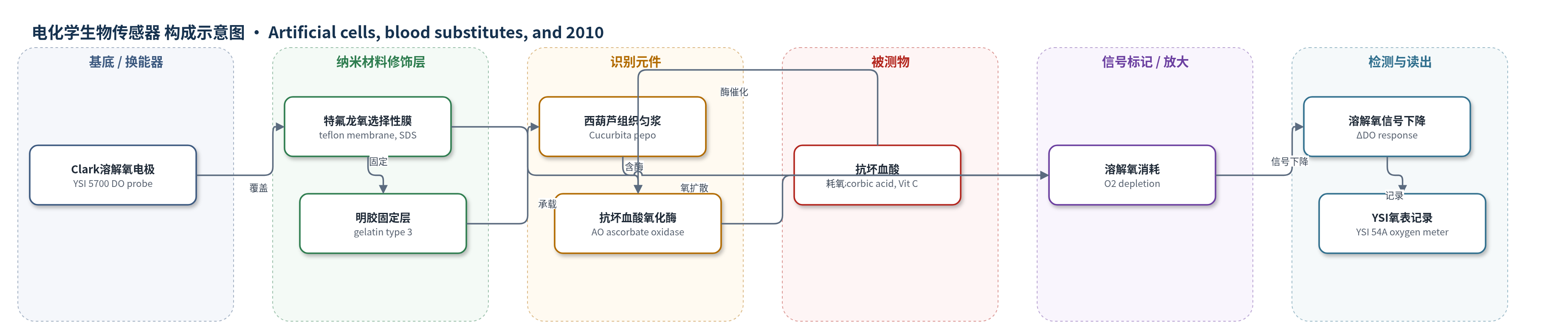
点击图片查看大图 · 依据论文自动绘制
传感器类型
电化学生物传感器
检测对象
抗坏血酸(ascorbic acid, AA,维生素C);样品基质:植物汁液(柠檬汁、葡萄柚汁、苹果汁、番茄汁、橙汁)和维C药片(药物制剂)
检测原理
西葫芦组织匀浆中的抗坏血酸氧化酶(AO)作为识别元件,在溶解氧存在下催化抗坏血酸氧化为脱氢抗坏血酸,反应式为 2 L-ascorbate + O2 → 2 dehydroascorbate + 2 H2O。该反应消耗氧分子,使特氟龙膜内侧酶层附近形成局部氧耗竭。Clark 溶解氧电极以安培方式检测氧还原信号,溶解氧下降量 ΔDO 随抗坏血酸浓度增加而增大。系统通过标准曲线将 ΔDO 转换为抗坏血酸浓度。该传感器未使用额外信号放大策略,主要依赖酶催化反应和氧选择性扩散产生的电化学信号变化。
检测灵敏度
LOD: 5×10^-6 M;线性范围: 5×10^-6 M–1.2×10^-3 M;灵敏度斜率: 0.0019(校准方程 y = 0.0019x + 0.3253);R^2 = 0.9975
效应效果
传感器对葡萄糖、柠檬酸、乙醇、天冬氨酸等干扰物响应低,但对儿茶酚、对苯二酚和苯酚等酚类有交叉响应,活性分别为 20%、17% 和 13%,这与 AO 的儿茶酚氧化酶活性有关。35°C 下热稳定 7 h 无明显失活,9 h 保留 94% 活性;4°C 储存 11 d,第 8 d 损失 12.5%,第 11 d 保留 75%。重复性良好,8 次测定 6×10^-4 M 抗坏血酸的偏差为 2.74%,R^2=0.9975。实际样品与 Tillman 比色法比较,维C药片、柠檬汁和葡萄柚汁偏差分别为 -3.6%、5.11% 和 -3.05%。作者认为其制备简单、成本低、线性范围宽,但储存稳定性不足。
传感器的构成
- 换能器电极:Clark 溶解氧电极(DO probe, YSI 5700),检测溶解氧浓度变化
- 氧选择性隔膜:特氟龙膜(teflon membrane),允许氧扩散并阻隔干扰物,经 0.5% SDS 预处理
- 固定基质:明胶(gelatin, type 3, 225 Bloom),承载并固定生物识别层
- 生物识别层:西葫芦组织匀浆(zucchini tissue homogenate, Cucurbita pepo),提供抗坏血酸氧化酶(AO)
- 交联剂:戊二醛(glutaraldehyde, GA, 2.5% v/v),交联明胶与组织蛋白,提高膜稳定性
- 工作缓冲液:磷酸盐缓冲液(PB, 50 mM, pH 7.5),维持酶反应环境
中文摘要
本文报道一种基于西葫芦(Cucurbita pepo)组织匀浆的安培型生物传感器,用于抗坏血酸(维生素C)测定。西葫芦组织匀浆富含抗坏血酸氧化酶(AO),与明胶混合后经戊二醛交联,固定在经十二烷基硫酸钠(SDS)预处理的特氟龙膜上,构成 Clark 溶解氧电极的生物识别层。在溶解氧存在下,AO 催化抗坏血酸氧化为脱氢抗坏血酸,导致酶层附近局部氧耗竭,使溶解氧电极信号下降。通过测量氧浓度降低量(ΔDO)并建立标准曲线,实现抗坏血酸定量。研究优化了组织匀浆量、明胶量、戊二醛浓度、缓冲体系、pH、缓冲液浓度和温度,并考察了热稳定性、储存稳定性和重复性。传感器在 5×10^-6 M 至 1.2×10^-3 M 范围内呈线性响应,R^2=0.9975。对植物汁液和维C药片样品测定并与 Tillman 比色法比较,偏差较小,表明该方法简便、低成本且可靠。
英文摘要
An amperometric biosensor based on zucchini (Cucurbita pepo) tissue homogenate is presented. The zucchini tissue homogenate was crosslinked with gelatine using glutaraldehyde and fixed on a pretreated teflon membrane. The zucchini tissue contained the enzyme ascorbate oxidase and this enzyme catalyzed the oxidation of ascorbic acid in the presence of dissolved oxygen. The principle of the measurements was based on the determination of the decrease in the dissolved oxygen level. Determinations were carried out by standard curves, which were obtained by the measurement of the decrease in the oxygen level related to ascorbic acid concentration. Optimization and characterization studies of the biosensor were carried out in detail. First of all, the amounts of zucchini tissue homogenate, gelatin, and glutaraldehyde percentage were optimized. Experimental parameters such as buffer system, pH, buffer concentration, and temperature were also optimized carefully. Thermal stability, storage stability, and repeatability of the biosensor were investigated. A linear response was observed from 5x10(-6) M to 1.2x10(-3) M ascorbic acid. Finally, the results of some plant and drug samples analyzed with the presented biosensor compared with the spectrophotometric method (Tillman reagent) used as a reference.