组成图示
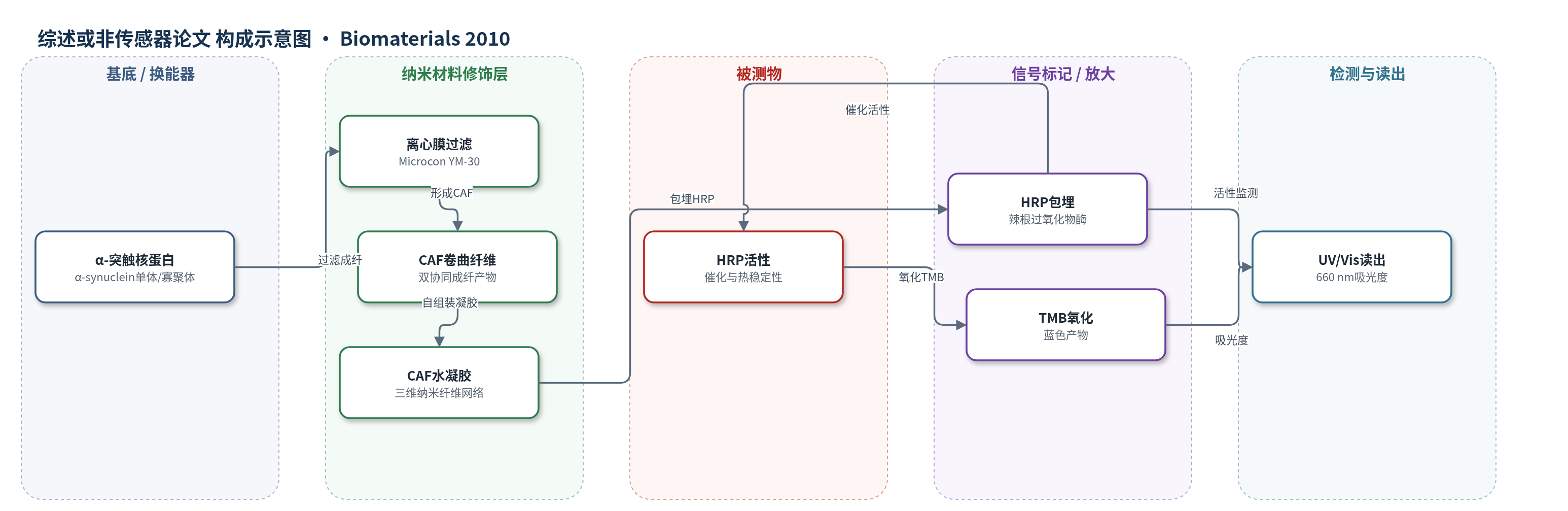
点击图片查看大图 · 依据论文自动绘制
传感器类型
综述或非传感器论文
检测对象
辣根过氧化物酶(HRP)活性、HRP热稳定性;样品基质:CAF淀粉样水凝胶、游离HRP溶液
检测原理
α-突触核蛋白单体在搅拌孵育下形成直纤维(SAF),而其中间寡聚体经离心膜过滤受剪切应力诱导,按双协同成纤模型快速形成卷曲纤维(CAF)。CAF通过三维纳米纤维网络自组装成淀粉样水凝胶,平均孔径约52.9 nm。将辣根过氧化物酶(HRP)与子代CAF混合并离心过滤后,HRP被包埋于纳米纤维网络中,包埋效率约80%。加入底物3,3',5,5'-四甲基联苯胺(TMB)后,HRP催化TMB氧化生成蓝色产物,660 nm吸光度随HRP活性升高而增大。由于纳米孔限制,游离HRP难以进入已形成的水凝胶,包埋HRP也难以逸出,因此多次催化和60 °C热处理下活性保持优于游离HRP。
检测灵敏度
原文未报告LOD、线性范围、灵敏度斜率或相关系数。
效应效果
CAF水凝胶平均孔径约52.9 nm,而胶原水凝胶平均孔径约31.5 μm,纳米孔结构更利于保护酶。HRP包埋效率约80%。在20轮多次催化中,包埋于CAF水凝胶的HRP活性大部分保持,而胶原水凝胶中HRP从第二轮起产物形成显著下降。60 °C热处理70 min内,包埋HRP活性最多下降12.5%,游离HRP失活超过50%;15 h后,包埋HRP失活约20%,游离HRP失活超过80%。作者认为该CAF纳米纤维网络具有组织工程、药物递送、纳米过滤和生物传感器开发等应用潜力。
传感器的构成
- 基底/换能器:未报告(非传感器论文)
- 识别元件:未报告(非传感器论文)
- 纳米基质:α-突触核蛋白(α-synuclein)卷曲淀粉样纤维(CAF)水凝胶,形成三维纳米纤维网络,平均孔径约52.9 nm
- 成纤方法:离心膜过滤(Microcon YM-30,14,000 g,37 °C)诱导寡聚体形成CAF
- 包埋酶:辣根过氧化物酶(HRP),与子代CAF混合后过滤包埋,包埋效率约80%
- 底物/显色剂:3,3',5,5'-四甲基联苯胺(TMB),被HRP催化氧化生成蓝色产物
- 信号读出:紫外可见分光光度计(UV/Vis),监测660 nm吸光度
中文摘要
阐明蛋白质基超结构分子组装机制对开发生物材料至关重要。单一淀粉样蛋白α-突触核蛋白在不同成纤过程中可形成两种形态不同的淀粉样纤维:卷曲纤维(CAF)和直纤维(SAF)。通过离心膜过滤预形成的α-突触核蛋白寡聚体可互斥地产生CAF,而搅拌孵育其单体则产生SAF,分别对应双协同成纤和成核依赖成纤模型。CAF与SAF二级结构差异导致其形态独特性、结构柔韧性和机械强度不同。两种多态均具有自传播特性,其特征形态可通过种子依赖成纤连续遗传至子代和孙代纤维。CAF积累形成由细纳米尺度三维蛋白纤维网络构成的淀粉样水凝胶。由子代CAF制备的水凝胶可作为酶包埋的合适纳米基质,使包埋的辣根过氧化物酶在多次催化和热处理中保持活性。因此,CAF纳米纤维网络在组织工程、药物递送、纳米过滤和生物传感器开发等纳米生物技术领域具有应用潜力。
英文摘要
Elucidation of molecular assembly mechanism of protein-based suprastructure formation is pivotal to develop biomaterials. A single amyloidogenic protein of alpha-synuclein turned into two morphologically distinctive amyloid fibrils - 'curly' (CAF) vs. 'straight' (SAF) - depending on its fibrillation processes. Mutually exclusive production of CAF and SAF was achieved with either centrifugal membrane filtration of the preformed oligomeric species of alpha-synuclein or agitated incubation of its monomeric form, representing amyloidogeneses via double-concerted and nucleation-dependent fibrillation model, respectively. Differences in secondary structures of CAF and SAF have been suggested to be responsible for their morphological uniqueness with structural flexibility and mechanical strength. Both polymorphs exerted the self-propagation property, demonstrating that their characteristic morphologies were inherited for two consecutive generations to daughter and granddaughter fibrils through the seed-dependent fibrillation procedure. Accumulation of CAF produced amyloid hydrogel composed of fine nano-scaled three-dimensional protein fibrillar network. The hydrogel made of daughter CAF was demonstrated to be a suitable nanomatrix for enzyme entrapment, which protected the entrapped enzyme of horseradish peroxidase from loss of activity due to multiple catalyses and heat treatment. The nano-scaled fibrillar network of CAF, therefore, could exhibit a full potential to be further applied in the promising areas of nanobiotechnology including tissue engineering, drug delivery, nanofiltration and biosensor development.