组成图示
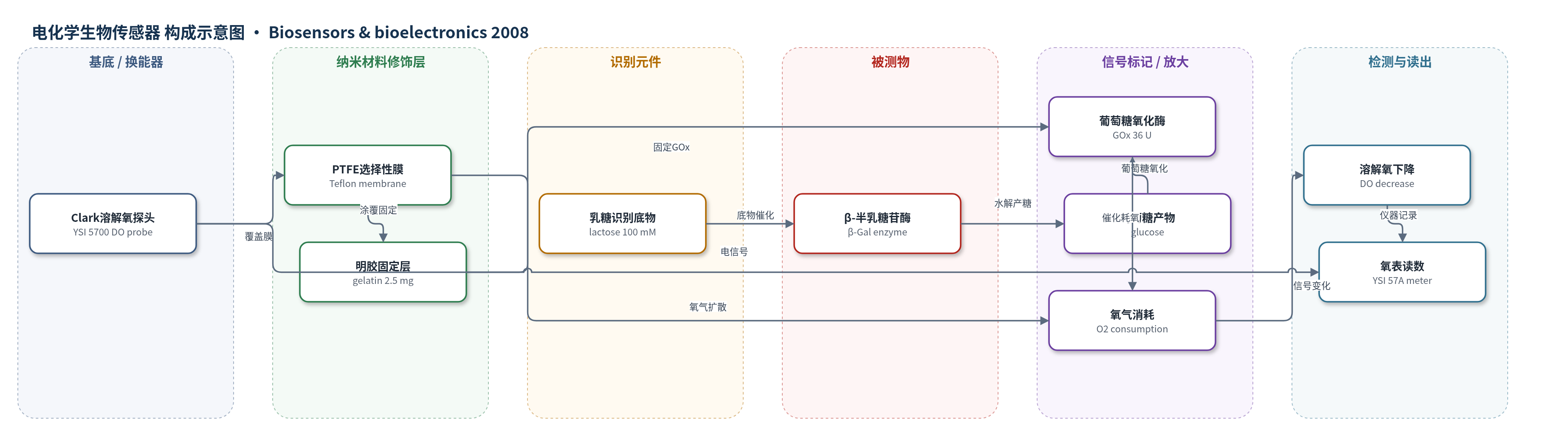
点击图片查看大图 · 依据论文自动绘制
传感器类型
电化学生物传感器
检测对象
β-半乳糖苷酶(β-galactosidase, β-Gal)活性;样品基质:人工肠液(artificial intestinal juice)、标准缓冲液
检测原理
该传感器采用酶级联反应将β-半乳糖苷酶活性转换为溶解氧信号。在pH 4.8、含100 mM乳糖的柠檬酸缓冲液中,被测β-半乳糖苷酶催化乳糖水解,生成葡萄糖和半乳糖。葡萄糖扩散至Clark电极表面的GOx固定层,GOx催化葡萄糖氧化为葡萄糖酸并消耗氧气。氧气透过PTFE选择性膜进入电极反应区,氧浓度下降被Clark电极检测。β-半乳糖苷酶活性越高,葡萄糖生成速率越快,GOx耗氧速率越大,溶解氧下降斜率或稳态差值越大,从而实现酶活性的定量测定。该方法无需显色或荧光底物,酶级联反应提供信号放大。
检测灵敏度
LOD: 9.4 × 10⁻⁵ U/ml(10 ng/ml);线性范围: 9.4 × 10⁻⁵–3.2 × 10⁻² U/ml;斜率: 63.596x + 0.1494(36 U GOx);R^2 = 0.9988
效应效果
传感器在40 ℃下连续测量23次仍保留95%初始活性,45 ℃下10次保留94%;4 ℃储存30天响应稳定,60天保留87%,90天保留78%。重复性变异系数为2.2%,重现性RSD小于3.8%,5个同批传感器R2为0.9980–0.9995,0.0188 U/ml标准液CV为3.7%。人工肠液加标0.0018 U/ml时,传感器测得0.0018 U/ml,参考分光光度法测得0.0019 U/ml,回收率100%,相对差5%。与分光光度法相比,该方法避免昂贵仪器和显色/荧光底物,操作简便、成本低,适合酶活性快速测定。
传感器的构成
- 换能器基底:Clark溶解氧探头(YSI 5700 DO probe),内置氧敏感电极,检测溶解氧变化
- 选择性膜:高灵敏度聚四氟乙烯(PTFE/Teflon)膜,用O-ring固定并经SDS预处理,允许氧气扩散并阻隔大分子
- 生物活性层:葡萄糖氧化酶(GOx,36 U)与明胶(gelatin,2.5 mg)混合涂覆于膜表面,GOx催化葡萄糖氧化并消耗氧气
- 交联固定层:戊二醛(glutaraldehyde,GA,5% v/v)交联明胶与GOx,形成稳定水凝胶层
- 底物识别层:工作缓冲液中的乳糖(lactose,100 mM)作为β-半乳糖苷酶底物,被水解生成葡萄糖
- 被测物:β-半乳糖苷酶(β-galactosidase,β-Gal)注入反应池,催化乳糖水解
- 信号读出:YSI 57A氧表记录溶解氧下降,氧耗速率对应β-Gal活性
中文摘要
β-半乳糖苷酶是一类催化β-半乳糖苷水解为单糖的水解酶,其底物包括神经节苷脂GM1、乳糖神经酰胺、乳糖及多种糖蛋白。本文提出一种基于Clark电极的葡萄糖氧化酶生物传感器,用于监测β-半乳糖苷酶活性。葡萄糖氧化酶以明胶为载体、戊二醛为交联剂固定在溶解氧探头表面。研究优化了葡萄糖氧化酶用量、明胶量、戊二醛交联比例等参数,并重点考察工作缓冲液中乳糖浓度对响应的影响。同时确定了最适温度、热稳定性、最适pH、缓冲体系及缓冲浓度,并评价了重复性、重现性、储存稳定性和操作稳定性。传感器对β-半乳糖苷酶活性的线性检测范围为9.4×10⁻⁵至3.2×10⁻² U/ml。最后,用该传感器测定人工肠液中β-半乳糖苷酶活性,并与参考分光光度法结果进行比较。
英文摘要
beta-Galactosidase is an hydrolase enzyme that catalyzes the hydrolysis of beta-galactosides into monosaccharides. Substrates of different beta-galactosidases include ganglioside GM1, lactosylceramides, lactose, and various glycoproteins. A novel aspect of the activity determination of beta-galactosidase was presented. A glucose oxidase biosensor based on Clark electrode was utilized in order to monitor beta-galactosidase. Immobilization of glucose oxidase was made by gelatin and glutaraldehyde as cross-linker. Several parameters such as glucose oxidase activity, gelatin amount, and glutaraldehyde percentage for cross-linking were optimized. The most important parameter, lactose concentration in working buffer was studied in detail. Optimum temperature, thermal stability, optimum pH, buffer system and its concentration effect on the biosensor system, repeatability, reproducibility, and storage and operational stabilities of the biosensor were identified. A linear detection range for beta-galactosidase was observed between 9.4 x 10(-5) and 3.2 x 10(-2)U/ml. Finally, beta-galactosidase activity in artificial intestinal juice was investigated by the biosensor and the results obtained were compared with a reference spectrophotometric method.