组成图示
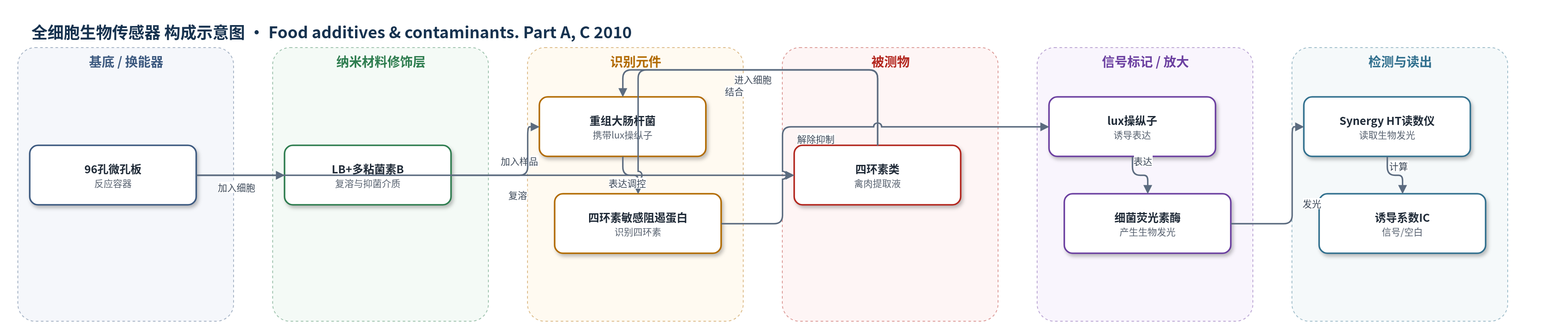
点击图片查看大图 · 依据论文自动绘制
传感器类型
全细胞生物传感器
检测对象
四环素类(tetracyclines,包括四环素 tetracycline、多西环素 doxycycline、土霉素 oxytetracycline、金霉素 chlortetracycline);样品基质:禽肉肌肉提取液(鸡、火鸡、珍珠鸡肌肉)
检测原理
该传感器以重组大肠杆菌为全细胞识别与换能单元。菌株携带细菌荧光素酶操纵子(lux operon),其表达受四环素敏感阻遏蛋白控制。无四环素时,阻遏蛋白抑制lux转录,发光信号低;四环素进入细胞并与阻遏蛋白结合,使其从启动子区解离,lux操纵子被诱导表达,荧光素酶催化底物氧化产生生物发光。孵育3 h后读取发光,并以诱导系数IC=诱导信号/空白信号进行判断,IC>2为阳性。由于高浓度四环素可抑制蛋白合成和细胞生长,导致信号下降,方法采用同一样品三个连续稀释,利用稀释系列IC变化模式识别高浓度样品并减少假阴性。
检测灵敏度
灵敏度: 10 mg kg−1(表2);氧四环素检测限: 约10 mg kg−1(接近化学确证定量限)
效应效果
在337份常规禽肉样品中,细胞生物传感器法检出36份可疑样品(10.7%),微生物抑制法检出7份(2%),所有可疑样品均经LC-MS/MS确证;仅1份超过MRL(195 mg/kg多西环素),多数低于10 mg/kg定量限。方法对0.5–4倍MRL的多种其他抗生素无诱导,恩诺沙星需达3000 mg/kg才产生负效应,显示良好选择性。三个连续稀释的IC模式可将需化学确证的样品减少约三分之二。检测时间约3 h,低于抑制法12–16 h,单样成本约7.50欧元,低于15.00欧元;但珍珠鸡等深红色样品因血红蛋白吸收干扰不适用。
传感器的构成
- 传感细胞:重组大肠杆菌(Escherichia coli)冻干细胞,携带含细菌荧光素酶操纵子(lux operon)的质粒,作为识别与信号产生元件
- 识别元件:四环素敏感阻遏蛋白(tetracycline-sensitive repressor),与四环素结合后解除对lux操纵子的抑制
- 信号元件:细菌荧光素酶(bacterial luciferase, lux operon),催化产生生物发光
- 反应介质:Luria肉汤(LB)含0.5 mg/mL多粘菌素B(polymyxin B),用于细胞复溶并抑制杂菌
- 缓冲螯合体系:100 mM磷酸盐缓冲液(pH 6)和25 mM EDTA,稳定反应并减少基质干扰
- 样品基质:禽肉肌肉提取液(poultry muscle extract),提供被测四环素类
- 读出装置:白色96孔平底微孔板与Synergy HT微孔板读数仪(BioTek),读取生物发光并计算诱导系数(IC)
中文摘要
四环素在兽医领域广泛使用,动物源性食品中残留监测需要快速、低成本的高通量筛查方法。本文对一种已建立的发光细菌细胞生物传感器方法进行了大规模现场评价,使用超过300份常规禽肉样品,并与微生物抑制法平行比较。细胞生物传感器法检出的可疑样品比例明显更高,为10.2%,而抑制法为2%;所有可疑样品均经液相色谱-串联质谱(LC-MS/MS)确证。仅1份样品超过最大残留限量(MRL,100 mg/kg),多数可疑样品残留量很低,低于10 mg/kg。该方法具有较好的特异性和稳健性;通过同一样品三个连续稀释的诱导系数模式设定确证切点,可将需进一步化学确证的样品数量降至最低,适用于禽肉中四环素类残留的常规筛查。
英文摘要
Tetracyclines are extensively used in veterinary medicine. For the detection of tetracycline residues in animal products, a broad array of methods is available. Luminescent bacterial biosensors represent an attractive inexpensive, simple and fast method for screening large numbers of samples. A previously developed cell-biosensor method was subjected to an evaluation study using over 300 routine poultry samples and the results were compared with a microbial inhibition test. The cell-biosensor assay yielded many more suspect samples, 10.2% versus 2% with the inhibition test, which all could be confirmed by liquid chromatography-tandem mass spectrometry (LC-MS/MS). Only one sample contained a concentration above the maximum residue limit (MRL) of 100 microg kg(-1), while residue levels in most of the suspect samples were very low (<10 microg kg(-1)). The method appeared to be specific and robust. Using an experimental set-up comprising the analysis of a series of three sample dilutions allowed an appropriate cut-off for confirmatory analysis, limiting the number of samples and requiring further analysis to a minimum.