组成图示
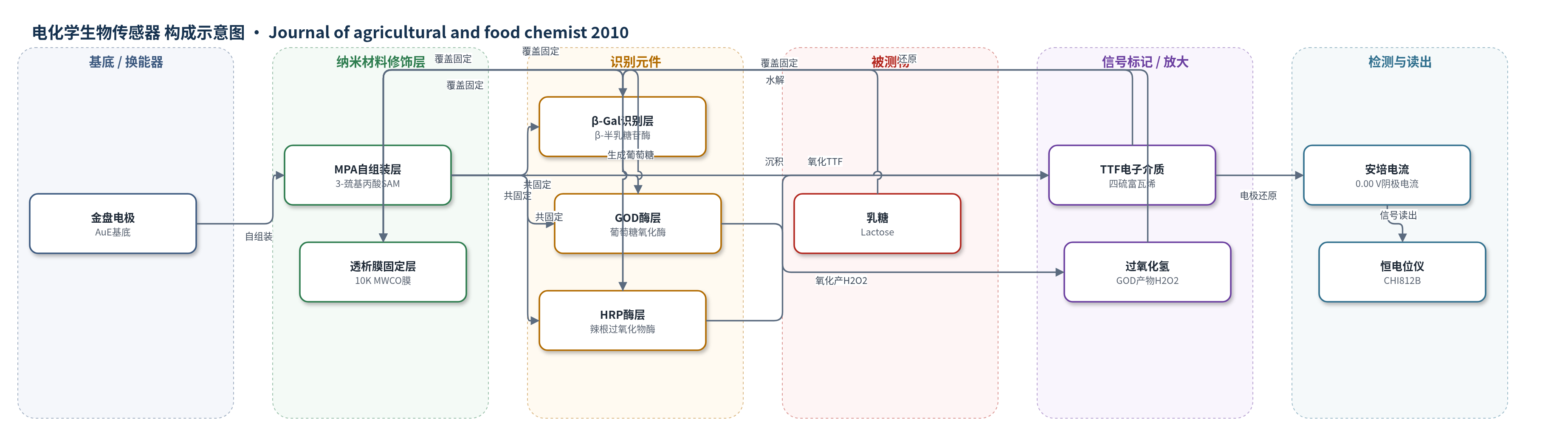
点击图片查看大图 · 依据论文自动绘制
传感器类型
电化学生物传感器
检测对象
乳糖(Lactose);样品基质:牛奶、奶粉、浓缩奶、奶油、酸奶、奶酪、巧克力、黄油、人造黄油、蛋黄酱等乳制品/食品
检测原理
该传感器基于三酶级联与氧化还原介质电子传递。β-Gal首先催化乳糖水解为葡萄糖和半乳糖,这是识别/催化事件;GOD随后催化葡萄糖与O2反应生成葡萄糖酸和H2O2;HRP催化H2O2还原,TTF作为电子介质将HRP再生为活性形式,同时自身被氧化为TTF+。在0.00 V(vs Ag/AgCl)下,TTF+在金电极表面被还原,产生阴极安培电流。由于一个乳糖分子经酶级联可驱动多次介质循环,信号被放大,稳态电流与乳糖浓度成正比。透析膜限制酶泄漏并维持界面微环境,MPA-SAM提供稳定固定界面。
检测灵敏度
批量安培:LOD: 4.6 × 10^-7 M;线性范围: 1.5 × 10^-6–1.2 × 10^-4 M;斜率 = (6.04 ± 0.05) × 10^2 μA M^-1;r = 0.999。流动注射安培:LOD: 3.8 × 10^-6 M;线性范围: 1.3 × 10^-5–1.0 × 10^-3 M;斜率 = (1.113 ± 0.007) × 10^4 nA M^-1;r = 0.999。
效应效果
重复性良好:同一传感器10次校准斜率RSD为3.6%,2.0×10^-5 M乳糖10次测量RSD为3.0%;8个传感器响应RSD为6.5%和6.6%。连续使用28天稳定,34天后降至65%。蔗糖、乳果糖、果糖、阿拉伯糖、尿酸、麦芽糖干扰不显著;葡萄糖、半乳糖、抗坏血酸有干扰,葡萄糖可用不含β-Gal的传感器扣除。流动注射15次进样RSD为7.2%。25个实际样品RSD均<10%,无基质效应;与商品化酶试剂盒相关斜率1.04±0.06、截距0.3±1.7、r=0.991,分析时间约缩短90 min,适合乳制品快速检测。
传感器的构成
- 基底/换能器电极:金盘电极(AuE),经抛光、KOH和酸处理,提供导电基底与电子转导界面
- 自组装单分子层:3-巯基丙酸(MPA)SAM,修饰金电极表面,提供羧基界面并稳定后续固定
- 电子介质层:四硫富瓦烯(TTF),作为氧化还原介质,介导HRP再生并在0.00 V被还原产生安培信号
- 过氧化物酶层:辣根过氧化物酶(HRP),催化H2O2还原,其还原形式由TTF再生
- 葡萄糖氧化酶层:葡萄糖氧化酶(GOD),催化葡萄糖氧化生成葡萄糖酸和H2O2
- 识别/催化元件:β-半乳糖苷酶(β-Gal),催化乳糖水解为葡萄糖和半乳糖
- 固定/封闭层:10K MWCO透析膜,覆盖电极表面,共固定酶与TTF并允许底物/产物扩散
中文摘要
本文报道了一种用于检测乳糖的集成安培生物传感器。该生物电极以3-巯基丙酸(MPA)自组装单分子层(SAM)修饰的金电极为基底,将β-半乳糖苷酶(β-Gal)、葡萄糖氧化酶(GOD)、辣根过氧化物酶(HRP)和氧化还原介质四硫富瓦烯(TTF)通过透析膜共同固定。β-Gal催化乳糖水解生成葡萄糖,GOD将葡萄糖催化氧化为葡萄糖酸和过氧化氢,HRP在TTF介导下还原过氧化氢;TTF+在0.00 V(vs Ag/AgCl)处被还原,产生与乳糖浓度成正比的安培信号。该传感器具有良好重复性、重现性和28天使用寿命,乳糖线性范围为1.5×10^-6至1.2×10^-4 M,检出限为4.6×10^-7 M。作者评估了蔗糖、乳果糖、果糖、阿拉伯糖、麦芽糖、半乳糖、葡萄糖及尿酸和抗坏血酸等潜在干扰物,并在流动注射安培检测中验证了适用性。该传感器用于牛奶及巧克力、黄油、人造黄油、酸奶、奶酪和蛋黄酱等食品中乳糖测定,结果与商品化酶试剂盒比较得到验证。
英文摘要
An integrated amperometric biosensor for the determination of lactose is reported. The bioelectrode design is based on the use of a 3-mercaptopropionic acid (MPA) self-assembled monolayer (SAM)-modified gold electrode on which the enzymes beta-galactosidase (beta-Gal), glucose oxidase (GOD), peroxidase (HRP) and the mediator tetrathiafulvalene (TTF) are coimmobilized by a dialysis membrane. beta-Gal catalyzes the hydrolysis of lactose, and the produced glucose is catalytically oxidized to gluconic acid and H(2)O(2), which is reduced in the presence of HRP. This enzyme reaction is mediated by TTF, and the reduction of TTF(+) at 0.00 V (vs Ag/AgCl) gives rise to an amperometric signal proportional to the lactose concentration. The biosensor exhibits a good repeatability of the measurement carried out with the same biosensor, a good reproducibility of the responses obtained with different biosensors and a useful lifetime of 28 days. A linear calibration plot was obtained for lactose over the 1.5 x 10(-6) to 1.2 x 10(-4) M concentration range, with a limit of detection of 4.6 x 10(-7) M. The effect of potential interferents (sucrose, lactulose, fructose, arabinose, maltose, galactose, glucose and uric and ascorbic acids) on the biosensor response was evaluated. Furthermore, the bioelectrode exhibits a suitable performance in flow-injection systems in connection with amperometric detection. The developed biosensor was applied to the determination of lactose in milk and other foodstuffs (chocolate, butter, margarine, yogurt, cheese and mayonnaise), and the results obtained were validated by comparison with those provided by using a commercial enzyme test kit.