组成图示
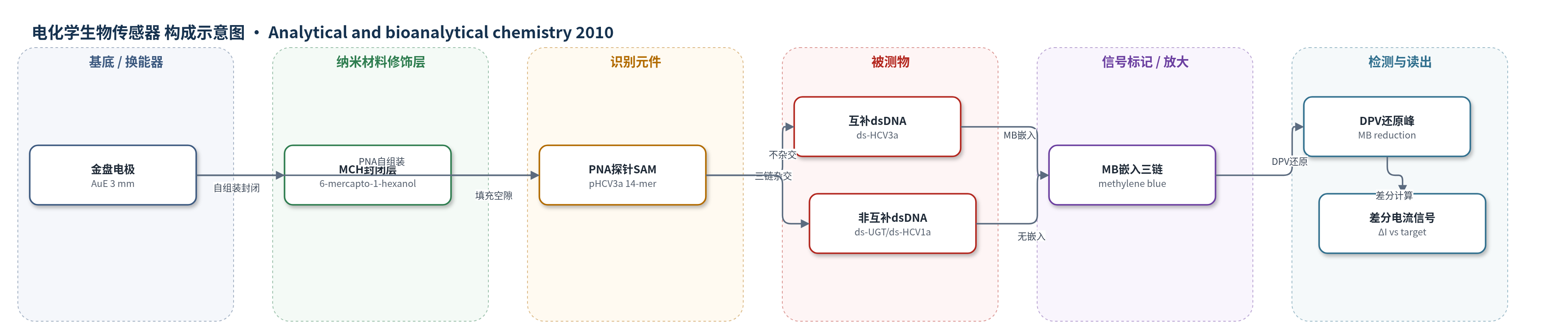
点击图片查看大图 · 依据论文自动绘制
传感器类型
电化学生物传感器
检测对象
双链寡核苷酸(dsDNA,HCV genotype 3a core/E1区,ds-HCV3a);样品基质:磷酸盐缓冲液(PBS,pH 7.0)及Tris-HCl缓冲液(pH 7.0,含20 mM NaCl)
检测原理
该传感器利用PNA探针与目标双链DNA之间的三链杂交实现识别。PNA探针通过巯基/半胱氨酸锚定在金电极表面,MCH封闭降低非特异吸附。目标dsDNA无需变性,PNA以Watson–Crick和Hoogsteen氢键与dsDNA中的嘌呤链结合,形成PNA–dsDNA三螺旋。三链结构为亚甲基蓝(MB)提供嵌入位点,使DPV还原峰电流增大;非互补dsDNA不能形成稳定三链,MB信号基本不变。信号以杂交前后MB还原峰差分ΔI表示,随目标浓度升高而增大,在10–100 pM呈线性。方法未使用HCR、RCA或酶催化放大,主要依靠PNA三链识别和MB嵌入指示。
检测灵敏度
LOD: 1.8×10⁻¹² M;线性范围: 10–100 pM;回归方程: y ΔI = 30.6 + 0.79 X pM;R^2 = 0.999
效应效果
选择性方面,1 nM非互补ds-UGT、ds-HCV1a及其混合液均不引起MB还原信号显著增加;互补ds-HCV3a单独存在与两种非互补序列混合存在时的MB信号几乎相同,说明传感器可在全匹配dsDNA与非匹配dsDNA混合液中识别目标。重现性方面,100 pM ds-HCV3a在三个独立PNA修饰电极上的RSD为3.1%。优化实验显示,预加热电极滴杂交较普通滴杂交使MB信号提高70%;探针浓度5 µM时信号最佳,高于7 µM因空间/静电阻碍导致三链形成减少;杂交20 h达到平台,4–5 h可获得最大信号的65–70%。作者认为该策略无需变性,可简化检测流程并降低污染风险,可作为HCV3a dsDNA检测的基础平台。
传感器的构成
- 基底/换能器:多晶金盘电极(AuE,polycrystalline gold working electrode,3 mm直径),提供电子转导与PNA自组装表面。
- 识别元件:14-mer肽核酸探针(PNA probe pHCV3a,Cys-O-O-CACACATATCACCC),通过巯基/半胱氨酸锚定到金表面,与HCV3a dsDNA形成三链。
- 封闭/修饰层:6-巯基-1-己醇(MCH,6-mercapto-1-hexanol,1 mM水溶液),填充PNA-SAM空隙并降低非特异吸附。
- 信号标记物:亚甲基蓝(MB,methylene blue,20 µM),嵌入PNA-dsDNA三链结构,其DPV还原峰随杂交增强。
- 电解液/缓冲体系:20 mM Tris-HCl(pH 7.0)含20 mM NaCl,用于MB积累与DPV测量;磷酸盐缓冲液(PBS,pH 7.0)用于目标杂交与LOD测定。
- 参比/辅助电极:饱和甘汞电极(SCE)与铂丝辅助电极,构成三电极电化学测量体系。
中文摘要
本文报道了一种基于肽核酸(PNA)探针和双链DNA杂交的电化学生物传感器,用于直接检测并区分对应丙型肝炎病毒(HCV)3a基因型core/E1区的双链寡核苷酸(dsDNA),无需对目标DNA进行变性。传感器以多晶金盘电极为基底,将14-mer PNA探针pHCV3a自组装于金表面,并用6-巯基-1-己醇(MCH)封闭。当目标dsDNA与PNA探针结合形成PNA–dsDNA三链结构时,亚甲基蓝(MB)嵌入量增加,差分脉冲伏安法(DPV)还原峰电流显著增强,从而实现检测与区分。非互补双链寡核苷酸不产生明显信号。在pH 7.0磷酸盐缓冲液中,检出限为1.8×10⁻¹² M;100 pM目标dsDNA在三个独立探针修饰电极上的相对标准偏差为3.1%,表明方法重现性良好。
英文摘要
Development of an electrochemical DNA biosensor for the direct detection and discrimination of double-stranded oligonucleotide (dsDNA) corresponding to hepatitis C virus genotype 3a, without its denaturation, using a gold electrode is described. The electrochemical DNA sensor relies on the modification of the gold electrode with 6-mercapto-1-hexanol and a self-assembled monolayer of 14-mer peptide nucleic acid probe, related to the hepatitis C virus genotype 3a core/E1 region. The increase of differential pulse voltammetric responses of methylene blue, upon hybridization of the self-assembled probe with the target ds-DNA to form a triplex is the principle behind the detection and discrimination. Some hybridization experiments with non-complementary oligonucleotides were carried out to assess whether the developed DNA sensor responds selectively to the ds-DNA target. Diagnostic performance of the biosensor is described and the detection limit was found to be 1.8 x 10(-12) M in phosphate buffer solution, pH 7.0. The relative standard deviation of measurements of 100 pM of target ds-DNA performed with three independent probe-modified electrodes was 3.1%, indicating a remarkable reproducibility of the detection method.