组成图示
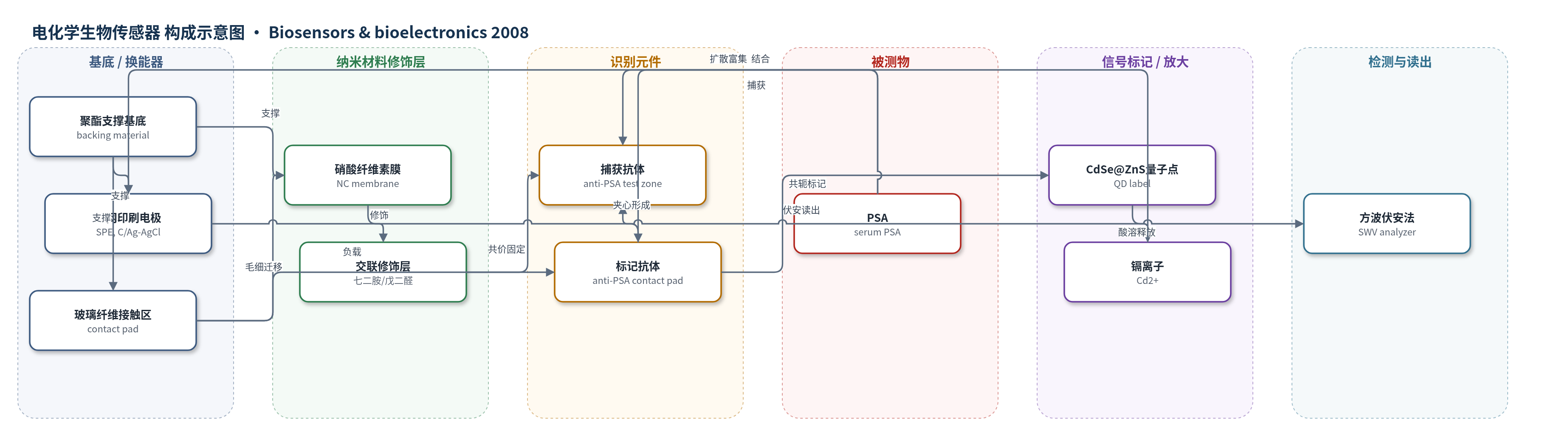
点击图片查看大图 · 依据论文自动绘制
传感器类型
电化学生物传感器
检测对象
前列腺特异性抗原(prostate-specific antigen, PSA),人血清(serum)
检测原理
血清样品滴加至试纸条后,在吸收垫毛细驱动下沿硝酸纤维素膜迁移。样品中的PSA在接触区与预载的anti-PSA–QD共轭物结合,形成PSA–anti-PSA–QD复合物;复合物继续迁移至测试区,被共价固定的捕获anti-PSA抗体识别,形成夹心免疫复合物anti-PSA–PSA–anti-PSA–QD。由于每个CdSe@ZnS量子点含上万Cd原子,QD标记提供显著信号放大。反应10 min后,用1 M HCl溶解测试区QD,释放Cd2+;Cd2+在含10 ppm Hg醋酸缓冲液中于SPE工作电极上恒电位预富集,随后方波伏安法氧化产生Cd剥离峰。峰电流随PSA浓度增加而增大,实现定量检测。
检测灵敏度
LOD: 0.02 ng/mL (S/N = 3);线性范围: 0.05–4 ng/mL;R^2 = 0.995;20倍稀释后血清检测范围: 1–80 ng/mL
效应效果
在优化条件下,IEB对PSA的线性范围为0.05–4 ng/mL,R2=0.995,检出限0.02 ng/mL,低于临床定性切点4.0 ng/mL;血清样品20倍稀释后适用检测范围为1–80 ng/mL,有助于降低基质干扰。方法重现性良好,RSD为6.4%。人血清加标0.5 ng/mL PSA时,IEB测得0.53±0.13 ng/mL,ELISA测得0.56±0.04 ng/mL,回收率分别为105%和111%,结果与ELISA一致。总检测时间少于10 min,结合便携式电化学分析仪,可低成本、快速、定量地用于PSA床旁检测。
传感器的构成
- 支撑基底:聚酯backing material,用于粘贴组装试纸条各功能区。
- 换能器电极:一次性丝网印刷电极SPE(碳工作电极、碳对电极、Ag/AgCl参比电极),嵌入测试区下方,用于方波伏安法检测。
- 样品加载区:玻璃纤维sample pad,用于加载血清样品并启动毛细流动。
- 接触区:玻璃纤维contact pad,物理吸附anti-PSA–QD共轭物,使PSA与标记抗体结合。
- 层析膜:硝酸纤维素膜NC membrane,作为免疫层析通道,样品和免疫复合物沿其迁移。
- 捕获识别元件:anti-PSA抗体经diaminoheptane和glutaraldehyde共价固定在测试区NC膜上,捕获PSA形成夹心复合物。
- 信号标记物:CdSe@ZnS量子点QD标记anti-PSA抗体,作为含Cd信号放大载体。
- 封闭剂:BSA(1%或3% BSA/PBS/Tween-20)封闭NC膜,降低非特异吸附。
- 吸收区:absorbent pad,提供毛细驱动力使样品流过试纸条。
中文摘要
本文报道了一种纳米颗粒标记/免疫层析电化学生物传感器(IEB),用于人血清中前列腺特异性抗原(PSA)的快速、灵敏检测。该传感器将免疫层析试纸条与电化学检测器集成,实现定量信号转换。CdSe@ZnS纳米颗粒作为信号放大载体,标记抗PSA抗体;在试纸条上进行夹心免疫反应,测试区捕获的纳米颗粒标记物通过一次性丝网印刷电极进行高灵敏剥离伏安法测定,检测溶解释放的镉金属组分。作者优化了免疫反应时间、抗PSA–纳米颗粒共轭物用量以及电化学预富集电位和时间等参数,并以血清PSA样品评估动态范围、重现性和检出限等性能。结果经酶联免疫吸附试验(ELISA)验证,一致性良好。该传感器检出限为0.02 ng/mL,相对标准偏差为6.4%,方法快速、临床实用且成本较低,结合便携式电化学分析仪,有望用于疾病相关蛋白生物标志物的简单、灵敏、定量床旁检测。
英文摘要
We present a nanoparticle (NP) label/immunochromatographic electrochemical biosensor (IEB) for rapid and sensitive detection of prostate-specific antigen (PSA) in human serum. This IEB integrates the immunochromatographic strip with the electrochemical detector for transducing quantitative signals. The NP label, made of CdSe@ZnS, serves as a signal-amplifier vehicle. A sandwich immunoreaction was performed on the immunochromatographic strip. The captured NP labels in the test zone were determined by highly sensitive stripping voltammetric measurement of the dissolved metallic component (cadmium) with a disposable-screen-printed electrode, which is embedded underneath the membrane of the test zone. Several experimental parameters (e.g., immunoreaction time, the amount of anti-PSA-NP conjugations applied) and electrochemical detection conditions (e.g., preconcentration potential and time) were optimized using this biosensor for PSA detection. The analytical performance of this biosensor was evaluated with serum PSA samples according to the "figure-of-merits" (e.g., dynamic range, reproducibility, and detection limit). The results were validated with enzyme-linked immunosorbent assay (ELISA) and showed high consistency. It is found that this biosensor is very sensitive with the detection limit of 0.02ngmL(-1) PSA and is quite reproducible (with a relative standard deviation (R.S.D.) of 6.4%). This method is rapid, clinically practical, and less expensive than other diagnostic tools for PSA; therefore, this IEB coupled with a portable electrochemical analyzer shows great promise for simple, sensitive, quantitative point-of-care testing of disease-related protein biomarkers.