组成图示
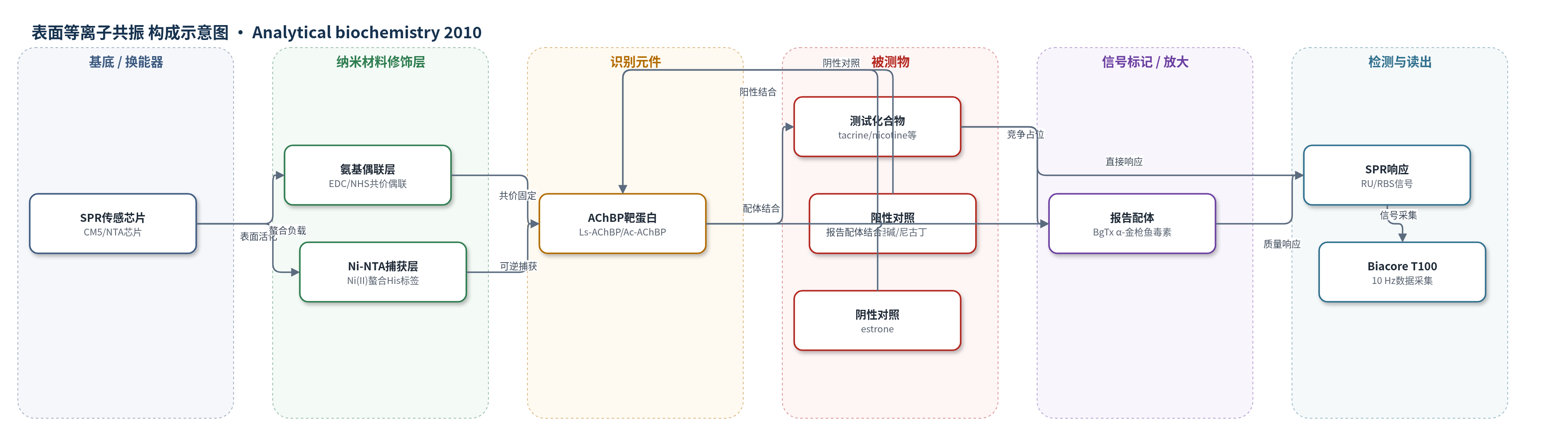
点击图片查看大图 · 依据论文自动绘制
传感器类型
表面等离子共振(SPR)生物传感器
检测对象
乙酰胆碱结合蛋白(AChBP)配体/小分子化合物(他克林 tacrine、尼古丁 nicotine、乙酰胆碱 acetylcholine、epibatidine、VUF 10674);样品基质为DMSO储备液稀释后的运行缓冲液(磷酸盐或PBS-Tris含P20)
检测原理
SPR传感器表面通过EDC/NHS共价固定或Ni-NTA可逆捕获AChBP。初筛中,小分子测试化合物直接结合AChBP,引起界面质量/折射率变化,产生共振单位(RU)响应;结合量随化合物浓度和亲和力增加。复筛采用顺序竞争:先注入测试化合物占据AChBP结合位点,随后立即注入高分子量报告配体α-金枪鱼毒素(BgTx)。BgTx仅结合剩余自由位点,其结合斜率(RBS)随测试化合物占据量增加而降低。由于BgTx分子量约8 kDa,远大于小分子,结合产生更大SPR质量响应,实现信号放大;通过比较RBS与缓冲液对照,可区分结合物与非结合物,并降低假阳性。
检测灵敏度
EC50: 55 nM (r2 = 0.96);EC50: 7.3 μM (r2 = 0.98);EC50: 9.4 μM (r2 = 0.99)
效应效果
初筛固定约3000 RU AChBP,表面至少稳定4天;复筛捕获约1000 RU时基线漂移0–15 RU/min。复筛信噪比为36,直接法为13,z0因子0.96,两种方法重现性相当。顺序竞争法对BgTx结合口袋具有选择性,非特异结合物不被检出,ERα-LBD对照无BgTx结合,可有效识别假阳性。他克林在初筛和复筛中均被检出,放射配体实验pKi为4.3,EC50为9.4 μM,低于乙酰胆碱亲和力。作者认为该方法适合低亲和力配体发现与nAChR先导化合物验证。
传感器的构成
- 基底/换能器:CM5或NTA SPR传感芯片,提供表面等离子共振信号读出
- 表面修饰层:CM5芯片经EDC/NHS氨基偶联固定AChBP;NTA芯片负载Ni(II)螯合His标签
- 识别元件:六组氨酸标签Ls-AChBP或Ac-AChBP,作为nAChR配体结合域模型蛋白
- 信号标记物:α-金枪鱼毒素BgTx,高分子量报告配体,结合剩余AChBP位点产生SPR响应
- 再生/清洗:EDTA去除NTA捕获蛋白;50% DMSO与70%乙醇冲洗去除残留化合物
- 运行缓冲液:PBS-Tris或磷酸盐缓冲液含0.005% P20表面活性剂,维持结合环境并降低非特异吸附
中文摘要
表面等离子共振(SPR)生物传感器在药物发现中日益重要。本文提出一种用于乙酰胆碱结合蛋白(AChBP)配体初筛和复筛的SPR生物传感器方法。初筛采用共价固定靶蛋白的直接结合检测;复筛采用顺序竞争检测:先将捕获的蛋白暴露于未知测试化合物,随后立即暴露于高分子量报告配体。利用报告配体探测传感器表面剩余自由结合位点,可显著增强信号,并验证直接结合初筛结果,有效识别假阳性。以AChBP作为神经元烟碱型乙酰胆碱受体(nAChR)的可溶性模型蛋白。复筛通量低于初筛,但信噪比约为直接检测的2倍,z0因子为0.96。结合两种方法,作者鉴定出他克林(tacrine)为AChBP配体。
英文摘要
Surface plasmon resonance (SPR) biosensors recently gained an important place in drug discovery. Here we present a primary and secondary SPR biosensor screening methodology. The primary screening method is based on a direct binding assay with covalent immobilized drug target proteins. For the secondary screening method, a sequential competition assay has been developed where the captured protein is first exposed to an unknown test compound, followed directly by an exposure to a high-molecular-weight reporter ligand. Using the high-molecular-weight reporter ligand to probe the remaining free binding site on the sensor, a significant signal enhancement is obtained. Furthermore, this assay format allows the validation of the primary direct binding assay format, efficiently revealing false positive data. As a model system, acetylcholine binding protein (AChBP), which is a soluble model protein for neuronal nicotinic acetylcholine receptors, has been used. The secondary assay is lower in throughput than the primary assay; however, the signal-to-noise ratio is two times higher compared with the direct assay, and it has a z' factor of 0.96. Using both assays, we identified the compound tacrine as a ligand for AChBP.