组成图示
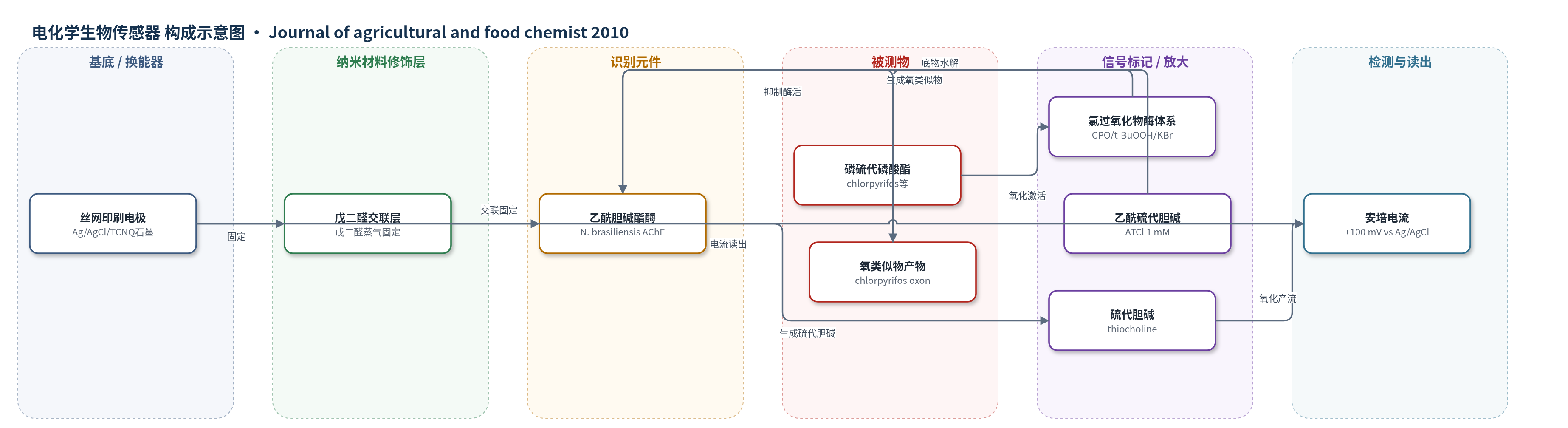
点击图片查看大图 · 依据论文自动绘制
传感器类型
电化学生物传感器
检测对象
磷硫代磷酸酯农药(phosphorothionate pesticides,如chlorpyrifos毒死蜱、triazophos三唑磷、fenitrothion、methidathion甲拌磷、parathion methyl);样品基质:有机橙汁(organic orange juice)
检测原理
磷硫代磷酸酯含P=S键,对AChE抑制弱。CPO在叔丁基过氧化氢(t-BuOOH)和KBr存在下催化卤素氧化,将P=S转化为P=O的oxon形式,使其磷酸化AChE活性位点丝氨酸的能力显著增强。预处理后的样品与固定AChE生物传感器孵育,oxon农药浓度越高,AChE被抑制越严重。随后加入乙酰硫代胆碱氯化物(ATCl),剩余AChE催化其水解生成硫代胆碱(thiocholine)。thiocholine在石墨工作电极+100 mV处被氧化,产生安培电流。因此农药浓度升高导致电流下降,实现电化学检测。
检测灵敏度
LOD: 5 μg/L(橙汁样品最终浓度 25 μg/L);线性范围: 5–75 μg/L(20%有机橙汁);R = 0.9845
效应效果
方法在有机橙汁中直接检测毒死蜱,无需溶剂提取,总时长约2 h。CPO可将毒死蜱和三唑磷完全氧化,fenitrothion、methidathion和parathion methyl转化率为54%–61%;KBr体系优于KCl,0.2 M KBr对AChE仅造成8.8%抑制,而KCl至1.0 M无影响。空白CPO/t-BuOOH/KBr体系不抑制AChE。加标橙汁中5 μg/L毒死蜱可检出,对应食品最终浓度25 μg/L,低于欧盟50 μg/kg限量。5个电极间CV为4.53%,单电极重复RSD为1.5%。相比GC/HPLC-MS和QuECHERS提取,该方法更快速、低成本,适合食品筛查。
传感器的构成
- 换能器电极:丝网印刷一次性生物传感器,含Ag/AgCl参比电极和7,7,8,8-四氰基对二甲苯(TCNQ)石墨工作电极,用于安培检测
- 识别元件:巴西纽虫乙酰胆碱酯酶B野生型(AChE B WT, N. brasiliensis),固定于工作电极,催化ATCl水解并被oxon农药抑制
- 固定层:戊二醛蒸气交联(glutaraldehyde vapor),将AChE固定在工作电极表面
- 底物/信号前体:乙酰硫代胆碱氯化物(ATCl, 1 mM),被AChE水解生成硫代胆碱(thiocholine)
- 检测介质:10 mM醋酸缓冲液含50 mM NaCl,pH 7.5,维持酶活性并提供离子环境
- 样品预处理体系:氯过氧化物酶(CPO, Caldariomyces fumago)、叔丁基过氧化氢(t-BuOOH/t-b HP)和KBr,在1 M醋酸缓冲液pH 5.5中将磷硫代磷酸酯氧化为oxon
中文摘要
乙酰胆碱酯酶(AChE)负责水解神经递质乙酰胆碱,可被有机磷和氨基甲酸酯类农药抑制;但磷硫代磷酸酯类农药对AChE的抑制很弱,导致其分析检测困难。本文开发了一种基于氯过氧化物酶(CPO)预处理和AChE生物传感器检测的酶促方法,可直接用于食品样品,无需繁琐的溶剂提取步骤。来自Caldariomyces fumago的CPO与叔丁基过氧化氢(t-BuOOH)及两种卤化物联用,可将磷硫代磷酸酯氧化为活性更高的oxon形式。结果显示,毒死蜱(chlorpyrifos)和三唑磷(triazophos)可被完全氧化;fenitrothion、methidathion和parathion methyl的转化率为54%–61%。将氧化后的样品用于AChE生物传感器检测时,加标于有机橙汁中的毒死蜱经氧化后,其oxon产物可被检测至5 μg/L(食品样品最终浓度为25 μg/L)。整个方法耗时约2 h。
英文摘要
Acetylcholinesterase (AChE) is responsible for the hydrolysis of acetylcholine in the nervous system. It is inhibited by organophosphate and carbamate pesticides. However, this enzyme is only slightly inhibited by organophosphorothionates, which makes the detection of these pesticides analytically very difficult. A new enzymatic method for the activation and detection of phosphorothionates was developed with the capability to be used directly in food samples without the need of laborious solvent extraction steps. Chloroperoxidase (CPO) from Caldariomyces fumago was combined with tert-butyl hydroperoxide and two halides. Chlorpyrifos and triazophos were completely oxidized. Fenitrothion, methidathion and parathion methyl showed conversion rates between 54 and 61%. Furthermore, the oxidized solution was submitted to an AChE biosensor assay. Chlorpyrifos spiked in organic orange juice was oxidized, where its oxon product was detected in concentrations down to 5 microg/L (final concentration food sample: 25 microg/L). The complete duration of the method takes about 2 h.