组成图示
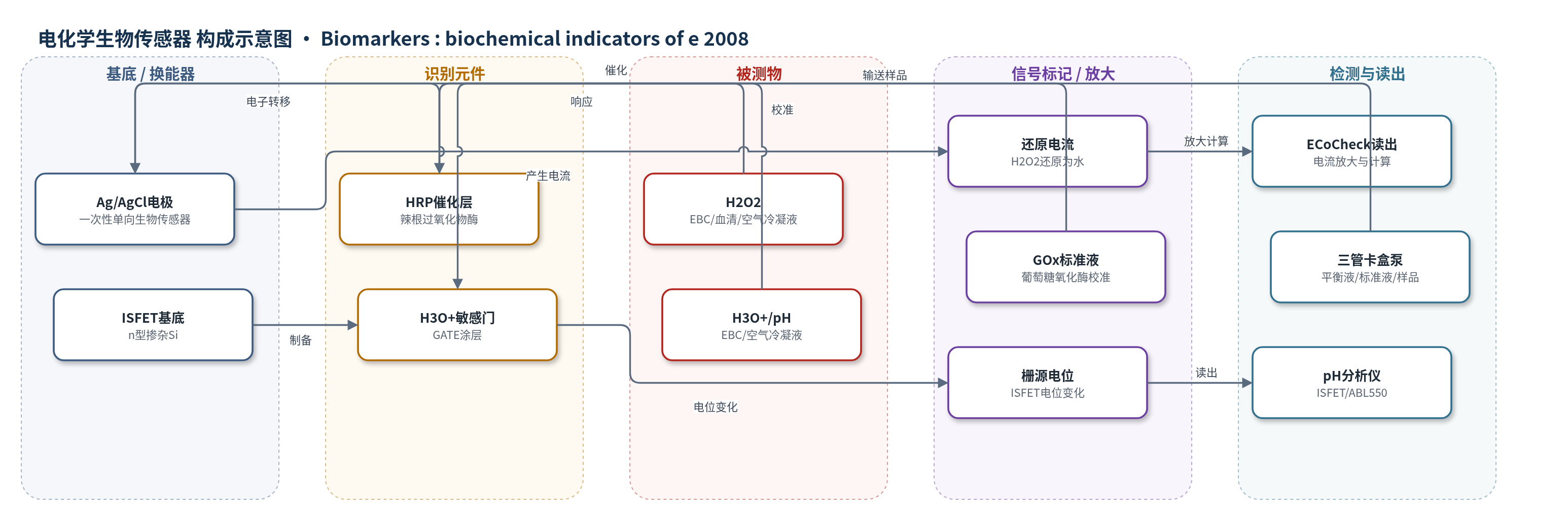
点击图片查看大图 · 依据论文自动绘制
传感器类型
电化学生物传感器
检测对象
过氧化氢(H2O2)、氢离子/酸碱度(pH, H3O+);样品基质:呼出气冷凝液(EBC)、血清/血液、环境空气冷凝液
检测原理
H2O2检测采用ECoCheck葡萄糖基电化学生物传感器:样品中的H2O2在Ag/AgCl电极上经HRP催化还原为水,电子转移产生与H2O2浓度成正比的电流;三管卡盒中的葡萄糖/GOx标准液生成H2O2用于校准,仪器放大电流并计算浓度。pH检测采用ISFET:H3O+敏感GATE膜使栅极电位随H3O+浓度变化,源漏电流或栅源电位被读出;ABL 550则用玻璃H3O+电极与甘汞参比电极测电位差。信号随被测物浓度单调变化,H2O2电流随浓度升高而增大,pH电位随H3O+活度变化。
检测灵敏度
LOD: >20 nmol l−1;线性范围: 至 4000 nmol l−1;H2O2 准确度: ±20 nmol l−1;pH 准确度: ±0.01;pH 回归: pH1=0.89+0.84 pH2,r=0.89,R^2=79.3%,p<0.001
效应效果
H2O2在144份EBC中142份可测,范围24–2270 nmol/L EBC,按100 L呼出气重算为0.04–3.24 nmol/100 L;个体间差异显著,个体内4周重复性良好,进食后升高,与呼吸变量和血清H2O2无相关。环境空气H2O2低于EBC,但昼夜升高,过滤器可改变浓度。pH方面,ISFET与ABL 550结果可比(r=0.89,R2=79.3%,p<0.001),非脱气EBC pH为5.3–6.5(ISFET 5.43–6.46,均值5.79±0.21;ABL 5.34–6.37,均值5.74±0.20),个体间无显著差异,晚间高于早晨,与血清pH无相关。作者主张按100 L呼出气标准化并扣除吸入室内H2O2,pH应采集后立即测定。
传感器的构成
- 换能器电极:银/氯化银(Ag/AgCl)一次性单向生物传感器电极,将H2O2还原反应转换为电流。
- 催化识别元件:辣根过氧化物酶(HRP),催化H2O2还原为水并产生与浓度成正比的电流。
- 校准信号液:葡萄糖/葡萄糖氧化酶(GOx)标准液,在卡盒中生成H2O2用于校准。
- 平衡液路:平衡液(equilibration solution),用于传感器测量前平衡。
- 样品液路:EBC、环境空气冷凝液或稀释血清样品,经高精度泵输送至传感器。
- pH换能器(ISFET):n型掺杂源/漏接触(SOURCE/DRAIN)与H3O+敏感门极(GATE)涂层,配合参考电极检测pH。
- pH玻璃电极系统:玻璃H3O+电极(G707)与甘汞参比电极(K606),用于ABL 550血气分析仪。
中文摘要
本研究为兽医方法学评价,旨在进一步标准化呼出气冷凝液(EBC)中过氧化氢(H2O2)和pH的测定。采用ECoScreen在健康犊牛(体重63–98 kg)中采集EBC,并平行采集血清和环境室内空气冷凝液。EBC、血液和环境空气中的H2O2用ECoCheck生物传感器系统测定。结果显示,EBC中H2O2浓度受进食影响,并随时间显著升高;06:00最低浓度为138–624 nmol/L EBC,或0.10–0.94 nmol/100 L呼出气,个体间差异显著,但同一动物4周内3天重复性良好。EBC-H2O2与血液H2O2无相关,也不受自主呼吸变量影响。作者认为标准化需按100 L呼出气重算浓度,并扣除吸入室内H2O2。pH测定中,ISFET电极与ABL 550血气分析仪结果可比(r=0.89,R2=79.3%,p<0.001);非脱气EBC pH为5.3–6.5,个体间无显著差异,但晚间高于早晨,且与血清pH无相关。
英文摘要
This veterinary study is aimed at further standardization of H(2)O(2) and pH measurements in exhaled breath condensate (EBC). Data obtained in the study provide valuable information for many mammalian species including humans, and may help to avoid general pitfalls in interpretation of EBC data. EBC was sampled via the 'ECoScreen' in healthy calves (body weight 63-98 kg). Serum samples and condensates of ambient (indoor) air were collected in parallel. In the study on H(2)O(2), concentrations of H(2)O(2) in EBC, blood and ambient air were determined with the biosensor system 'ECoCheck'. In EBC, the concentration of H(2)O(2) was found to be dependent on food intake and increased significantly in the course of the day. Physiologically, lowest H(2)O(2) concentrations at 06:00 varied within the range 138-624 nmol l(-1) EBC or 0.10-0.94 nmol per 100 l exhaled breath and individual concentrations were significantly different indicating a remarkable intersubject variability. Highly reproducible results were seen within each subject (three different days within 4 weeks). No correlation existed between H(2)O(2) concentrations in EBC and blood, and EBC-H(2)O(2) was not influenced by variables of spontaneous breathing. Further results confirmed that standardization of H(2)O(2) measurements in EBC requires (1) the re-calculation of the concentration exhaled per 100 l exhaled breath (because the analyzed concentration in the liquid condensate underlies multiple methodological sources of variability given by the collection process), and (2) subtracting the concentration of inspired indoor H(2)O(2). In the study on pH use of the ISFET electrode (Sentron, the Netherlands) and a blood gas analyzer ABL 550 (Radiometer, Denmark) led to comparable results for EBC-pH (r=0.89, R(2)=79.3%, p<or=0.001). Physiological pH data in non-degassed EBC samples varied between 5.3 and 6.5, and were not significantly different between subjects, but were significantly higher in the evening compared with the morning. EBC-pH was not dependent on variables of spontaneous breathing pattern or ambient conditions, and no significant correlation was found between serum and EBC for pH.