组成图示
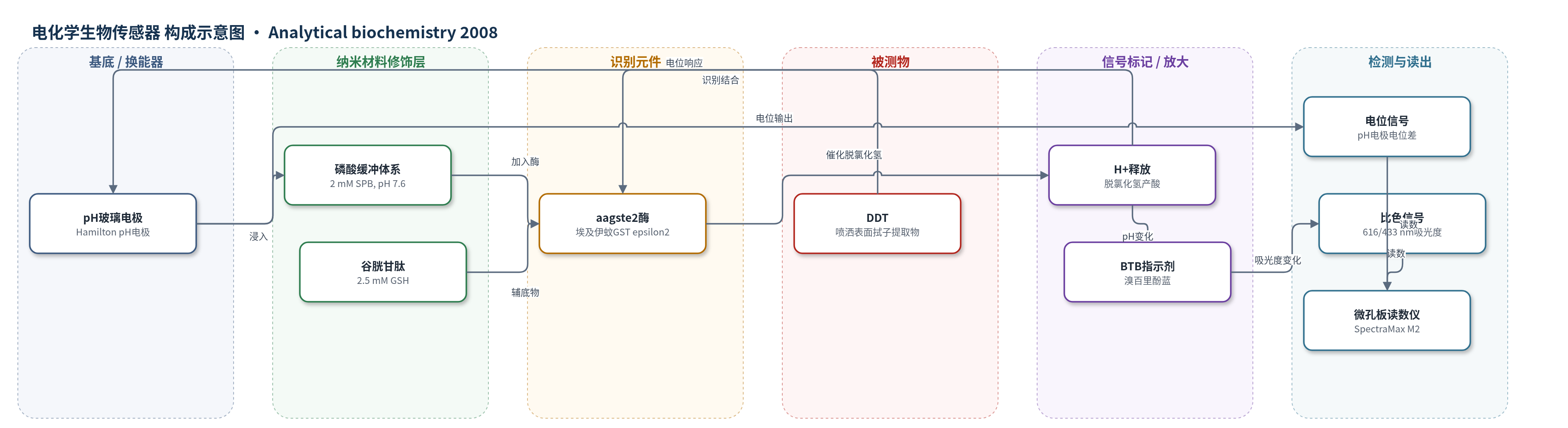
点击图片查看大图 · 依据论文自动绘制
传感器类型
电化学生物传感器
检测对象
DDT(p,p'-DDT,1,1,1-trichloro-2,2-bis(p-chlorophenyl) ethane);样品基质:DDT喷洒瓷砖表面拭子提取物(乙酸乙酯/己烷提取、乙腈溶解)
检测原理
aagste2作为识别与催化元件,特异性结合p,p'-DDT并催化其脱氯化氢反应,生成H+和Cl-。在2 mM磷酸钠缓冲液(SPB)低缓冲容量体系中,H+累积使溶液pH下降。pH玻璃电极将H+活度变化转换为电位差;若加入溴百里酚蓝(BTB),pH变化引起指示剂由蓝变黄,616/433 nm吸光度差随之改变。反应动力学呈双相,快相速率与初始DDT浓度呈线性关系,因此电位或比色信号随DDT浓度增加而增大。该方法依靠酶催化产酸实现信号放大,无需额外标记或核酸扩增。
检测灵敏度
LOD: 3.8 μg/ml;LOQ: 11.5 μg/ml;线性范围: 12–250 μg/ml;比色线性范围: 20–100 μg/ml;R^2 = 0.98
效应效果
该方法对o,p'-DDT、DDE、dicofol以及多种拟除虫菊酯类杀虫剂均无反应,表现出对p,p'-DDT的高选择性和抗干扰能力。电位法pH响应的相对标准偏差约为±5%(n=4)。对12个DDT喷洒瓷砖表面拭子进行盲测,生物传感器结果与HPLC定量结果高度一致,相关系数R2=0.98。定量下限11.5 μg/mL约相当于0.1 cm2喷洒表面的DDT量,低于WHO推荐的100–200 μg/cm2喷洒剂量,足以检测小于1 cm2表面的残留。作者认为该酶体系稳定、成本低、操作简便,适合现场质量控制,可支持非洲室内残留喷洒项目的DDT监测和疟疾控制。
传感器的构成
- 换能器电极:单孔玻璃pH电极(Hamilton),将H+浓度变化转换为电位信号
- 反应缓冲层:2 mM磷酸钠缓冲液(SPB,pH 7.6)与10 mM NaCl,维持反应环境并降低缓冲容量
- 辅底物层:2.5 mM还原型谷胱甘肽(GSH),作为aagste2催化DDT脱氯化氢反应的辅底物
- 识别催化元件:埃及伊蚊谷胱甘肽S-转移酶epsilon 2(aagste2/GST),特异性识别并催化p,p'-DDT
- 信号指示剂:溴百里酚蓝(BTB),随pH变化发生蓝-黄颜色/吸光度变化,用于比色读出
- 样品基质:DDT喷洒瓷砖表面拭子提取物(乙酸乙酯/己烷提取、乙腈溶解),提供被测DDT
- 读出装置:SpectraMax M2微孔板读数仪或pH电位计,记录616/433 nm吸光度差或电位差
中文摘要
本研究利用埃及伊蚊(Aedes aegypti)谷胱甘肽S-转移酶epsilon 2(aagste2/GST)建立了一种高特异性DDT检测方法。该酶在田间被选择为DDT代谢抗性关键酶,可特异性催化DDT发生脱氯化氢反应。检测原理是反应过程中伴随释放H+,在适当缓冲体系中引起pH变化,并通过pH电极电位法或加入pH指示剂后的比色法进行监测。该方法的理论检出限为3.8 μg/mL,线性定量范围为12–250 μg/mL。方法不能识别生物活性DDT类似物或主要DDT光降解及分解产物,对具有杀虫活性的p,p'-DDT具有高度特异性。作者用DDT喷洒表面拭子对该生物传感器进行验证,结果与高效液相色谱(HPLC)相比具有良好重复性和可靠性,相关系数R2=0.98。鉴于DDT在非洲疟疾媒介室内残留喷洒中的扩大应用,该简便方法可用于监测喷洒表面DDT水平,对疟疾媒介控制具有重要意义。
英文摘要
A glutathione S-transferase (GST) from the mosquito Aedes aegypti (aagste2), selected in the field as a major metabolic resistance enzyme for this parasite vector, was employed to produce a highly specific assay for the determination of DDT [1,1,1-dichloro-2,2-bis(p-chlorophenyl)ethylene]. Detection is based on the pH change occurring in an appropriate buffer system by the concomitant release of H(+) during the aagste2-catalyzed dehydrochlorination reaction and is monitored potentiometrically or colorimetrically in the presence of a pH marker. The theoretical limit of detection (LOD) of the assay is 3.8 microg/ml, and the linear range of quantification is 12 to 250 microg/ml. The method does not recognize biologically inactive DDT analogues or major DDT photodegradants and breakdown molecules, and it is highly specific for the insecticidal p.p'DDT [1,1,1-trichloro-2,2-bis(p-chlorophenyl) ethane]. The biosensor was validated with a number of insecticide swabs from DDT-sprayed surfaces and found to be reproducible and reliable as compared with high-performance liquid chromatography (HPLC) (correlation coefficient R(2)=0.98). Given the current expansion of DDT residual sprayings in many regions of Africa as a key strategic intervention for malaria vector control, this simple assay to monitor DDT levels for vector control spraying programs could have an important impact on malaria control.