组成图示
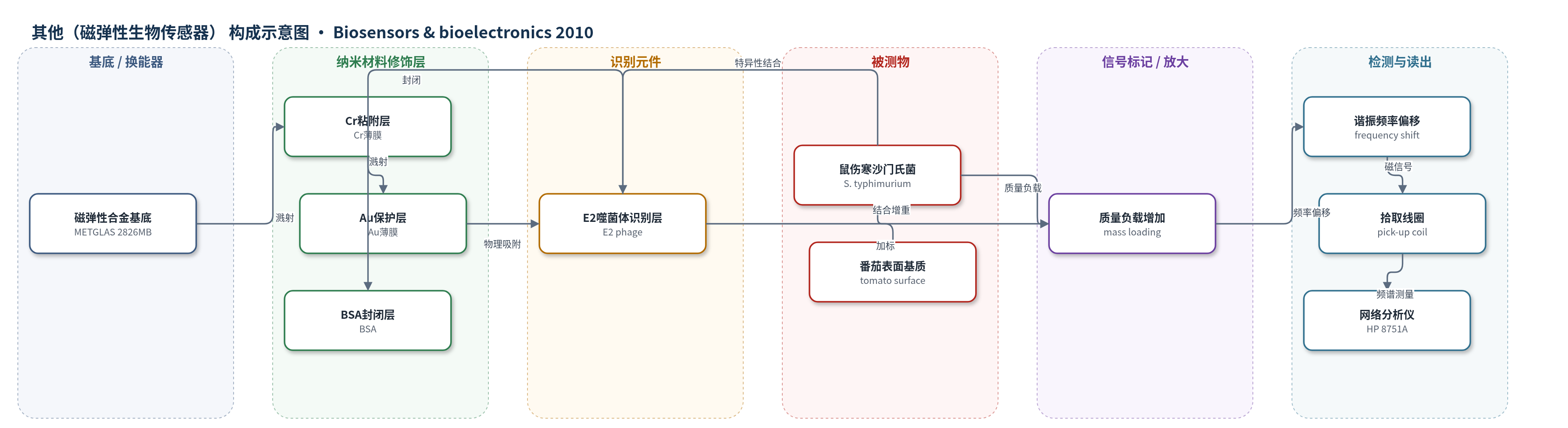
点击图片查看大图 · 依据论文自动绘制
传感器类型
其他(磁弹性生物传感器)
检测对象
鼠伤寒沙门氏菌(Salmonella typhimurium, S. typhimurium);样品基质:新鲜番茄表面(fresh tomato surface)
检测原理
该传感器基于磁弹性(ME)谐振器的质量负载效应。METGLAS 2826MB合金在交变磁场中发生磁致伸缩形变,产生纵向机械振动,其基频由长度、杨氏模量、密度和泊松比决定。E2噬菌体固定于Au表面作为识别元件,当传感器接触番茄表面时,噬菌体特异性捕获鼠伤寒沙门氏菌,使谐振器表面质量增加。附加质量Δm引起谐振频率下降,Δf与Δm成正比,灵敏度Sm=Δf/Δm=−1/(4L^2wt)√(E/[ρ^3(1−ν^2)])。谐振器振动同时辐射磁信号,由外部拾取线圈远程接收,网络分析仪读取频率谱。细菌浓度越高,结合细胞越多,质量负载越大,频率偏移越大;无噬菌体对照传感器仅发生少量非特异结合,用于补偿环境漂移。
检测灵敏度
未报告LOD、线性范围、灵敏度斜率或相关系数。
效应效果
SEM图像证实测量传感器表面密集结合鼠伤寒沙门氏菌,而对照传感器仅见少量细胞、灰尘和盐残留,表明E2噬菌体具有特异性。对5×10^8 CFU/ml加标番茄,单个测量传感器频率偏移达6325 Hz,对照传感器仅275 Hz。多传感器统计显示,加标浓度≥5×10^2 CFU/ml时测量与对照响应差异置信度>80%;其中5×10^6 CFU/ml时p=0.002664、置信度99.73%,5×10^7 CFU/ml时p=0.012172、置信度98.78%,5×10^5 CFU/ml时p=0.01188、置信度98.81%。由于番茄表面细菌分布不均,单传感器响应波动较大,需多传感器部署。未报告稳定性、RSD、回收率及与ELISA/PCR对比;作者主张其可用于生鲜食品现场实时检测,无需水洗采样。
传感器的构成
- 基底/换能器:METGLAS® 2826MB 磁弹性合金条带(0.028 mm×0.2 mm×1 mm),作为ME谐振器平台,在交变磁场下产生机械振动与特征谐振频率。
- 界面粘附层:Cr 溅射薄膜,提高合金基底与Au层的结合。
- 保护/生物相容层:Au 溅射薄膜,提供防腐蚀和噬菌体固定表面。
- 识别元件:丝状E2噬菌体(filamentous E2 phage),由f8/8噬菌体库亲和筛选,工程化特异性结合S. typhimurium,物理吸附固定于Au表面。
- 封闭剂:BSA(牛血清白蛋白,1 mg/ml),封闭非特异性结合位点。
- 对照传感器:相同ME平台、Cr/Au层和BSA封闭,但不含E2噬菌体,用于补偿环境变化与非特异性结合。
- 读出系统:HP 8751A网络分析仪与拾取线圈(pick-up coil),无线测量谐振频率。
中文摘要
现有细菌检测需采样并在实验室制备分析,费时费力且成本高,只能检测有限样品。本文报道基于噬菌体的磁弹性(ME)生物传感器直接检测新鲜番茄表面鼠伤寒沙门氏菌(Salmonella typhimurium)。传感器由涂覆工程化丝状E2噬菌体的ME谐振器平台构成,E2噬菌体可特异性结合目标菌。ME传感器为无线传感器,通过磁场驱动和检测谐振频率;尺寸为0.028 mm×0.2 mm×1 mm。番茄表面加标5×10^1–5×10^8 CFU/ml菌悬液并风干后,在潮湿环境中将测量传感器和对照传感器直接置于表面30 min。对照传感器不含噬菌体,二者均用BSA封闭。放置前后测量谐振频率,测量传感器出现频率偏移,对照变化可忽略。SEM验证了特异性结合。统计分析显示,加标浓度≥5×10^2 CFU/ml时测量与对照响应统计显著不同,证明可在生鲜食品表面直接检测食源性细菌。
英文摘要
Current bacterial detection methods require the collection of samples followed by preparation and analysis in the laboratory, both time and labour consuming steps. More importantly, because of cost, only a limited number of samples can be taken and analyzed. This paper presents the results of an investigation to directly detect Salmonella typhimurium on fresh tomato surfaces using phage-based magnetoelastic (ME) biosensors. The biosensor is composed of a ME resonator platform coated with filamentous E2 phage, engineered to bind with S. typhimurium. The ME biosensors are wireless sensors, whose resonance oscillation and resonance frequency are actuated and detected through magnetic fields. The sensors used in this study were 0.028 mm×0.2 mm×1 mm in size. In this study, the tomato surface was spiked with S. typhimurium suspensions with concentrations ranging from 5×10(1) to 5×10(8)CFU/ml and then allowed to dry in air. The detection was conducted by directly placing ME measurement biosensors and control sensors on the spiked surface for 30 min in a humid environment. The control sensors were identical to the measurement biosensors, but without phage. Both measurement and control sensors were blocked with BSA to reduce non-specific binding. The resonance frequencies of both measurement and control sensors were measured prior to and after the placement of the sensors on the tomato. Shifts in the resonance frequency of the measurement biosensors were observed, while the control sensors showed negligible change. Scanning electron microscopy (SEM) was used to verify the specific binding of S. typhimurium to the biosensor. Results of multiple biosensor detection and corresponding analyzes showed statistically different responses between the measurement and control sensors for tomatoes spiked with S. typhimurium suspensions with concentrations of 5×10(2)CFU/ml and greater. This study demonstrates the direct detection of food-borne bacteria on fresh produce.