组成图示
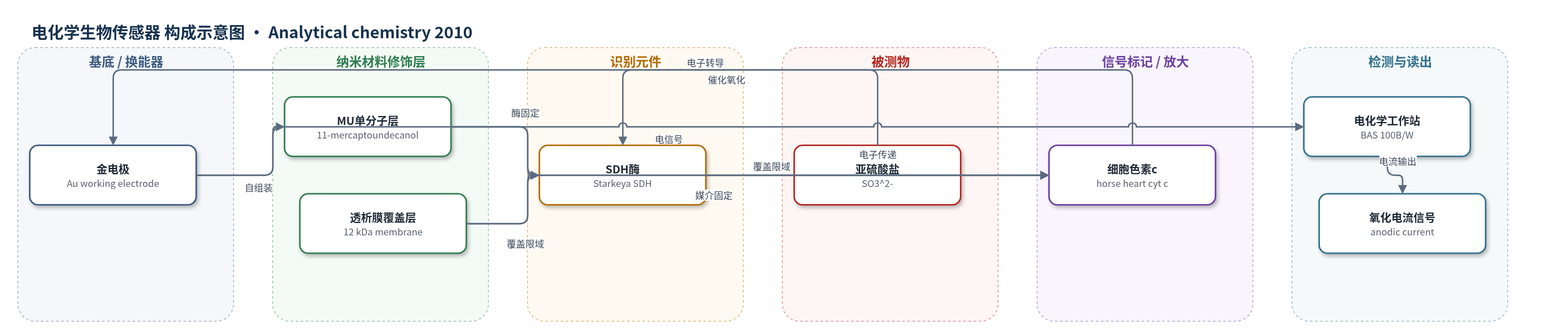
点击图片查看大图 · 依据论文自动绘制
传感器类型
电化学生物传感器
检测对象
亚硫酸盐(sulfite, SO3^2-);样品基质:啤酒、白葡萄酒、Tris 缓冲标准液
检测原理
亚硫酸盐进入酶层后被 SDH 特异性识别并催化氧化为硫酸盐;SDH 活性中心 Mo(VI) 的赤道氧配体转移给亚硫酸盐,Mo 被还原为 Mo(IV),随后两个电子经血红素辅基依次传递给细胞色素 c,使 cyt c 还原。电极在正电位下将还原态 cyt c 氧化回 Fe(III),实现电子从酶到电极的介导传递;cyt c 的再生使催化电流持续放大,形成 ECcat 过程。稳态下阳极电流随亚硫酸盐浓度增加而增大,低浓度呈线性,高浓度趋于饱和,符合 Michaelis-Menten 动力学。
检测灵敏度
LOD: 44 pM (S/N = 3);线性范围: 1–6 µM (correlation coefficient = 0.9995);线性范围: 0.5–5.5 µM;KM,app: 43 µM
效应效果
该传感器对亚硫酸盐具有酶特异性,啤酒与白葡萄酒中未观察到其他电活性物质干扰。重复使用 10 次阳极峰电流 RSD 为 1%;3 个独立电极 10 次重复 RSD 也为 1%。4 °C Tris 缓冲液中保存 3 天响应无明显下降,2 周仅损失约 4% 灵敏度。实际样品采用标准加入法,结果与 Ellman 试剂分光光度法一致:陈年白葡萄酒 135 对 140 µM,新鲜啤酒 133 对 132 µM,陈年啤酒 26 对 27 µM,中等强度陈年啤酒 27 对 26 µM,RSD 2–3%。其 44 pM 检出限优于其他酶基亚硫酸盐传感器(1 µM、50 µM、0.5 µM),分析仅需数分钟,且不受样品颜色/浊度影响。
传感器的构成
- 基底/换能器电极:金电极(Au working electrode,3 mm),经机械、化学和电化学清洗,作为电子转导基底
- 自组装单分子层:11-巯基十一醇(11-mercaptoundecanol, MU)自组装单分子层(SAM),在金表面形成界面,促进细胞色素 c 直接电子转移
- 识别/催化元件:Starkeya novella 亚硫酸盐脱氢酶(SDH),特异性催化亚硫酸盐氧化为硫酸盐,并将电子传递给细胞色素 c
- 电子媒介/信号元件:马心脏细胞色素 c(horse heart cytochrome c, cyt c),作为可逆氧化还原蛋白媒介,在电极与 SDH 间传递电子并产生电催化电流
- 覆盖/限域层:半透透析膜(perm-selective dialysis membrane,MW cutoff ca. 12 kDa),覆盖电极表面,防止蛋白流失并维持微环境
- 固定/密封件:聚四氟乙烯帽(Teflon cap)和橡胶 O 形圈(rubber O-ring),压紧透析膜并固定电极表面
- 储存/缓冲介质:50 mM Tris 缓冲液(pH 8.0),维持酶活性与电极储存
中文摘要
本文报道一种高灵敏、稳定的电化学(伏安法)亚硫酸盐生物传感器,由 Starkeya novella 亚硫酸盐脱氢酶(SDH)、马心脏细胞色素 c(cyt c)以及修饰在金电极上的 11-巯基十一醇(MU)自组装单分子层组成。作者对 pH 和 cyt c/SDH 比例进行了优化。在酶修饰电极上,亚硫酸盐的电催化氧化电流在 1–6 µM 范围内线性增加,相关系数为 0.9995,表观 Michaelis 常数为 43 µM。采用恒电位安培法时,亚硫酸盐检出限为 44 pM(信噪比 S/N = 3)。该修饰电极在 50 mM Tris 缓冲液、4 °C 条件下保存 2 周仅损失约 4% 的初始灵敏度,3 天内响应保持稳定。该酶电极成功用于啤酒和白葡萄酒中亚硫酸盐的测定,电化学分析结果与使用 Ellman 试剂的独立分光光度法一致,但电化学方法的检出限显著更低。
英文摘要
This paper describes a highly sensitive electrochemical (voltammetric) determination of sulfite using a combination of Starkeya novella sulfite dehydrogenase (SDH), horse heart cytochrome c (cyt c), and a self-assembled monolayer of 11-mercaptoundecanol (MU) cast on a gold electrode. The biosensor was optimized in terms of pH and the ratio of cyt c/SDH. The electrocatalytic oxidation current of sulfite increased linearly from 1 to 6 microM at the enzyme-modified electrode with a correlation coefficient of 0.9995 and an apparent Michaelis constant (K(M,app)) of 43 microM. Using an amperometric method, the low detection limit for sulfite at the enzyme-modified electrode was 44 pM (signal-to-noise ratio = 3). The modified electrode retained a stable response for 3 days while losing only ca. 4% of its initial sensitivity during a 2 week storage period in 50 mM Tris buffer solution at 4 degrees C. The enzyme electrode was successfully used for the determination of sulfite in beer and white wine samples. The results of these electrochemical analyses agreed well with an independent spectrophotometric method using Ellman's reagent, but the detection limit was far superior using the electrochemical method.