组成图示
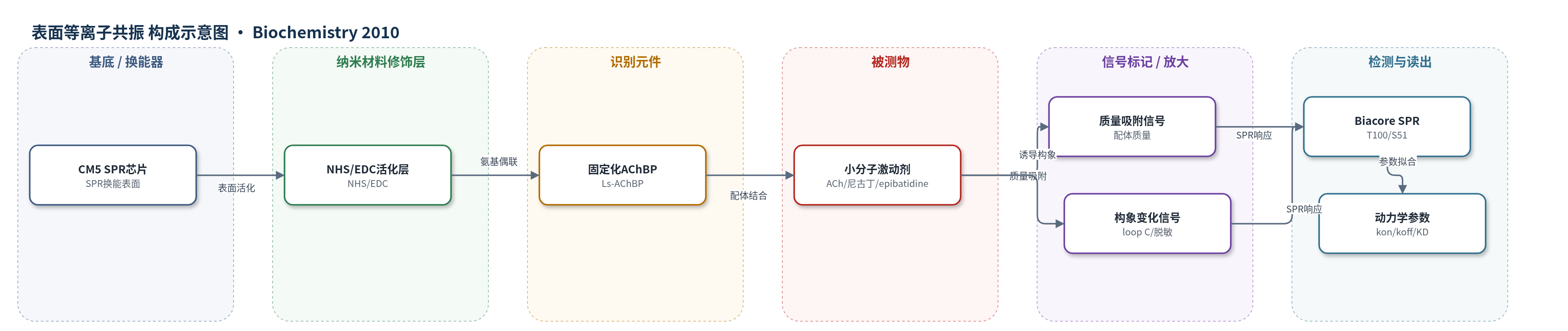
点击图片查看大图 · 依据论文自动绘制
传感器类型
表面等离子共振(SPR)生物传感器
检测对象
乙酰胆碱(acetylcholine, ACh)、尼古丁(nicotine)、epibatidine、奎宁环衍生物(quinuclidine analogues 1–5);样品基质为 SPR 流动相缓冲液(10 mM sodium phosphate、137 mM NaCl、3 mM KCl、0.05% Tween,部分含 5% DMSO)
检测原理
固定化 AChBP 通过 NHS/EDC 氨基偶联于 CM5 SPR 芯片表面,乙醇胺封闭后,小分子激动剂随流动相流过芯片。配体与 AChBP 结合位点结合后,一方面引起界面质量吸附,改变金表面附近折射率;另一方面诱导 AChBP 发生构象变化,包括 loop C 快速适应和缓慢脱敏态转变,进一步改变光学厚度。SPR 仪器通过监测反射光共振角变化,将上述界面变化转换为响应单位(RU)信号。配体浓度升高时结合量增加,信号上升并趋于饱和;停止注入后配体解离,信号回落。由于结合速率极快,数据拟合需加入质量传输限制项;未使用酶或核酸放大,信号主要来自直接质量吸附与构象诱导的 SPR 响应。
检测灵敏度
原文未报告 LOD、线性范围、灵敏度斜率或 R^2;报告 KD(0% DMSO):乙酰胆碱 458 ± 39 nM,尼古丁 40.7 ± 9.9 nM,epibatidine 0.0835 ± 0.0303 nM;5% DMSO:乙酰胆碱 3850 ± 980 nM,尼古丁 310 ± 61 nM,epibatidine 2.67 ± 1.34 nM;奎宁环 1–5:4250 ± 910、345 ± 40、141 ± 47、53.5 ± 45、12.8 ± 4.3 nM。
效应效果
该 SPR 测定法可稳定使用约 100 个循环,结合能力损失不超过 20%;单表面约需 2 μg AChBP,固定量可达 10 kRU,交联后 20 kRU,表观结合容量约 50–70%。亲和力与文献一致:乙酰胆碱 458 对 823 nM,尼古丁 40.7 对 45.2 nM,epibatidine 0.0835 对 0.16 nM。5% DMSO 降低亲和力与结合容量,epibatidine/尼古丁约 20–40%,乙酰胆碱约 40–70%。动力学极快并受质量传输限制,仅尼古丁在含 DMSO 条件下可估算 kon/koff。归一化 Rmax 与分子体积相关(r=0.86),与亲和力相关较弱(r=0.54)。作者认为可用于 Cys-loop 受体机制研究和药理配体筛选。
传感器的构成
- 基底/换能器:CM5 SPR 芯片,提供表面等离子共振换能表面与流动池
- 活化/偶联层:NHS/EDC(N-hydroxysuccinimide 与 N-ethyl-N'-(dimethylamino)propyl carbodiimide)活化 CM5 表面,用于 AChBP 氨基共价偶联
- 识别元件:固定化 AChBP(Lymnaea stagnalis acetylcholine-binding protein),作为 Cys-loop 受体胞外域模型,识别小分子激动剂
- 交联层(可选):NHS/EDC 交联固定化 AChBP,减少乙醇胺封闭时蛋白损失并提高固定量至约 20 kRU
- 封闭剂:乙醇胺(ethanolamine,1 M,pH 8.5),封闭未反应表面
中文摘要
本研究以淡水螺 Lymnaea stagnalis 的乙酰胆碱结合蛋白(AChBP)作为 Cys-loop 配体门控离子通道胞外域模型,采用乙酰胆碱、尼古丁、epibatidine 及一系列取代奎宁环化合物作为配体,建立了基于表面等离子共振(SPR)生物传感器的直接相互作用测定方法。该方法可实时表征固定化 AChBP 与小分子激动剂之间的结合动力学,并监测蛋白结构动态。结果显示,AChBP 与激动剂的相互作用对实验条件高度敏感,并呈现多种复杂性,可解析为两种具有不同动力学的配体诱导二级效应,分别对应快速和缓慢的构象变化。作者通过机制模型解释数据,并结合诱导契合对接与环柔性分子模拟获得结构解释。结果表明,AChBP 存在配体诱导的结构动态,符合 Cys-loop 受体门控机制;AChBP 与配体初始 encounter complex 的形成非常快,满足神经传递所需的功能特征。所建立的方法有助于进一步研究 Cys-loop 受体功能机制,并筛选可用于药理研究的特异性配体。
英文摘要
The mechanism of agonist interactions with Cys-loop ligand-gated ion channels has been studied using the acetylcholine-binding protein (AChBP) from Lymnaea stagnalis as a model protein and acetylcholine, nicotine, epibatidine, and a series of substituted quinuclidines as ligands. A biosensor-based assay for direct interaction studies of immobilized AChBP and small molecule ligands was developed. It allowed the characterization of the interaction kinetics of the ligands and the structural dynamics of the protein. The interactions with AChBP were very sensitive to variations in the experimental conditions and showed several types of complexities. These could be resolved into two types of ligand-induced secondary effects with different kinetics, representing fast and slow conformational changes. The data could be rationalized in a mechanistic model, and a structural interpretation of the interaction was obtained by molecular modeling involving induced fit and loop flexibility simulations. The data suggest that AChBP exhibits ligand-induced structural dynamics, as expected for the ligand gating mechanism of Cys-loop receptors. It shows that the formation of the initial encounter complex between AChBP and ligands is very rapid, in accordance with the functional characteristics required of neurotransmission. These developed procedures will enable further exploration of the mechanism of Cys-loop receptor function and the identification of specific ligands suitable for pharmacological use.