组成图示
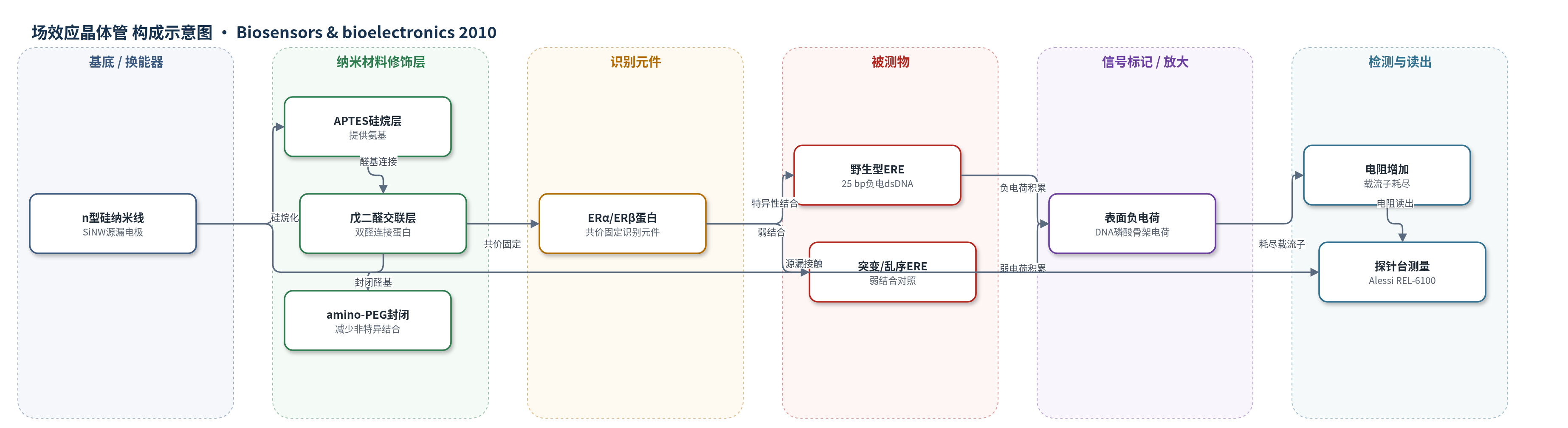
点击图片查看大图 · 依据论文自动绘制
传感器类型
场效应晶体管(FET)生物传感器
检测对象
雌激素反应元件双链DNA(estrogen-response element, ERE;wt-ERE、mut-ERE、non-ERE);样品基质:SSC缓冲液(孵育用6× SSC,测量用0.01× SSC)
检测原理
传感器以 n 型 SiNW 为电阻换能器,ERα/ERβ 经 APTES 和戊二醛共价固定于表面,amino-PEG 封闭非特异位点。当带负电的 25 bp 双链 ERE 与表面 ER 特异性结合时,DNA 磷酸骨架的负电荷在 SiNW 表面积累,使 n 型 SiNW 体内电子耗尽、导电性下降,源漏电阻增加。结合量随 ERE 浓度升高而增加,因此电阻变化幅度随浓度增大;突变或乱序 ERE 结合弱,响应较小。低离子强度 0.01× SSC 测量缓冲增大德拜长度,减少电荷屏蔽,提高灵敏度。0.1% SDS 可解离 ERE,实现传感器再生。
检测灵敏度
LOD: 10 fM;浓度响应: 1 fM–1 pM(1 pM: ~26.0%,100 fM: ~16.3%,10 fM: ~6.4%,1 fM: ~3.3%)
效应效果
传感器能区分 ERE 序列:1 pM wt-ERE 使 ERα 功能化 SiNW 电阻增加约 26.0%,mut-ERE 约 8.9%,non-ERE 约 1.9%;ERβ 功能化时 wt-ERE、mut-ERE、non-ERE 分别约 29.9%、19.3%、7.7%,说明 ERα 序列特异性高于 ERβ。孵育盐浓度影响结合,6× SSC 最佳,10× SSC 使响应降低约 22.7%,0.01× SSC 降低约 25.7%。测量缓冲 0.01× SSC 响应约 26.0%,0.1× SSC 约 11.1%,1× SSC 约 7.0%。0.1% SDS 处理 5 min 可恢复基线,传感器可再生一次,第二次响应减小,第三次无变化。结果与 SPR 方法一致,但可检测 fM 水平 ERE。
传感器的构成
- 基底/换能器:n型硅纳米线(SiNW),由硅梁自限制氧化制备,作为电阻换能器
- 源漏电极:源(S)漏(D)金属接触,用于单独寻址和测量 SiNW 电阻
- 硅烷修饰层:3-氨基丙基三乙氧基硅烷(APTES),在 SiNW 表面提供氨基
- 交联层:戊二醛(glutaraldehyde),双醛基连接 APTES 氨基与 ER 蛋白
- 识别元件:人重组雌激素受体 ERα/ERβ,共价固定于表面,特异性结合 ERE
- 封闭层:O-(2-氨基乙基)-O′-甲基聚乙二醇750(amino-PEG),封闭未反应醛基,降低非特异结合
- 测量介质:0.01× SSC 低离子强度缓冲液,增大德拜长度,减少电荷屏蔽
中文摘要
为深入理解雌激素受体(ER)在基因表达调控中的作用,必须表征雌激素受体与雌激素反应元件(ERE)之间的相互作用。本文报道了一种高灵敏、可重复使用的硅纳米线(SiNW)生物传感器,用于研究人 ERα 和 ERβ 亚型蛋白与双链 ERE 的相互作用。ER 蛋白通过硅烷化学共价固定于 n 型 SiNW 表面,随后将野生型、突变型和乱序型 ERE 施加到蛋白功能化表面。由于双链 DNA 带负电,ERE 与 ER 结合后在 SiNW 表面积累负电荷,导致 n 型 SiNW 载流子耗尽、电阻增加。结果表明,ERE–ERα 结合的特异性高于 ERE–ERβ,突变 ERE 会降低其与 ERα 和 ERβ 的结合亲和力。将不同浓度野生型 ERE 作用于 ERα 功能化 SiNW 时,10 fM 的野生型 ERE 即可被检测到。通过结合与解离实验实现了 ERα 与野生型 ERE 的可逆相互作用,表明该传感器可重复用于蛋白–DNA 结合研究。该工作建立了 SiNW 生物传感器作为研究激素受体–反应元件相互作用的有前景方法。
英文摘要
To thoroughly understand the role that estrogen receptors partake in regulation of gene expression, characterization of estrogen receptors (ERs) and estrogen-response elements (EREs) interactions is essential. In the work, we present a highly sensitive and reusable silicon nanowire (SiNW) biosensor to study the interactions between human ER proteins (ER, α and β subtypes) and EREs (dsDNA). The proteins were covalently immobilized on the SiNW surface. Various EREs including wild-type, mutant and scrambled DNA sequences were then applied to the protein-functionalized SiNW surface. Due to negatively charged dsDNA, binding of the EREs to the ERs on the n-type SiNW biosensor leads to the accumulation of negative charges on the surface, thereby inducing increase in resistance. The results show that the specificity of the ERE-ERα binding is higher than that of the ERE-ERβ binding, what is more, the mutant ERE reduces the binding affinity for both ERα and ERβ. By applying various concentrations of wild-type ERE to the bound ERα, a very low concentration of 10 fM wild-type ERE was found to be able to bind to the ERα. The reversible association and dissociation between ERα and wt-ERE was achieved, pointing to a reusable biosensor for protein-DNA binding. Through the study, we have established the SiNW biosensor as a promising method in providing comprehensive study for hormone receptor-response element interactions.