组成图示
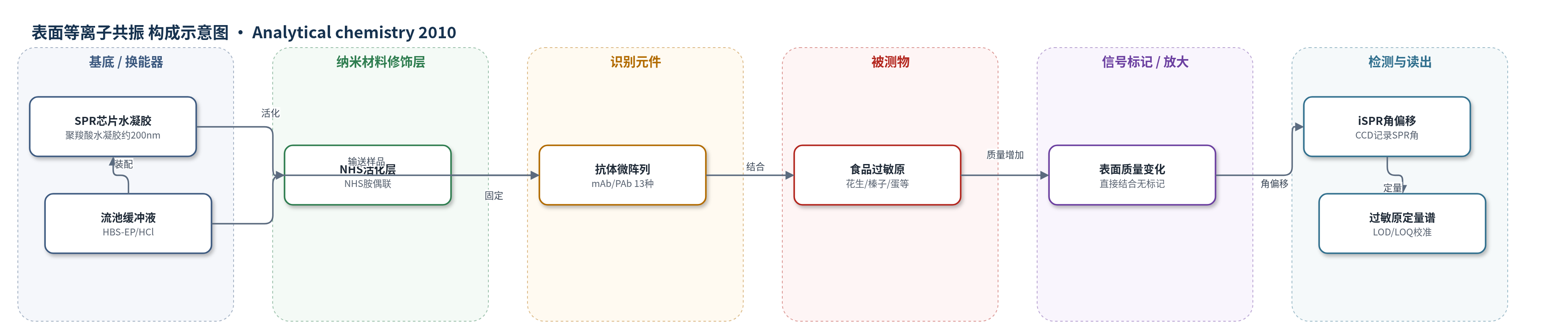
点击图片查看大图 · 依据论文自动绘制
传感器类型
表面等离子共振(SPR)生物传感器
检测对象
花生蛋白(peanut protein)、榛子蛋白(hazelnut protein)、κ-酪蛋白(κ-casein,牛奶)、大豆蛋白(soy protein)、蛋蛋白(egg protein)、羽扇豆蛋白(lupine protein)、杏仁蛋白(almond protein)、澳洲坚果蛋白(macadamia nut protein)、巴西坚果蛋白(brazil nut protein)、松子蛋白(pine nut protein)、开心果蛋白(pistachio nut protein)、腰果蛋白(cashew nut protein)、山核桃蛋白(pecan protein);样品基质:饼干提取物、黑巧克力提取物。
检测原理
iSPR芯片表面先以NHS活化聚羧酸水凝胶,再经连续流微流控点样固定13种过敏原特异性抗体,形成空间编码的抗体微阵列。食品提取物中的过敏原蛋白进入流池后,与对应抗体发生特异性识别并结合,使芯片局部表面质量/折射率发生变化。该界面变化改变表面等离子共振条件,导致共振角发生偏移;iSPR仪器用CCD相机对不同区域成像,从角度-强度曲线提取各斑点的SPR角偏移。最大角偏移随被测过敏原浓度增加而增大,经非线性单阶段结合模型拟合得到浓度。方法为直接检测,不使用标记物、信号放大或洗脱步骤,多路复用依靠微阵列空间编码实现。
检测灵敏度
LOD(饼干/黑巧克力,mg kg-1):花生 3.2/3.9;κ-酪蛋白 0.2/na;羽扇豆 0.8/0.6;蛋 0.5/0.8;榛子 1.5/4.6;杏仁 1.9/1.5;澳洲坚果 1.6/2.9;巴西坚果 0.6/0.4;松子 0.5/0.6;开心果 1/0.8;腰果 0.4/0.9;山核桃 1.5/5;大豆 5/na(大豆饼干值由缓冲液计算)。校准浓度范围: 0.1–10 mg L-1;最佳工作范围: <2 mg L-1。
效应效果
芯片选择性良好:花生、κ-酪蛋白、蛋、榛子抗体交叉反应<1%;羽扇豆、大豆、杏仁及部分坚果中等;腰果与开心果互有交叉,山核桃作通用结合阳性对照。芯片稳定,完成>200次测量后响应才下降;7条校准曲线各含20次进样。食品基质影响较小,蛋响应不变,花生在黑巧克力中略低。LOD达低mg kg-1,与ELISA/Biacore相当。7种饼干和3种黑巧克力验证中,iSPR榛子结果与定性/定量ELISA一致,无假阴性;并发现标签未标坚果/蛋及花生/牛奶标示错误。单周期12 min可定量12种过敏原,适合高通量、在线监测。
传感器的构成
- 基底/换能器:SPR芯片(玻璃棱镜与流池)及约200 nm线性聚羧酸水凝胶(linear polycarboxylate hydrogel),承载抗体并产生SPR角偏移。
- 活化层:N-羟基琥珀酰亚胺(NHS)预活化,形成酯基用于抗体胺基共价偶联。
- 识别元件:13种过敏原抗体微阵列(mAb/PAb),包括抗花生mAb 51-12D2、抗榛子mAb 48-10F3m、抗κ-酪蛋白mAb 33-4G10、抗大豆mAb 3G12、抗羽扇豆PAb MH22、抗蛋PAb MH7等,经连续流微流控点样(CFM)固定。
- 封闭层:0.5 M乙醇胺(ethanolamine,pH 8.5)封闭未反应酯基,降低非特异结合。
- 样品接触层:HBS-EP缓冲液(Hepes、NaCl、EDTA、P20)输送食品提取物,使过敏原直接结合抗体。
- 再生层:10 mM HCl(pH 2)洗脱结合物,恢复芯片表面用于重复测量。
- 信号读出:IBIS iSPR仪器与CCD相机,通过扫描SPR角并记录角偏移(m°)实现定量。
中文摘要
食物过敏是日益严重的健康问题,目前约影响4%成人和8%婴儿。为保护消费者,法规要求食品标签披露主要过敏原,但现有监测方法费时、费力且昂贵,尤其多过敏原筛查困难。本研究将成像表面等离子共振(iSPR)与抗体微阵列结合,用于食品过敏原的快速、定量、多组分检测。该方法可在单次测量中通过空间编码的抗体阵列同时识别多种过敏原,并在短时间内提供完整过敏原谱,且灵敏度满足食品检测需求。作者以不同厂家饼干和黑巧克力样品验证方法适用性,并用酶联免疫吸附测定(ELISA)测定榛子含量,结果与iSPR测定值良好相关。该新方法为自动化、高通量食品过敏原分析提供途径,有助于提高食品标签准确性和消费者安全。
英文摘要
Food allergy is a growing health concern, which currently affects approximately 4% of adults and 8% of infants. For consumer protection purposes, food producers are required by law to disclose on the product label whether a major allergen is used during the production process. The commonly employed monitoring methods are highly laborious, time-consuming, and often expensive when screening for multiple allergens. Here, we utilize imaging surface plasmon resonance (iSPR) in combination with antibody array for rapid, quantitative, and multianalyte food allergens detection. We demonstrate how the use of this technology provides a complete allergen profile within short measurement time and with adequate sensitivity. The successful applicability of this approach is demonstrated by analyzing cookies and dark chocolate products from different manufacturers. Hazelnut content of the tested food products is also determined by enzyme linked immunosorbent assay and is found to correlate well with the hazelnut content determined by iSPR. This newly developed method opens the door to automated and high-throughput allergen analysis, ultimately aiming at providing the consumer with safer food.