组成图示
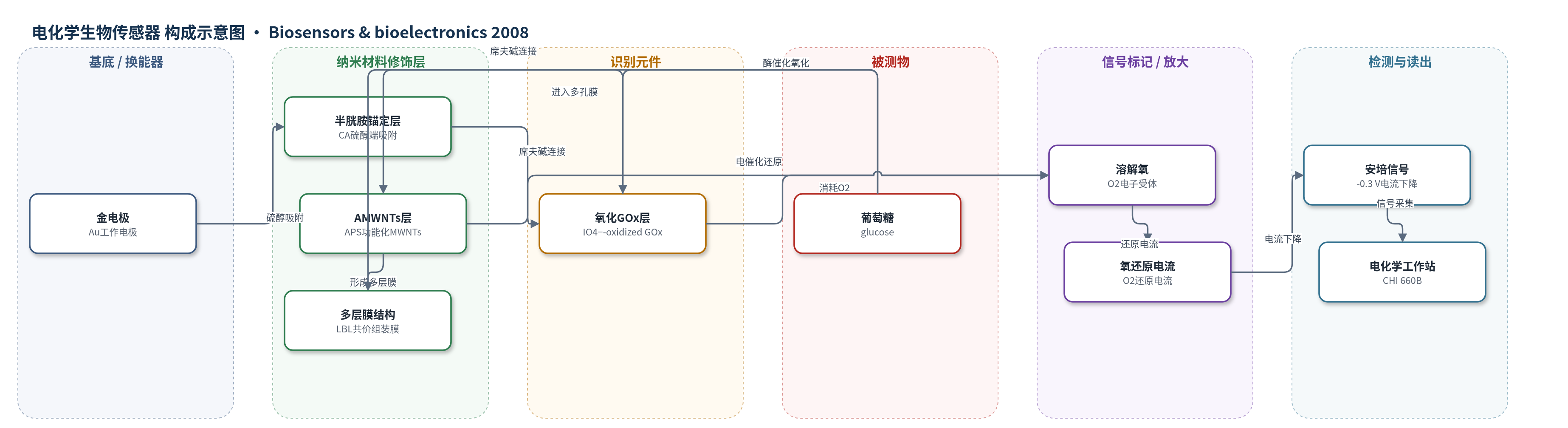
点击图片查看大图 · 依据论文自动绘制
传感器类型
电化学生物传感器
检测对象
葡萄糖(glucose),样品基质为空气饱和0.1 M磷酸盐缓冲液(PBS, pH 6.82)
检测原理
该传感器以Au电极为基底,先吸附半胱胺(CA)暴露氨基,再与高碘酸氧化葡萄糖氧化酶(IO4−-oxidized GOx)及氨基功能化多壁碳纳米管(AMWNTs)通过席夫碱反应层层共价组装,形成多孔导电多层膜。检测时,葡萄糖进入膜内并被GOx催化氧化为葡萄糖-δ-内酯,同时消耗溶解氧(O2)生成过氧化氢(H2O2)。AMWNTs具有电催化还原O2的能力,可显著降低氧还原过电位。在-0.3 V下,O2在电极表面还原产生还原电流;葡萄糖浓度升高导致O2消耗增加,氧还原电流随之下降。电流下降值与葡萄糖浓度在一定范围内线性相关。该体系无需外加人工介质,低电位工作减少干扰,多层结构提高酶负载和电子传递,使灵敏度可调。
检测灵敏度
LOD: 8.0 μM(S/N = 3);线性范围: 0–7.0 mM;灵敏度: 7.46 μA mM−1 cm−2;R^2 = 0.996
效应效果
该传感器在-0.3 V下对葡萄糖选择性良好,0.1 mM抗坏血酸、0.1 mM尿酸和1 mM对乙酰氨基酚均无干扰,且无需人工介质或选择性膜。响应时间小于10 s;4层电极灵敏度为7.46 μA mM−1 cm−2,高于Au纳米颗粒-GOx多层传感器(3.9 μA mM−1 cm−2)和PDDA交联GOx/SDS-MWNTs传感器(5.6 μA mM−1 cm−2)。灵敏度随双层层数可调:2、3、4层分别为2.27、4.95和7.46 μA mM−1 cm−2。4°C存储3周无明显下降,1个月后保留约90%初始灵敏度;连续循环100次电流稳定。作者认为其可用于准确、快速、低成本的葡萄糖检测。
传感器的构成
- 基底/换能器电极:金电极(Au electrode),直径2.0 mm、面积0.032 cm2,作为工作电极与电子传导基底
- 界面锚定层:半胱胺(cystamine, CA),硫醇端化学吸附于Au表面并暴露氨基,用于共价连接GOx
- 识别元件:高碘酸氧化葡萄糖氧化酶(IO4−-oxidized GOx),表面醛基与CA或AMWNTs氨基形成席夫碱,催化葡萄糖氧化并消耗O2
- 纳米材料修饰层:氨基功能化多壁碳纳米管(AMWNTs),由氧化MWNTs经3-氨基丙基三乙氧基硅烷(APS)硅烷化得到,提供氨基、导电通道、多孔结构并电催化还原O2
- 信号介质:溶解氧(O2),作为天然电子受体,其还原电流随葡萄糖消耗O2而下降
- 缓冲介质:0.1 M磷酸盐缓冲液(PBS, pH 6.82),提供支持电解质环境
- 读出系统:CHI 660B电化学工作站,三电极体系(Au工作电极、铂丝辅助电极、饱和甘汞电极SCE),在-0.3 V安培法读取电流
中文摘要
采用3-氨基丙基三乙氧基硅烷(APS)作为硅烷偶联剂,通过硅烷化法制备氨基功能化多壁碳纳米管(AMWNTs)。将AMWNTs与高碘酸氧化葡萄糖氧化酶(IO4−-oxidized GOx)通过无交联剂的层层共价自组装方法构建葡萄糖生物传感器。扫描电镜显示组装的AMWNTs主要呈小束或单根纳米管形态,其表面密度随GOx/AMWNTs双层层数均匀增加;伏安信号分析表明每层GOx覆盖量线性增加。所得传感器对溶解氧的电化学还原具有优异催化活性,可在低过电位下方便地监测葡萄糖浓度。酶电极对葡萄糖表现出良好的电催化响应,且响应随双层层数增加而增强,表明可通过调节沉积层数调控灵敏度和检出限。由4层GOx/AMWNTs构成的传感器灵敏度为7.46 μA mM−1 cm−2,检出限为8.0 μM,响应时间小于10 s。由于施加电位较低,其他可电氧化化合物的干扰被显著降低,选择性提高;GOx与AMWNTs之间的共价作用还赋予电极良好稳定性。
英文摘要
Multi-wall carbon nanotubes (MWNTs) functionalized with amino groups were prepared via silane treatment using 3-aminopropyltrimethoxysilane (APS) as a silane-coupling agent. The resultant amino terminated MWNTs (AMWNTs) were applied to construct glucose biosensors with IO(4)(-)-oxidized glucose oxidase (IO(4)(-)-oxidized GOx) through the layer-by-layer (LBL) covalent self-assembly method without any cross-linker. Scanning electron microscopy (SEM) indicated that the assembled AMWNTs were almost in a form of small bundles or single nanotubes, and the surface density increased uniformly with the number of GOx/AMWNTs bilayers. From the analysis of voltammetric signals, a linear increment of the coverage of GOx per bilayer was estimated. The resulting biosensor showed excellent catalytic activity towards the electroreduction of dissolved oxygen at low overvoltage, based on which glucose concentration was monitored conveniently. The enzyme electrode exhibited good electrocatalytic response towards the glucose and that response increased with the number of GOx/AMWNTs bilayers, suggesting that the analytical performance such as sensitivity and detection limit of the glucose biosensors could be tuned to the desired level by adjusting the number of deposited GOx/AMWNTs bilayers. The biosensor constructed with four bilayers of GOx/AMWNTs showed high sensitivity of 7.46 microA mM(-1)cm(-2) and the detection limit of 8.0 microM, with a fast response less than 10s. Because of relative low applied potential, the interference from other electro-oxidizable compounds was minimized, which improved the selectivity of the biosensors. Furthermore, the obtained enzyme electrodes also showed remarkable stability due to the covalent interaction between the GOx and AMWNTs.