组成图示
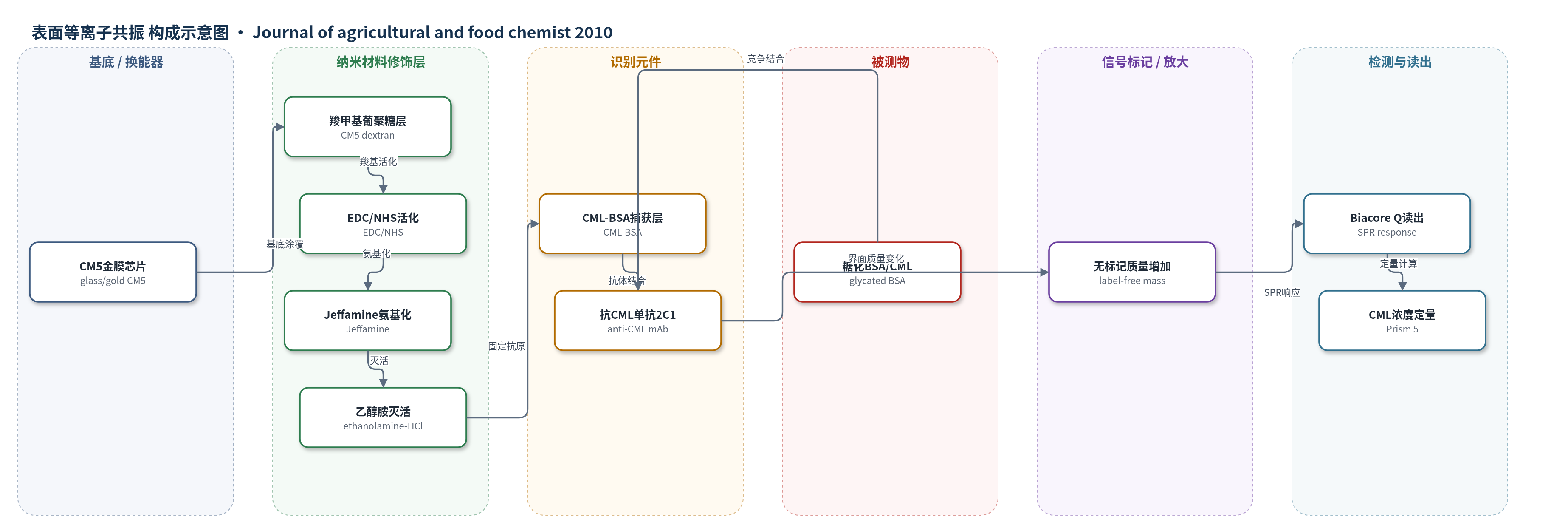
点击图片查看大图 · 依据论文自动绘制
传感器类型
表面等离子共振(SPR)生物传感器
检测对象
Nε-(羧甲基)赖氨酸(CML, Nε-(carboxymethyl)lysine);样品基质:葡萄糖-牛血清白蛋白(glucose-BSA / AGE-BSA)模型体系
检测原理
SPR芯片以CM5金膜/羧甲基葡聚糖为基底,经EDC/NHS活化、Jeffamine氨基化和乙醇胺灭活后共价固定CML-BSA捕获抗原。检测时,抗CML单克隆抗体2C1与含CML的糖化BSA样品混合,样品中CML-BSA与抗体结合,改变抗体在芯片CML-BSA表面的结合量。抗体-抗原结合引起金膜界面分子质量与折射率变化,Biacore Q通过表面等离子共振响应实时读出。样品CML含量越高,竞争占据抗体越多,芯片响应越低;以CML-BSA标准曲线定量。该方法为无标记免疫SPR检测,无酶促或核酸放大。
检测灵敏度
SPR: LOD: 1.7 μg CML/g BSA;LOQ: 17 μg CML/g BSA;校准范围: 0–3500 μg CML/g BSA;R^2 = 0.997。ELISA: LOD: 1.51 μg CML/g BSA;LOQ: 5.20 μg CML/g BSA。UPLC-MS/MS: LOD: 1.62 μg CML/g BSA;LOQ: 5.41 μg CML/g BSA。方法间相关: SPR vs ELISA R^2 = 0.977;UPLC-MS/MS vs SPR R^2 = 0.85;UPLC-MS/MS vs ELISA R^2 = 0.75。
效应效果
三种方法趋势一致,但绝对值不同:SPR测得CML为45–1603 μg/g BSA,ELISA为6–900 μg/g BSA,UPLC-MS/MS为194–1075 μg/g BSA;SPR比ELISA高1.6倍,UPLC-MS/MS比SPR低0.79倍、比ELISA高1.35倍。SPR与ELISA相关良好(R^2=0.977),UPLC-MS/MS与SPR、ELISA相关系数分别为0.85和0.75。批内CV<10%;SPR和UPLC-MS/MS批间CV<10%,ELISA部分样品达24%。单抗2C1对CML-BSA特异、不结合CEL-BSA。作者认为SPR无标记、试剂用量小、自动化和重复性较好,免疫化学法比UPLC-MS/MS更快速、低成本。
传感器的构成
- 基底/换能器:CM5传感器芯片(glass/gold CM5 chip),表面为羧甲基葡聚糖基质(carboxymethylated dextran),提供SPR光学换能与羧基固定位点
- 化学活化层:EDC/NHS活化羧基,Jeffamine引入氨基,乙醇胺盐酸盐(ethanolamine-HCl)灭活剩余位点,形成氨基功能化表面
- 固相捕获层:CML-BSA(Nε-(carboxymethyl)lysine-modified BSA)以1 mg/mL共价固定,提供CML表位捕获/竞争结合位点
- 液相识别元件:抗CML单克隆抗体2C1(anti-CML mAb 2C1),特异性识别CML-BSA表位
- 信号标记物:无标记(label-free),抗体-抗原结合引起芯片界面分子质量/折射率变化
- 缓冲与再生体系:HBS-EP缓冲液(HEPES/NaCl/EDTA/Polysorbate 20)维持结合条件,50 mM NaOH再生芯片表面
中文摘要
本研究比较了表面等离子共振(SPR)生物传感器、酶联免疫吸附测定(ELISA)和超高效液相色谱-串联质谱(UPLC-MS/MS)三种方法在葡萄糖-牛血清白蛋白(BSA)模型体系中检测Nε-(羧甲基)赖氨酸(CML)的能力,并考察R-生育酚、阿魏酸、芦丁、硫胺、硫胺单磷酸和硫胺焦磷酸等候选抗糖化剂对CML形成的抑制作用。结果显示,CML测定值随分析方法不同而变化:SPR生物传感器报告浓度最高,ELISA最低,但两种免疫化学方法之间呈高度相关。CML生成量取决于抑制剂种类和浓度;除R-生育酚外,阿魏酸、芦丁、硫胺及其磷酸化衍生物均能降低葡萄糖-BSA体系中CML的形成。
英文摘要
The present study was designed to compare surface plasmon resonance (SPR) biosensor, enzyme-linked immunosorbent assay (ELISA), and ultraperformance liquid chromatography-tandem mass spectrometry (UPLC-MS/MS) methods for the analysis of Nε-(carboxymethyl)lysine (CML) in glucose-bovine serum albumin (BSA) model systems and to investigate the possible inhibitory effect of selected compounds (α-tocopherol, ferulic acid, rutin, thiamin, thiamin monophosphate, and thiamin pyrophosphate) on CML formation. The reported levels of CML detected were dependent upon the method of analysis employed. The highest reported concentrations were obtained with the SPR biosensor, whereas the lowest were found by ELISA. However, a high correlation was observed between these two immunochemical procedures. CML concentrations were dependent upon the type and concentration of the candidate CML inhibitor. All inhibitory compounds investigated, with the exception of α-tocopherol, decreased the level of CML formation in the glucose-BSA system.