组成图示
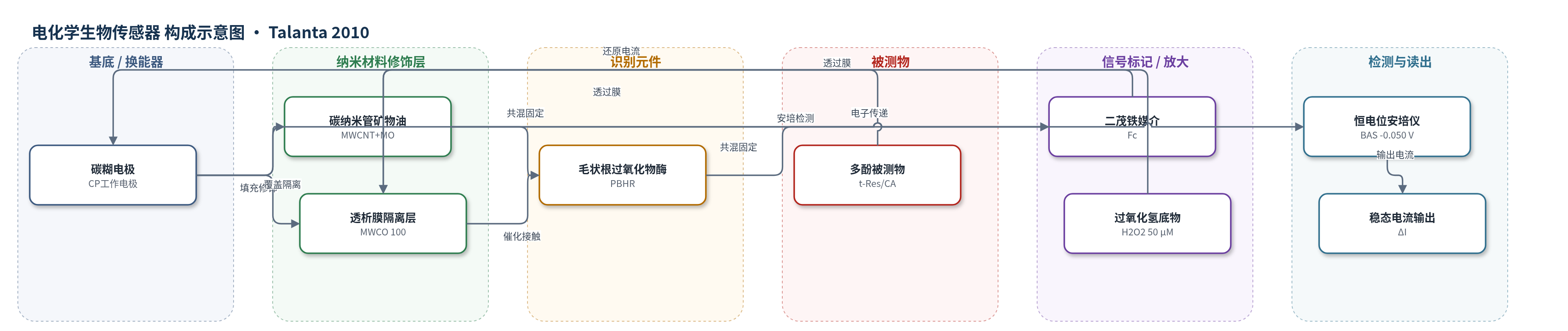
点击图片查看大图 · 依据论文自动绘制
传感器类型
电化学生物传感器
检测对象
总多酚含量(total polyphenolic content, TPC;以反式白藜芦醇 trans-resveratrol, t-Res 或咖啡酸 caffeic acid, CA 计);样品基质:葡萄酒(wine)、茶(tea)
检测原理
检测时,在 pH 7.00 磷酸盐缓冲液(PBS)中加入 H2O2 和 PBHR。PBHR 催化 H2O2 还原为水,同时氧化二茂铁(Fc)为 Fc+;电极在 −0.050 V vs SCE 下还原 Fc+,产生稳态安培电流。多酚类化合物作为电子供体,在溶液体相中还原 PBHR 并消耗 H2O2,使 Fc+ 生成量降低,Fc+ 还原电流随之下降。电流差 ΔI 与多酚浓度呈 Michaelis–Menten 型关系,在线性范围内用于校准。MWCNT+MO 提高电子传递速率,透析膜隔离电极表面,减少噪声和氧化多酚聚合物污染。
检测灵敏度
LOD: 0.023 mg L−1(t-Res,S/N=3:1);0.020 mg L−1(CA,S/N=3:1);线性范围: 0.05–52 mg L−1(t-Res);0.06–69 mg L−1(CA);灵敏度斜率: (9.08 ± 0.06) × 10−3 μA mg−1 L(t-Res);(5.44 ± 0.01) × 10−3 μA mg−1 L(CA);相关系数: r = 0.9997(t-Res);r = 0.9999(CA)
效应效果
传感器重现性(RSD)为 t-Res 7.0%、CA 8.4%,重复性为 4.1% 和 5.2%;同一电极连续使用约5天内斜率基本稳定,第10天下降约40%。抗干扰方面,亚硫酸氢钠至50 mg L−1、葡萄糖100 μmol L−1、抗坏血酸至60 mg L−1均无明显影响。实际葡萄酒和茶样品中,电化学法与 Folin–Ciocalteu 法结果线性相关,相关系数分别为0.9950(t-Res)和0.9949(CA),但 FC 法数值偏高,斜率为2.09±0.07和1.56±0.05。作者认为该方法样品量小、速度快、可测有色样品,适合食品总多酚快速筛查。
传感器的构成
- 工作电极基底:碳糊电极(carbon paste, CP)圆盘,直径1.6 mm,作为导电基底与安培换能器
- 导电纳米修饰层:多壁碳纳米管/矿物油(MWCNT + MO,55% MWCNT + 45% MO),增强电子传递并构成导电碳糊
- 催化识别元件:油菜毛状根过氧化物酶(PBHR),催化 H2O2 氧化多酚并参与 Fc 再生
- 电子媒介:二茂铁(Fc),在电极表面可逆氧化还原,传递酶反应电子
- 隔离封闭层:透析膜(dialysis membrane,截断分子量100),覆盖电极表面,减少噪声与氧化多酚聚合物污染
- 固定组件:特氟龙实验室膜(Teflon laboratory film)和 O 形圈(O-ring),将透析膜固定于电极体侧部
中文摘要
本文首次提出一种基于油菜(Brassica napus)毛状根过氧化物酶(PBHR)的安培生物传感器,用于测定葡萄酒和茶样品中的总多酚含量。该传感器采用碳糊电极(CP),其中填充 PBHR、二茂铁(Fc)以及嵌入矿物油的多壁碳纳米管(MWCNT + MO),并按特定组成制备为 PBHR–Fc–MWCNT + MO 电极。电极外表面覆盖透析膜,并用特氟龙实验室膜和 O 形圈固定在电极体侧部。以反式白藜芦醇(t-Res)或咖啡酸(CA)作为多酚标准参考物,通过稳态电流随浓度变化的校准曲线估算实际样品中的总多酚含量。t-Res 和 CA 的重现性分别为 7.0% 和 8.4%,重复性分别为 4.1% 和 5.2%。校准曲线在 0.05–52 mg L−1(t-Res)和 0.06–69 mg L−1(CA)范围内线性良好;信噪比为 3:1 时最低检测浓度分别为 0.023 mg L−1 和 0.020 mg L−1。
英文摘要
An amperometric biosensor based on peroxidases from Brassica napus hairy roots (PBHR) used to determine the total polyphenolic content in wine and tea samples is proposed by the first time. The method employs carbon paste (CP) electrodes filled up with PBHR, ferrocene (Fc), and multi-walled carbon nanotubes embedded in a mineral oil (MWCNT+MO) at a given composition (PBHR-Fc-MWCNT+MO). The biosensor was covered externally with a dialysis membrane, which was fixed at the electrode body side part with a Teflon laboratory film and an O-ring. Calibration curves obtained from steady-state currents as a function of the concentration of a polyphenolic standard reference compound such as t-resveratrol (t-Res) or caffeic acid (CA) were then used to estimate the total polyphenolic content in real samples. The reproducibility and the repeatability were of 7.0% and 4.1% for t-Res (8.4% and 5.2% for CA), respectively, showing a good biosensor performance. The calibration curves were linear in a concentration range from 0.05 to 52 mg L(-1) and 0.06 to 69 mg L(-1) for t-Res and CA, respectively. The lowest polyphenolic compound concentration values measured experimentally for a signal to noise ratio of 3:1 were 0.023 mg L(-1) and 0.020 mg L(-1) for t-Res and CA, respectively.