组成图示
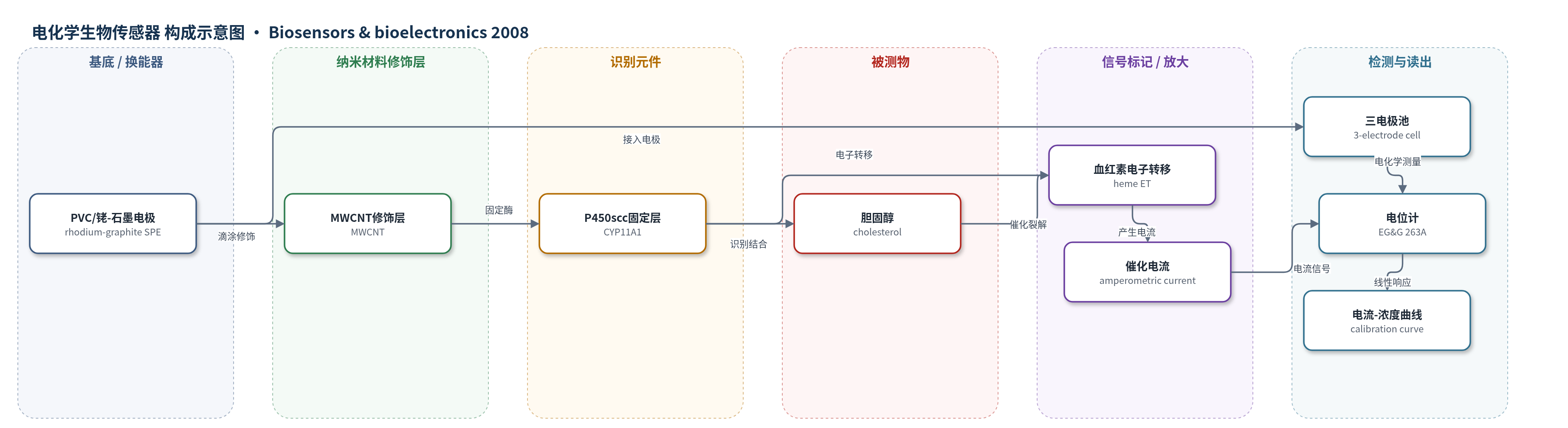
点击图片查看大图 · 依据论文自动绘制
传感器类型
电化学生物传感器
检测对象
胆固醇(cholesterol);样品基质为磷酸盐缓冲液(100 mM phosphate buffer, 50 mM KCl, pH 7.4),胆固醇以 30% 钠胆酸盐储备液加入。
检测原理
P450scc 对胆固醇具有高度特异性,可识别并催化其 C20–C22 侧链裂解,在氧存在下发生酶促反应。MWCNT 修饰层在铑–石墨电极表面形成导电纳米网络,缩短血红素铁与电极之间的电子转移距离,降低电子转移阻力,使酶促电子流直接转化为电流。在循环伏安或恒电位安培检测中,胆固醇浓度增加时,P450scc 催化产生的电流随之增大;在 −400 mV 下测得安培响应,电流与胆固醇浓度近似线性。MWCNT 中金属性碳管贡献更强电子转移,从而提高灵敏度并改善线性。
检测灵敏度
灵敏度斜率: 1.12 μA/(mM mm2);线性相关系数 R = 0.99(MWCNT)
效应效果
该传感器利用 P450scc 对胆固醇及其代谢物的高特异性识别,具有较高选择性。MWCNT 修饰使酶促氧化峰电流达 196 μA,较金纳米粒修饰提高 2.4 倍,较裸电极提高 17.8 倍;灵敏度为 1.12 μA/(mM mm2),与金纳米粒系统同数量级,但线性显著改善,MWCNT 系统线性相关系数 R=0.99,金纳米粒为 0.60,核黄素为 0.99。作者认为其灵敏度比近期基于胆固醇氧化酶/酯酶的系统高几个数量级,并与 FET 纳米线系统(388 μM 氧化 LDL 胆固醇产生 1 μA)相当,适合高灵敏胆固醇检测。
传感器的构成
- 基底/换能器电极:PVC 基底上的铑–石墨丝网印刷电极(rhodium–graphite screen-printed electrode),提供导电工作电极,面积 20 mm2。
- 绝缘层:Marastar SR 057 绝缘墨丝网印刷,隔离电极电路。
- 纳米材料修饰层:多壁碳纳米管(MWCNT)滴涂层,形成导电纳米网络,促进 P450scc 血红素与电极间电子转移。
- 识别/催化元件:细胞色素 P450scc(CYP11A1)固定层,特异性识别并催化胆固醇侧链裂解。
- 信号标记物:无外加标记物,P450scc 酶促电子转移直接产生电流。
中文摘要
本文研究了固定在纳米结构铑–石墨电极上的细胞色素P450scc(CYP11A1)的电子转移行为。多壁碳纳米管(MWCNT)通过滴涂法沉积到铑–石墨电极表面,随后将细胞色素P450scc沉积于MWCNT修饰电极上;同时,将P450scc分别沉积到金纳米粒修饰电极和裸铑–石墨电极上,以与前期工作比较。循环伏安结果表明,MWCNT修饰表面使酶活性增强最大,证实纳米管能够更有效地介导电极与细胞色素P450scc血红素之间的电子转移,其效果优于金纳米粒修饰体系。该体系用于胆固醇检测时,灵敏度比近期报道的基于胆固醇氧化酶和酯酶的系统高几个数量级。与金纳米粒相比,MWCNT使电子转移改善超过2.4倍;与裸电极相比改善17.8倍。传感器灵敏度为1.12 μA/(mM mm2),且响应线性优于金纳米粒体系。
英文摘要
This paper is concerned with an investigation of electron transfer between cytochrome P450scc (CYP11A1) immobilized on nanostructured rhodium-graphite electrodes. Multi-walled carbon nanotubes (MWCNT) were deposited onto the rhodium-graphite electrodes by drop casting. Cytochrome P450scc was deposited onto MWCNT-modified rhodium-graphite electrodes. Cytochrome P450scc was also deposited onto both gold nanoparticle-modified and bare rhodium-graphite electrodes, in order to have a comparison with our previous works in this field. Cyclic voltammetry indicated largest enhanced activity of the enzyme at the MWCNT-modified surface. The role of the nanotubes in mediating electron transfer to the cytochrome P450scc was verified as further improved with respect to the case of rhodium-graphite electrodes modified by the use of gold nanoparticles. The sensitivity of our system in cholesterol sensing is higher by orders of magnitude with respect to other similar systems very recently published that are based on cholesterol oxidase and esterase. The electron transfer improvement attained by the use of MWCNT in P450-based cholesterol biosensors was demonstrated to be larger than 2.4 times with respect to the use of gold nanoparticles and 17.8 times larger with respect to the case of simple bare electrodes. The sensitivity was equal to 1.12 microA/(mM mm(2)) and the linearity of the biosensor response was improved with respect to the use of gold nanoparticles.