组成图示
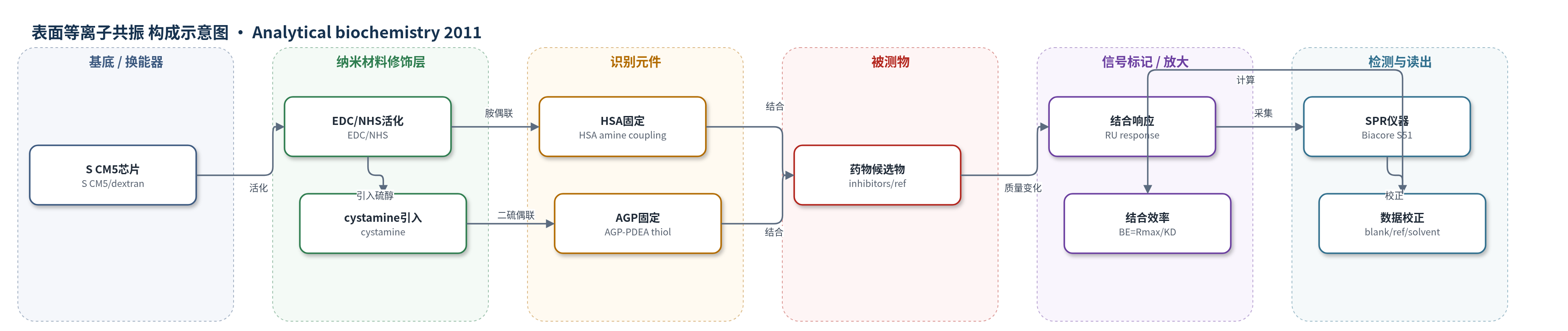
点击图片查看大图 · 依据论文自动绘制
传感器类型
表面等离子共振(SPR)生物传感器
检测对象
药物候选物(cathepsin K 抑制剂、HIV-1 蛋白酶抑制剂、HIV-1 逆转录酶抑制剂及参考化合物),样品基质:PBS 含 5% Me2SO(SPR 流动相);人血清用于超滤/细胞验证
检测原理
SPR 芯片的 dextran 表面经 EDC/NHS 活化后,分别以胺偶联固定 HSA 和以 PDEA/二硫-硫醇偶联固定 AGP。药物候选物随 PBS/5% Me2SO 流过表面,与蛋白结合或解离,使界面质量/折射率改变,Biacore S51 以共振单位 RU 实时读出。由于多数相互作用快速、弱亲和且存在多结合位点,传统 KD、kon、koff 常不可靠。作者将饱和曲线在低浓度下的斜率定义为结合效率 BE=Rmax/KD,并通过全浓度数据集非线性回归直接拟合,使信号变化可在未饱和条件下定量比较。数据经空白、参考和溶剂校正,并按分子量与固定量归一化。
检测灵敏度
原文未报告 LOD、线性范围、灵敏度斜率或相关系数。
效应效果
SPR 相互作用可逆且快速,无需再生;经空白、参考和溶剂校正降低非特异与折射率干扰。BE 由全浓度数据集非线性回归获得,表 1 为三次重复均值±标准差,显示可重复性。相比传统表观 KD 和速率常数,BE 在弱亲和、未饱和及多结合位点时更稳健,可比较约 100 倍亲和力差异,且浓度不超过 30 μM。与参考化合物排序显示多数抑制剂为低至中等 BE。与细胞/超滤数据整体无显著相关,但 AGP 慢解离的 HIV-1 PI 7 和 13 在 50% 人血清中 EC50 增加 132 和 121 倍,提示解离速率与血清效应相关。作者认为可用于早期药物发现中血清蛋白结合谱排序与构效关系分析。
传感器的构成
- 换能器基底:S CM5 SPR 芯片(dextran 基质),提供表面等离子共振信号与蛋白固定平台
- 活化层:EDC/NHS 活化 dextran 羧基,形成反应性 NHS 酯用于胺偶联或硫醇引入
- 识别元件(HSA 区):人血清白蛋白 HSA,经胺偶联固定,作为药物结合靶蛋白
- 识别元件(AGP 区):α1-酸性糖蛋白 AGP,经 PDEA 修饰后通过二硫/硫醇偶联固定,作为药物结合靶蛋白
- 交联/修饰剂:2-(2-pyridinyldithio)ethane amine (PDEA) 与 cystamine dihydrochloride,用于引入二硫键/硫醇并偶联 AGP
- 封闭/失活剂:ethanolamine 封闭 HSA 区未反应基团;PDEA/NaCl 失活 AGP 区未反应基团
- 信号读出:SPR 共振单位 RU,经空白、参考和溶剂校正后按分子量与固定量归一化
中文摘要
为建立高效、可靠地预测药物候选物血清蛋白结合的方法,作者利用表面等离子共振(SPR)生物传感器研究了若干化合物与人血清白蛋白(HSA)及α1-酸性糖蛋白(AGP)相互作用的动力学特性。传统基于合理机理模型、通过速率常数或亲和力进行定量的方法仅适用于少数化合物;部分化合物可估计主要相互作用的亲和力及低亲和力次要相互作用的贡献,但许多化合物无法用这些方法可靠定量。为此,作者提出类似酶“催化效率”的“结合效率”(binding efficiency, BE)概念,用于在弱亲和力、可溶浓度范围内未达饱和或次要结合位点干扰解释的情况下定量化合物结合。该策略还可识别具有较大分数结合的化合物,并相对参考化合物进行简单定量,从而实现对化合物血清蛋白结合谱的排序和构效关系识别。
英文摘要
To develop efficient and reliable methods for prediction of serum protein binding of drug leads, the kinetic characteristics for the interactions between selected compounds and human serum albumin and α₁-acid glycoprotein have been explored using a surface plasmon resonance biosensor. Conventional methods for quantification of interactions (i.e., using rate constants or affinities determined on the basis of a reasonable mechanistic model) were applicable for only a few of the compounds. The affinity of a primary interaction and the contribution of lower affinity secondary interactions could be estimated for some compounds, but the affinity of many compounds could not be quantified by either of these methods. To have a quantification method that could be used for all compounds, independent of affinity and complexity of interaction mechanisms, the concept of "binding efficiency," analogous to "catalytic efficiency" used for enzymes, was developed. It allowed the quantification of the binding of compounds interacting with weak affinity and for which saturation is not reached within a concentration range where the compound is soluble or when the influence of interactions with secondary sites makes interpretations difficult. In addition, compounds with large fractional binding can be identified by this strategy and simply quantified relative to reference compounds. This approach will enable ranking and identification of structure-activity relationships of compounds with respect to their serum protein binding profile.