组成图示
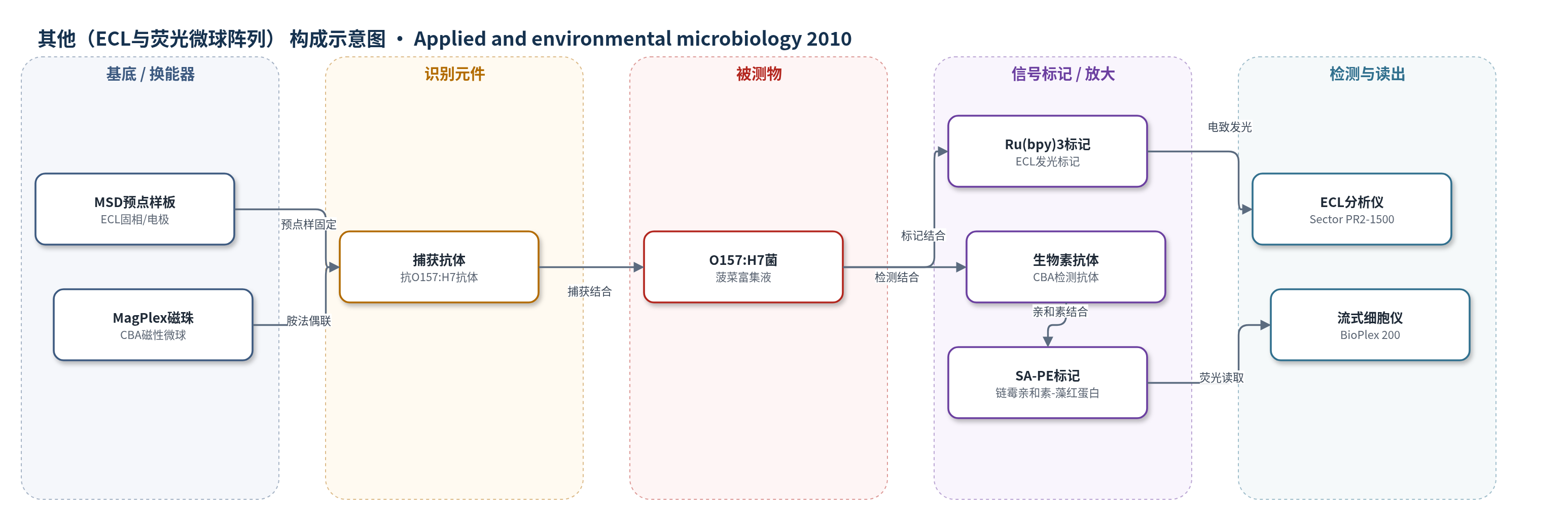
点击图片查看大图 · 依据论文自动绘制
传感器类型
其他(ECL与荧光微球阵列)
检测对象
大肠杆菌O157:H7(Escherichia coli O157:H7),样品基质为菠菜冲洗液/富集液(spinach rinse/enriched mBPWp)及人工污染菠菜叶。
检测原理
两种方法均基于抗体识别。ECL系统中,抗O157:H7抗体预点样于MSD板,目标菌结合后,Ru(bpy)3^2+标记抗体/偶联物结合形成免疫复合物;电极施加电位使Ru(bpy)3^2+发生氧化还原电子转移并释放光子,光信号强度随菌量增加,约10^1–10^6 cells/ml内呈线性,10^7 cells/ml饱和。CBA系统中,抗O157:H7抗体胺法偶联至MagPlex微球,捕获目标菌后,生物素化检测抗体与SA-PE依次结合,产生橙色荧光;流式细胞仪按红/红外编码识别微球并读取橙色荧光中位强度,信号随菌量增加。短程42°C富集提高菌量,降低检测限。
检测灵敏度
ECL: LOD: 10^2 cells/ml in PBS and 10^3 cells/ml in spinach rinse;线性范围: 1 × 10^1 to 1 × 10^6 cells/ml(linear relationship observed;saturation at 10^7 cells/ml);R^2 = 0.96 for PBS and 0.97 for spinach rinse。CBA: LOD: 10^4 cells/ml in PBST;enriched cultures: 10^4 to 10^5 CFU/ml;diluted spinach rinse: approximately 10^5 cells/ml(average S/N ratio of 15.1 ± 3.4)。菠菜叶: less than 0.1 CFU/g(ECL after 5 h enrichment;CBA after 7 h enrichment)。
效应效果
两种方法均可实现菠菜中低水平O157:H7同日检测。ECL经5 h富集检出<0.1 CFU/g,总时间6.5 h;IMS-CBA经7 h富集检出<0.1 CFU/g,总时间<10 h,加标样品100%阳性。未加标样品无假阳性,早期时点偶见阳性可能为假阳性。ECL背景低、自动化高,信号与菌量在约10^2–10^7 CFU/ml内相关,可粗略定量;CBA基质效应较明显,需以过滤样品设基线,但多路复用潜力更高。与商业试剂盒(总时间约8–11 h,假阴性率4–13%或31–66%)相比,二者在更短或相当时间内检出更低初始污染,适合食品行业多病原筛查。
传感器的构成
- 换能器/固相载体:MSD 96孔预点样板与Sector PR2-1500电极系统(ECL);MagPlex磁性微球(CBA),用于固定捕获抗体、施加电刺激或磁分离与流式编码。
- 识别元件:预点样于MSD板的抗E. coli O157:H7抗体(ECL);胺法偶联至MagPlex微球的抗E. coli O157:H7多克隆抗体(CBA),特异性捕获目标菌。
- 封闭剂:PBS-TBN中25%马血清(PBS含0.1% BSA、0.05% Tween 20、0.05%叠氮化钠),封闭CBA微球非特异结合位点。
- 信号标记物:Ru(bpy)3^2+标记的生物偶联物(如抗体)(ECL);生物素化抗E. coli O157:H7抗体与链霉亲和素-藻红蛋白(SA-PE,发射575 nm)(CBA),分别产生电致发光或橙色荧光。
- 读出装置:Sector PR2-1500自动化ECL分析仪;BioPlex 200流式细胞仪(635/532 nm激发),读取ECL光信号或微球中位荧光强度。
中文摘要
新鲜农产品被大肠杆菌O157:H7等食源性病原菌污染常导致食物中毒和疾病暴发。因此需要对农产品进行病原筛查,但现有方法难以在易腐食品上实现低初始污染水平的可重复同日检测,且希望单次检测多种病原。本研究建立了用于菠菜中E. coli O157:H7快速筛查的实验流程,采用具备多路复用能力的免疫学检测,并通过生物传感器读取信号。检测分别使用自动化电化学发光(ECL)系统和基于荧光的流式细胞术微球阵列(CBA)。ECL系统在5 h富集后检出菠菜中低于0.1 CFU/g的E. coli O157:H7,总检测时间约6.5 h;CBA在7 h富集后检出低于0.1 CFU/g,总时间少于10 h。结果表明,两种生物传感器方法均可用于农产品中E. coli O157:H7的快速检测,时间框架与其他检测格式相当或更优,并有望用于食品工业及其他场景的多病原检测。
英文摘要
Contamination of fresh produce with Escherichia coli O157:H7 and other pathogens commonly causes food-borne illness and disease outbreaks. Thus, screening for pathogens is warranted, but improved testing procedures are needed to allow reproducible same-day detection of low initial contamination levels on perishable foods, and methods for detecting numerous pathogens in a single test are desired. Experimental procedures were developed to enable rapid screening of spinach for E. coli O157:H7 by using multiplex-capable immunological assays that are analyzed using biosensors. Detection was achieved using an automated electrochemiluminescent (ECL) assay system and a fluorescence-based cytometric bead array. Using the ECL system, less than 0.1 CFU of E. coli O157:H7 per gram of spinach was detected after 5 h of enrichment, corresponding to 6.5 h of total assay time. Using the cytometric bead array, less than 0.1 CFU/g was detected after 7 h of enrichment, with a total time to detection of less than 10 h. These results illustrate that both biosensor assays are useful for rapid detection of E. coli O157:H7 on produce in time frames that are comparable to or better than those of other testing formats. Both methods may be useful for multiplexed pathogen detection in the food industry and other testing situations.