组成图示
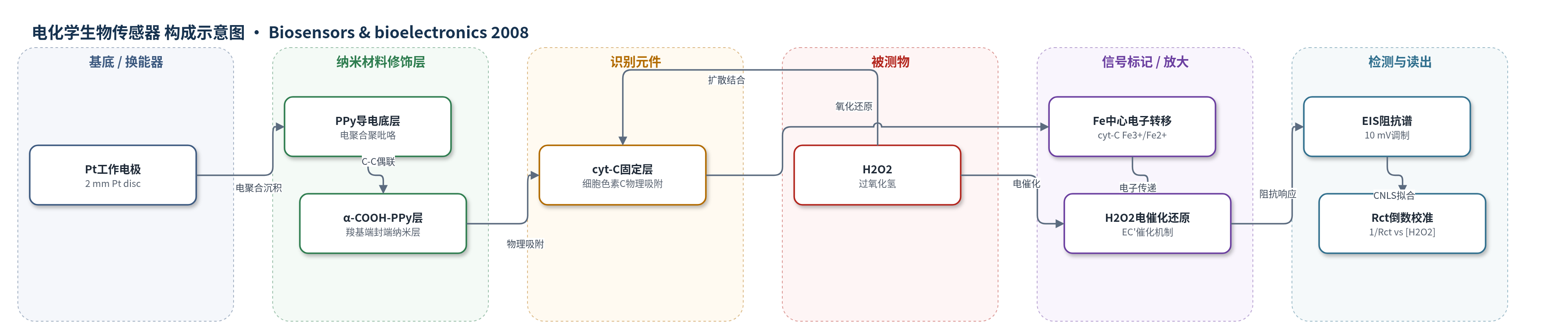
点击图片查看大图 · 依据论文自动绘制
传感器类型
电化学生物传感器
检测对象
过氧化氢(hydrogen peroxide, H2O2);样品基质:0.1 mol L−1 磷酸盐缓冲液(PBS, pH 5)
检测原理
传感器以Pt电极为基底,PPy/α-COOH-PPy导电聚合物薄膜提供导电通道和纳米支架,cyt-C通过物理吸附固定于表面。在−0.4 V偏压下,cyt-C的血红素Fe中心与电极发生直接电子转移,Fe3+被还原为Fe2+,对应Nyquist图中的电荷转移半圆。当H2O2扩散到电极表面时,cyt-C催化其还原,形成EC′催化机制,使电子转移加快、电荷转移电阻Rct下降。因此1/Rct随H2O2浓度增加而线性增大,EIS通过拟合Randles等效电路读取阻抗变化,实现H2O2检测。
检测灵敏度
LOD: 0.25 μmol L−1;线性范围: 1–200 μmol L−1;灵敏度: 2.0 × 10⁻⁵ Ω−1 μmol L−1;RSD: 7%
效应效果
该传感器在1–200 μmol L−1范围内对H2O2呈线性响应,校准灵敏度为2.0×10⁻⁵ Ω−1 μmol L−1,LOD为0.25 μmol L−1,五次重复测定RSD为7%。对照实验显示,未固定cyt-C的α-COOH-PPy电极对H2O2响应不显著,说明信号主要来自cyt-C的电催化作用。稳定性测试表明,储存10天后仍保留约95%初始响应,说明cyt-C/α-COOH-PPy支架能较好保持蛋白活性与界面稳定性。作者认为其性能可与文献报道的H2O2传感器相比,并在某些方面更优。
传感器的构成
- 工作电极:2 mm Pt disc,作为电子传导基底与换能器
- 底层导电聚合物:PPy(polypyrrole)薄膜,约200 nm,提供导电通道
- 纳米结构修饰层:α-COOH-PPy(α-carboxypyrrole polypyrrole)羧基端封端聚吡咯,提供纳米形貌与羧基结合位点
- 生物识别/催化元件:cyt-C(cytochrome C)细胞色素C,物理吸附固定,催化H2O2还原
- 信号标记物:无外加标记物,cyt-C自身Fe中心作为氧化还原信号源
- 电解质介质:0.1 mol L−1 PBS(phosphate buffer solution,pH 5),支持离子传导与阻抗测量
中文摘要
本研究采用电化学阻抗谱(EIS)研究纳米结构导电聚合物掺杂过程的动力学。聚吡咯(PPy)及其衍生物可形成具有优良电荷转移行为的导电薄膜,并可用于生物电化学领域。作者通过电化学方法在PPy底层上制备α-羧基吡咯(α-COOH-PPy)薄膜,并用EIS分析其行为。阻抗拟合结果表明,薄膜充放电机制受扩散过程控制,同时获得体相聚合物参数,包括扩散系数(D)、平衡电容(C0)和扩散电阻(R0)。扫描电镜(SEM)显示薄膜具有均一纳米结构。随后将该薄膜用作支架固定细胞色素C(cyt-C),并研究其电化学行为。cyt-C/α-COOH-PPy修饰电极可用于溶液中过氧化氢(H2O2)的电催化还原,并作为新型阻抗生物传感器进行评价。校准曲线给出检出限为0.25 μmol L−1,相对标准偏差为7%。长期稳定性测试证实该传感器具有较高稳定性和重现性。
英文摘要
Electrochemical impedance spectroscopy (EIS) as a powerful, non-invasive and informative technique was used to obtain important information about kinetics of doping process in conducting polymers. Polypyrrole (PPy) and its derivatives can form conducting polymer films which represent excellent charge transfer behaviors during doping processes. It can also have a wide range of applications in bioelectrochemistry. In the present study the conducting polymer of alpha-carboxy pyrrole (alpha-COOH-PPy), appended onto the underlying film of PPy, was prepared by electrochemical methods and its behavior was analyzed using EIS. From highly accurate fitting of impedance results it was found that the charging mechanism is governed by the diffusion process. In addition, the impedance analyses provided values for the bulk polymer parameters including diffusion coefficient (D), equilibrium capacitance (C(0)) and diffusion resistance (R(0)). The surface morphology of the polymeric film was characterized using scanning electron microscopy (SEM). The film was then used to immobilize the cytochrome C (cyt-C) and to perform its electrochemical studies. The modified cyt-C/alpha-COOH-PPy electrode was used for electrocatalytic reduction of H(2)O(2) in solution and its viability as a new impedimetric biosensor was examined. Based on the calibration curve obtained for the proposed impedimetric biosensor, the limit of detection and relative standard deviation were evaluated as 0.25 micromolL(-1) and 7%, respectively. Finally, the prolonged stability test was performed and high stability and reproducibility of the new biosensor was confirmed.