组成图示
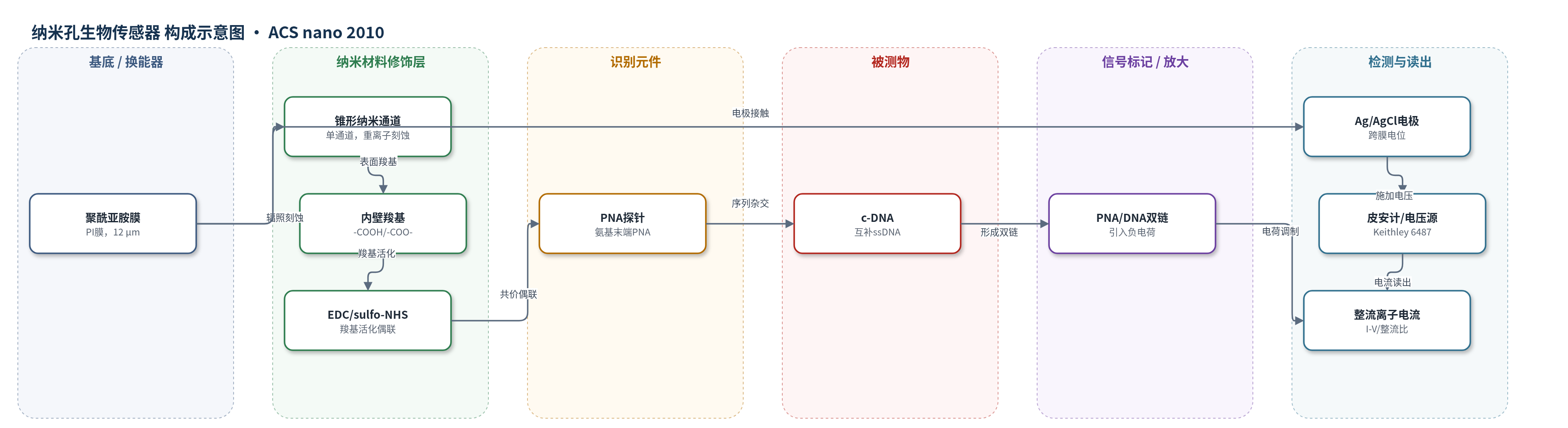
点击图片查看大图 · 依据论文自动绘制
传感器类型
纳米孔生物传感器
检测对象
互补单链DNA(c-DNA,5′-TGCTTCCGACTA-3′)、非互补DNA(nc-DNA)、单碱基错配DNA(bm-DNA);样品基质:PBS/0.1 M KCl水溶液(pH 7.6)
检测原理
该传感器以单个锥形纳米通道的表面电荷调制离子整流为换能机制。重离子刻蚀在PI通道内壁产生羧基,使通道呈负电并产生离子电流整流。中性PNA探针经EDC/sulfo-NHS共价固定后屏蔽部分负电荷,整流电流和整流比下降。当互补c-DNA进入纳米通道并与PNA杂交时,DNA磷酸骨架引入负电荷,使通道表面电荷密度升高,离子选择性增强,整流离子电流和整流比恢复并增大。Ag/AgCl电极施加跨膜电位,皮安计记录I-V曲线和整流比。完全互补序列杂交程度最高,信号最强;非互补序列无显著变化,单碱基错配信号介于两者之间,从而实现序列判别。
检测灵敏度
—
效应效果
该器件在0.1 M KCl/PBS中表现出明显的表面电荷响应。PNA固定使-1 V整流电流由53.6±2.7 nA降至16.7±0.3 nA,约下降69%;c-DNA杂交后升至37.0±3.2 nA。整流比由11.4±0.6降至3.9±0.1,杂交后升至21.3±1.6,约为羧基化通道的两倍。另一通道中,nc-DNA未引起显著I-V变化,bm-DNA使-1 V电流由14.4±1.2 nA升至31.6±1 nA,c-DNA进一步升至60±1.6 nA。结果表明传感器对完全互补序列具有良好选择性,并能区分单碱基错配。作者认为其仪器简单、成本低,可用于短ssDNA序列检测与判别。
传感器的构成
- 基底/换能器:聚酰亚胺(PI)膜,经重离子辐照和不对称化学刻蚀形成单个锥形纳米通道,作为离子传输通道与换能器
- 通道内壁修饰层:刻蚀产生的羧基(-COOH)/羧酸根(-COO-),提供表面电荷和共价偶联位点
- 偶联试剂:EDC和sulfo-NHS,活化羧基形成活性酯,实现PNA探针共价偶联
- 识别元件:氨基末端PNA探针(5′-H2N-O-Lys-TAGTCGGAAGCA),通过N端赖氨酸/乙二醇连接臂与通道羧基结合,识别互补ssDNA
- 电解液/离子介质:0.1 M KCl/PBS(pH 7.6),提供离子电流和整流信号
- 电极/读出:Ag/AgCl电极与皮安计/电压源(Keithley 6487),施加跨膜电位并测量离子电流
中文摘要
本文报道了一种基于单个合成锥形纳米通道的简单、高灵敏且高选择性纳流体传感器件,用于单链DNA寡核苷酸的序列特异性检测。该器件的传感性能敏感依赖于通道内壁表面电荷及化学基团,这些基团作为不同分析物的结合位点。未带电肽核酸(PNA)探针通过碳二亚胺偶联化学共价固定于通道表面,使通道表面负电荷降低,导致通过通道的整流离子电流显著下降。PNA修饰通道可作为高特异、高选择性器件检测互补单链DNA序列。PNA/DNA杂交后,由于带负电DNA链的存在,通道表面电荷密度增加。表面电荷依赖的电流-电压(I-V)曲线和整流比变化证实了PNA固定及纳米受限空间内PNA/DNA杂交的成功。对照实验表明,该生物传感器对互补DNA链具有显著特异性,并能基于纳米通道中的整流离子通量区分单碱基错配DNA序列。作者认为,PNA探针功能化的单个锥形纳米通道可为未知序列短单链DNA寡核苷酸的检测与判别提供生物传感平台。
英文摘要
Here we demonstrate the design and construction of a simple, highly sensitive and selective nanofluidic sensing device, based on a single synthetic conical nanochannel for the sequence specific detection of single-stranded DNA oligonucleotides. The biosensing performance of the device depends sensitively on the surface charge and chemical groups incorporated on the inner channel wall that act as binding sites for different analytes. Uncharged peptide nucleic acid (PNA) probes are covalently immobilized on the channel surface through carbodiimide coupling chemistry. This diminishes the channel surface charge, leading to a significant decrease in the rectified ion current flowing through the channel. The PNA-modified channel acts as a highly specific and selective device for the detection of a complementary single-stranded DNA sequence. Upon PNA/DNA hybridization, the channel surface charge density increased due to the presence of the negatively charged DNA strand. The changes in the surface charge-dependent current-voltage (I-V) curves and rectification ratio of the channel confirm the success of immobilization and PNA/DNA hybridization within a confined space at the nanoscale. In addition, a control experiment indicated that the biosensor exhibits remarkable specificity toward a cDNA strand and also has the ability to discriminate single-base mismatch DNA sequences on the basis of rectified ion flux through the nanochannel. In this context, we envision that the single conical nanochannels functionalized with a PNA probe will provide a biosensing platform for the detection and discrimination of short single-stranded DNA oligomer of unknown sequence.