组成图示
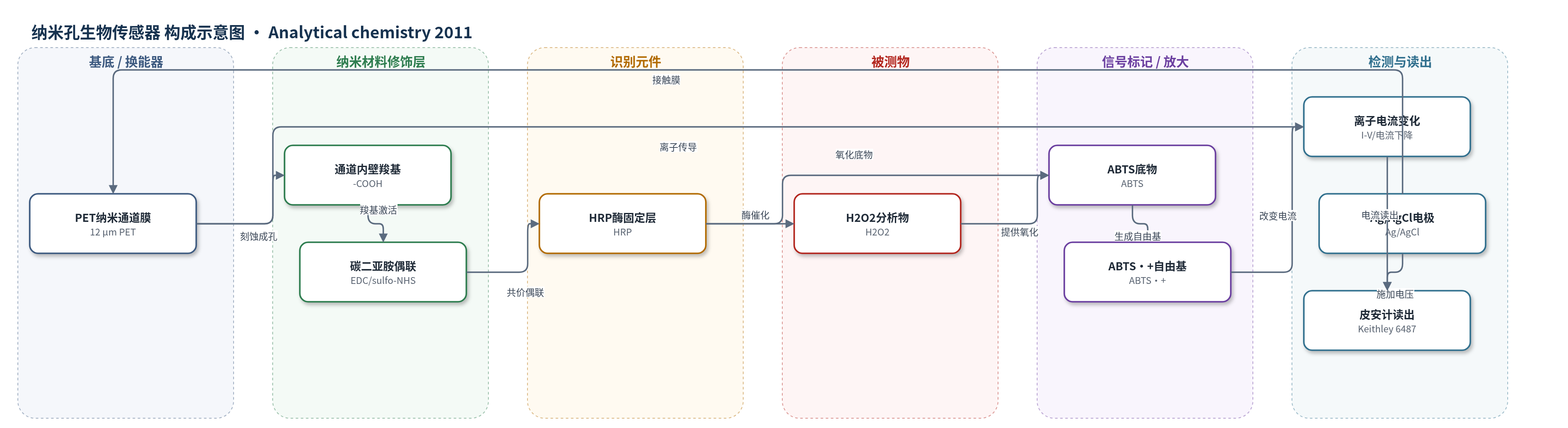
点击图片查看大图 · 依据论文自动绘制
传感器类型
纳米孔生物传感器
检测对象
过氧化氢(H2O2, hydrogen peroxide);样品基质:0.1 M KCl 溶液(pH 6.5,含 1.5 mM ABTS)
检测原理
HRP 共价固定于锥形 PET 纳米通道内壁。当 H2O2 进入通道时,HRP 被 H2O2 氧化为 Compound I,再经两步单电子还原回到 Fe3+ 基态;在此过程中 HRP 催化氧化 ABTS 生成 ABTS•+ 阳离子自由基。由于通道体积为亚飞升级,少量 H2O2 即可在通道内积累 ABTS•+。ABTS•+ 与通道壁负电荷发生静电作用,降低有效表面电荷密度,并可能在窄口处与 K+ 竞争、造成空间阻碍,从而改变跨膜离子传输。H2O2 浓度越高,生成的 ABTS•+ 越多,正偏压下离子电流下降越明显,并出现波动和滞后。通过 Ag/AgCl 电极施加电压,用皮安计记录 I-V 曲线或恒定电压电流,即可定量读出 H2O2 浓度。
检测灵敏度
灵敏度斜率: ∼1.5 (0.2) pA per 1 nM of H2O2;线性范围: 纳摩尔至微摩尔(0–1.0 μM,含 10 nM);预计检测精度: ∼10 nM
效应效果
作者未报告选择性、抗干扰、实际样品回收率或 RSD 数值,但展示了良好的可逆性与重现性:同一纳米通道在含与不含 0.5 mM H2O2 的 0.1 M KCl/1.5 mM ABTS 溶液间多次切换,+2 V 电流可重复恢复;恒定电压下电流波动不超过信号的 20%,1 μM H2O2 使 +2 V 电流下降约 5 倍。系统预计灵敏度约 10 nM,优于许多现有 H2O2 传感器,但低于最佳电化学传感器约 10 pM。其制备简单、不易污染、可重复使用,共价固定可防止 HRP 泄漏,并可用于研究单个纳米通道内酶功能;作者认为更窄通道有望进一步降低检测限。
传感器的构成
- 基底/换能器:12 μm 厚聚对苯二甲酸乙二醇酯(PET)膜,经离子刻蚀形成单个锥形纳米通道,作为离子电流换能器。
- 通道内壁官能团:刻蚀产生的羧基(-COOH,约 1 个/nm²),作为 HRP 共价偶联位点。
- 偶联剂:N-(3-二甲氨基丙基)-N'-乙基碳二亚胺盐酸盐(EDC)和 N-羟基磺基丁二酸酯(sulfo-NHS),激活羧基并形成酰胺键。
- 识别/催化元件:辣根过氧化物酶(HRP),共价固定于通道内壁,催化 H2O2 氧化 ABTS。
- 底物/信号标记物:2,2'-偶氮双(3-乙基苯并噻唑-6-磺酸)(ABTS),被氧化为 ABTS•+ 阳离子自由基,改变通道界面电荷与离子传输。
- 电解质/样品基质:0.1 M KCl 溶液(pH 6.5,含 1.5 mM ABTS),提供离子传导环境并容纳 H2O2 分析物。
- 电极/读出:Ag/AgCl 电极与 Keithley 6487 皮安计/电压源,施加跨膜电压并测量 I-V 电流信号。
中文摘要
受生物离子通道功能与响应性启发,研究者发展了基于聚合物和固态纳米通道的生物传感系统。此类纳米通道能否检测周围环境中特定外源分析物,关键取决于通道内壁的表面特性;将识别位点固定到通道壁即可制备针对特定分子的传感器。已有许多纳米通道平台用于检测 DNA 和蛋白质,但能检测小分子的平台较少。本文报道了一种用于检测过氧化氢(H2O2)的纳米通道平台。H2O2 既是细胞系统中的有毒代谢废物,也是氧化还原信号通路中的关键分子。该传感器基于离子刻蚀聚合物膜中制备的单个锥形纳米通道,通道内壁通过碳二亚胺偶联化学固定辣根过氧化物酶(HRP)。作者通过测量 pH 依赖的电流-电压(I-V)曲线证实 HRP 成功固定。该 HRP-纳米通道系统以 2,2'-偶氮双(3-乙基苯并噻唑-6-磺酸)(ABTS)为底物,可检测纳摩尔浓度 H2O2,表明固定 HRP 能在单个纳米通道的亚飞升级体积内诱导氧化还原反应。研究还证明该生物传感器响应可逆,可多次用于不同浓度 H2O2 的检测。
英文摘要
Inspired from the funtioning and responsiveness of biological ion channels, researchers attempt to develop biosensing systems based on polymer and solid-state nanochannels. The applicability of these nanochannels for detection/sensing of any foreign analyte in the surrounding environment depends critically on the surface characteristics of the inner walls. Attaching recognition sites to the channel walls leads to the preparation of sensors targeted at a specific molecule. There are many nanochannel platforms for the detection of DNA and proteins, but only a few are capable of detecting small molecules. Here, we describe a nanochannel platform for the detection of hydrogen peroxide, H(2)O(2), which is not only a toxic waste product in the cellular systems but also a key player in the redox signaling pathways. The sensor is based on single conical nanochannels fabricated in an ion tracked polymer membrane. The inner walls of the channel are decorated with horseradish peroxidase (HRP) enzyme using carbodiimide coupling chemistry. The success of the HRP immobilization on the channel surface is confirmed by measuring the pH-dependent current-voltage (I-V) curves of the system. The reported HRP-nanochannel system detects nanomolar concentrations of H(2)O(2) with 2,2'-azino-bis(3-ethylbenzothiazoline-6-sulfonate) (ABTS) as the substrate. The immobilized HRP enzyme is thus capable of inducing redox reactions in a subfemtoliter volume of single nanochannels. We demonstrate that functioning of the designed biosensor is reversible and can be used multiple times to detect H(2)O(2) at various concentrations.