组成图示
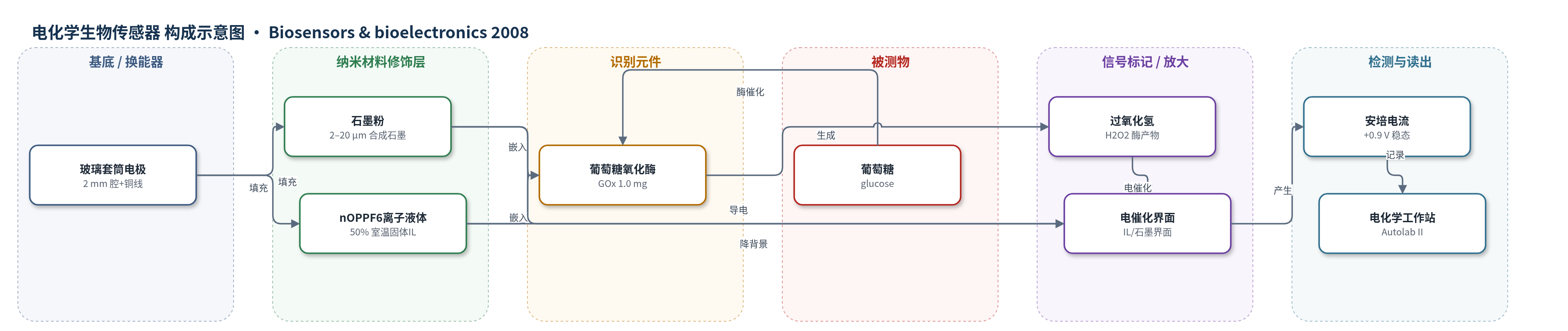
点击图片查看大图 · 依据论文自动绘制
传感器类型
电化学生物传感器
检测对象
葡萄糖(glucose)、过氧化氢(hydrogen peroxide,中间产物);样品基质:0.05 M 磷酸盐缓冲液(pH 7.5)
检测原理
葡萄糖氧化酶(GOx)识别并催化葡萄糖氧化,生成过氧化氢(H2O2)。n-octyl-pyridinium hexafluorophosphate(nOPPF6)与石墨粉形成三维复合基体,石墨提供导电网络,nOPPF6 降低背景电流并增强 H2O2 的电催化电子转移,使 H2O2 可在较低过电位下发生氧化/还原。在 +0.9 V 工作电位下,H2O2 的氧化电流被安培法读出;随着葡萄糖浓度升高,酶反应产生的 H2O2 增多,稳态电流相应增大,在 2–20 mM 范围内呈线性。该体系未使用额外标记物或核酸放大,信号放大主要来自酶催化与离子液体/石墨界面的电催化协同。
检测灵敏度
线性范围: 2–20 mM(葡萄糖);线性范围: 至 2.8 mM(H2O2)
效应效果
与矿物油/石墨/GOx 复合电极相比,IL/石墨/GOx 电极在 +0.9 V 下对连续 2 mM 葡萄糖添加产生明显更大的安培信号,而矿物油电极几乎无响应;即使将矿物油电极 GOx 负载增至 10.0 mg,响应仅提高 2–3 倍。IL 电极对葡萄糖呈高度线性响应,范围 2–20 mM,响应时间约 5 s;对 H2O2 在 +0.5 V 或 -0.2 V 下 1–2 s 内达到稳态,线性至 2.8 mM。50% nOPPF6 负载使背景电流显著降低、机械稳定性提高,且无需加热。作者认为该体系可扩展至其他氧化酶/脱氢酶安培传感器。
传感器的构成
- 基底/换能器电极:玻璃套筒电极腔(2 mm 直径、3 mm 深)与铜线电接触,构成工作电极载体;三电极体系含 SCE 参比电极和铂丝对电极。
- 复合基体层:合成石墨粉(2–20 μm 不规则微粒)与 n-octyl-pyridinium hexafluorophosphate(nOPPF6)按 50/50 混合,形成低背景、机械稳定的三维 IL/石墨导电基体。
- 识别元件:葡萄糖氧化酶(GOx,Aspergillus Niger,EC 1.1.3.4,234,900 U/g)以 1.0 mg 负载嵌入 IL/石墨矩阵,催化葡萄糖氧化。
- 信号换能层:无外加标记物;酶反应生成的过氧化氢(H2O2)在 IL/石墨界面发生电催化氧化/还原,产生安培电流。
- 电解质介质:0.05 M 磷酸盐缓冲液(pH 7.5),提供离子导电与酶反应环境。
中文摘要
本文报道了一种基于室温固体离子液体正辛基吡啶六氟磷酸盐(n-octyl-pyridinium hexafluorophosphate, nOPPF6)的离子液体/石墨复合葡萄糖生物传感器。将 nOPPF6 与石墨粉混合形成三维复合基体,可克服传统离子液体糊状电极背景电流高、机械稳定性差的问题,并保持离子液体对过氧化氢的电催化活性。将葡萄糖氧化酶(GOx)嵌入该 IL/石墨矩阵后,葡萄糖被酶催化氧化生成过氧化氢,后者在复合电极界面发生电催化氧化/还原,从而产生安培电流。与矿物油/石墨/GOx 复合电极相比,该传感器具有更低背景电流、更快电子转移、更好线性响应和更简单制备过程。研究考察了离子液体和 GOx 负载对伏安、安培、电容和电阻的影响,表明 50% IL 与 1.0 mg GOx 为较优组成。该工作为离子液体基电化学生物传感器提供了新的制备策略。
英文摘要
The use of ionic liquids that are solid at room temperature such as n-octyl-pyridinium hexafluorophosphate (nOPPF(6)) is shown to be advantageous in the fabrication of new form of biocomposite materials with attractive performance over other types of composites and pastes involving non-conductive binders. The resulting IL/graphite material brings new capabilities for electrochemical devices by combining the advantages of ILs and "bulk" composite electrodes. The electrocatalytic properties of the ILs are not impaired by their association with the graphite powder. The marked electrocatalytic activity towards hydrogen peroxide permits effective amperometric biosensing of glucose in connection with the incorporation of glucose oxidase within the three-dimensional IL/graphite matrix. The accelerated electron transfer is coupled with low background current and improved linearity. The advantages of these IL-based biocomposite devices are illustrated from comparison to conventional mineral oil/graphite biocomposite. The influence of the IL and glucose oxidase (GOx) loading upon the amperometric and voltammetric data, as well as the electrode capacitance and resistance, is examined. The preparation of IL/graphite composites overcomes a major obstacle for creating IL-based biosensing devices and expands the scope of IL-based electrochemical devices.