组成图示
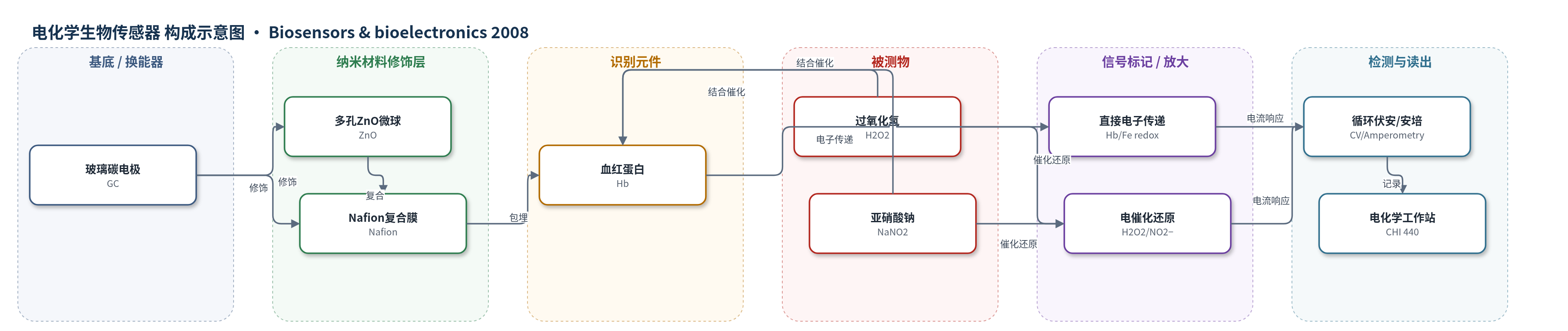
点击图片查看大图 · 依据论文自动绘制
传感器类型
电化学生物传感器
检测对象
过氧化氢(H2O2,pH 7.0 PBS缓冲液)、亚硝酸根(NO2−,以NaNO2加入,pH 5.2醋酸缓冲液)
检测原理
Hb包埋于多孔ZnO–Nafion复合膜中,ZnO纳米腔体保持Hb天然二级结构,Nafion提供质子传导,使血红素Fe中心与GC电极发生直接电子传递。检测H2O2时,Hb(FeIII)与H2O2反应生成Compound I,Compound I再与H2O2反应再生Hb(FeIII)并释放O2;电极上Hb(FeIII)被还原为Hb(FeII),O2与Hb(FeII)结合后再被还原,总反应为H2O2+2H+ +2e-→2H2O,产生随H2O2浓度增大的阴极电流。检测NO2−时,Hb在pH 5.2醋酸缓冲液中电催化还原NO2−,在-0.675 V产生稳态电流。多孔结构增大有效面积并缩短底物扩散距离,使电流响应随被测物浓度线性增强。
检测灵敏度
H2O2: 线性范围: 1-410 μM;灵敏度: 137 mA cm-2 M-1;R = 0.9998(n = 18)。NaNO2: LOD: 4 μM(信噪比=3);线性范围: 10-2700 μM;R = 0.9997(n = 30)。
效应效果
传感器对H2O2检测选择性良好:60或120 μM H2O2存在下,加入60或120 μM NaNO2不干扰;抗坏血酸、尿酸、葡萄糖与H2O2同浓度时也不干扰。H2O2响应重现性好,30和120 μM连续5次测量RSD分别为0.48%和0.8%,电极间RSD为2%。4 ℃保存20天后保留96%初始响应。NaNO2检测响应时间小于5 s,可重复使用且灵敏度无明显下降。作者认为该无介质第三代电化学生物传感器具有宽线性范围、低检出限、快速响应和良好长期稳定性,适用于生物医学检测和环境分析。
传感器的构成
- 基底电极:玻璃碳电极(GC),作为换能器提供电子传递界面
- 纳米材料修饰层:多孔纳米片基氧化锌微球(ZnO),提供高比表面积、纳米腔体和生物相容固定化环境
- 复合固定化膜:Nafion全氟磺酸聚合物,与ZnO形成无机–有机杂化膜,增强质子传导并辅助固定Hb
- 识别/催化元件:牛血红蛋白(Hb),包埋于ZnO–Nafion膜中,实现直接电子传递并催化H2O2和NO2−还原
- 信号元件:血红蛋白血红素(Heme)中心,直接参与Fe(III)/Fe(II)电子传递并产生电流
中文摘要
本文通过简便化学浴沉积法结合热处理,制备了具有多孔纳米结构的纳米片基氧化锌(ZnO)微球,并将其用于构建电化学生物传感器。光谱与电化学表征表明,ZnO基复合材料是良好的生物相容性酶固定化基质,可保持酶的稳定性与生物活性。借助纳米结构无机–有机杂化材料优势,在pH 7.0缓冲液中获得了稳定、清晰的血红蛋白(Hb)准可逆氧化还原峰,形式电位为-0.345 V(vs. Ag/AgCl)。在ZnO基酶电极上实现了金属酶的直接电子传递,表观异相电子传递速率常数ks为3.2 s-1。对比研究表明,多孔纳米片基ZnO微球比实心ZnO微球更能促进固定化酶的电子传递,这可能源于其独特纳米结构和更大比表面积。所制备传感器用于检测H2O2和NaNO2,线性范围分别为1-410 μM和10-2700 μM。包埋的Hb对H2O2催化还原具有较高过氧化物酶样活性,表观米氏常数KappM为143 μM。多孔纳米片基ZnO有望成为直接电化学生物传感器制备的优良基质,在生物医学检测和环境分析中具有潜在应用。
英文摘要
Nanosheet-based ZnO microsphere with porous nanostructures was synthesized by a facile chemical bath deposition method followed by thermal treatment, which was explored for the construction of electrochemical biosensors. Spectroscopic and electrochemical researches revealed the ZnO-based composite was a biocompatible immobilization matrix for enzymes with good enzymatic stability and bioactivity. With advantages of nanostructured inorganic-organic hybrid materials, a pair of stable and well-defined quasi-reversible redox peaks of hemoglobin was obtained with a formal potential of -0.345 V (vs. Ag/AgCl) in pH 7.0 buffer. Facilitated direct electron transfer of the metalloenzymes with an apparent heterogeneous electron transfer rate constant (k(s)) of 3.2s(-1) was achieved on the ZnO-based enzyme electrode. Comparative studies demonstrated the nanosheet-based ZnO microspheres were more effective in facilitating the electron transfer of immobilized enzyme than solid ZnO microspheres, which may result from the unique nanostructures and larger surface area of the porous ZnO. The prepared biosensor displayed good performance for the detection of H(2)O(2) and NaNO(2) with a wide linear range of 1-410 and 10-2700 microM, respectively. The entrapped hemoglobin exhibits high peroxidase-like activity for the catalytic reduction of H(2)O(2) with an apparent Michaelis-Menten constant (K(M)(app)) of 143 microM. The nanosheet-based ZnO could be a promising matrix for the fabrication of direct electrochemical biosensors, and may find wide potential applications in biomedical detection and environmental analysis.