组成图示
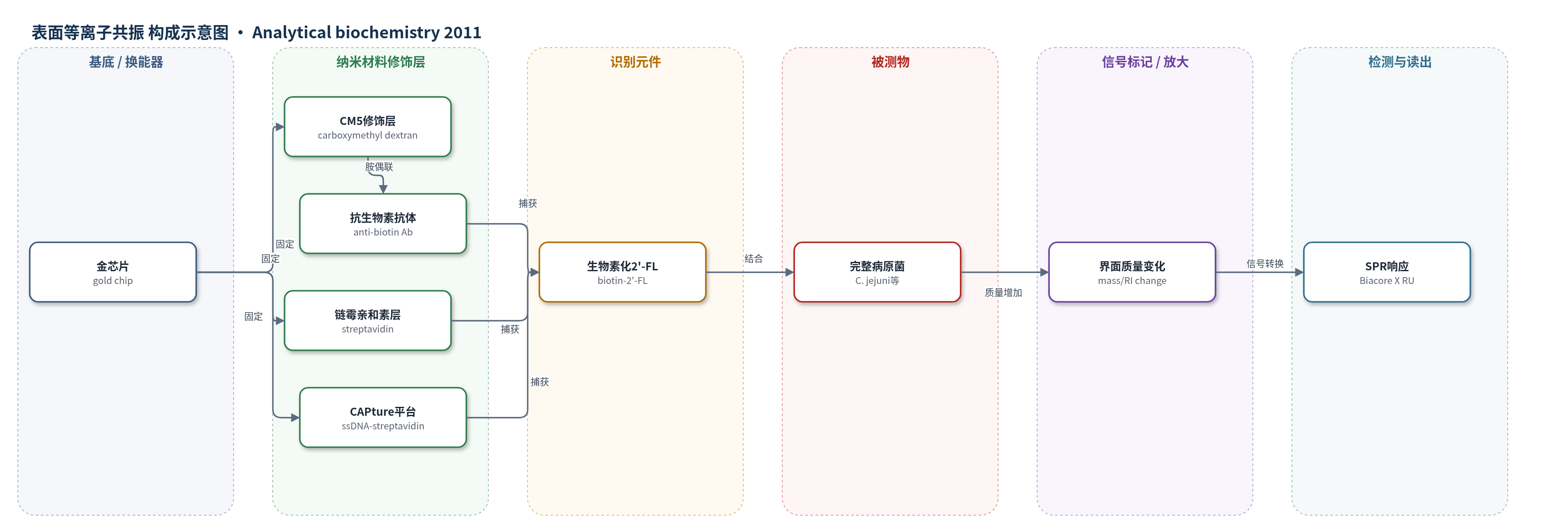
点击图片查看大图 · 依据论文自动绘制
传感器类型
表面等离子共振(SPR)生物传感器
检测对象
完整病原菌细胞(whole bacterial cells),包括空肠弯曲菌(Campylobacter jejuni, C. jejuni)、鼠伤寒沙门氏菌(Salmonella enterica serovar Typhimurium)、金黄色葡萄球菌(Staphylococcus aureus)等;样品基质:HBS-EP缓冲液重悬的细菌悬液
检测原理
将生物素化2'-岩藻糖基乳糖(2'-FL)通过抗生物素抗体、链霉亲和素或DNA-链霉亲和素平台固定于Biacore金芯片表面。完整病原菌细胞流过芯片时,其表面黏附因子/凝集素与固定2'-FL特异性结合,形成细菌-寡糖复合物。结合事件使芯片表面附近质量与折射率发生变化,激发表面等离子共振条件改变,Biacore X以响应单位(RU)实时记录结合曲线。细菌浓度越高,结合量越大,响应信号越强;参考通道扣除非特异吸附。未标记2'-FL预孵育可竞争占据细菌结合位点,使信号下降,从而验证结合特异性。方法无需酶标或荧光标记,直接检测全细胞结合动力学。
检测灵敏度
原文未报告LOD、线性范围、灵敏度斜率或R^2;仅报告细菌结合检测限于浓度大于 1 × 10^8 CFU/ml 的样品。
效应效果
方法选择性与重现性良好。CM5芯片10^8与10^9 CFU/ml空肠弯曲菌信号为15±0.58和31±1.25 RU,检测限于>1×10^8 CFU/ml。SA芯片1×10^8 CFU/ml细菌在5 µl/min下使信号升至147±0.57 RU。未标记2'-FL预孵育使信号降低60%。biotin CAPture平台中空肠弯曲菌响应39.03±7.79 RU,铜绿假单胞菌无响应,金黄色葡萄球菌基线增加7.76±0.90 RU;24循环不衰减,寡糖捕获增加26.34±1.43 RU。参考表面扣除非特异结合,检测<40 min。
传感器的构成
- 基底/换能器:金芯片(gold chip)/Biacore SPR芯片,提供表面等离子共振检测界面
- 修饰层:CM5羧甲基葡聚糖(carboxymethyl dextran, CM5)、SA链霉亲和素(streptavidin, SA)或biotin CAPture ssDNA-链霉亲和素平台,用于固定/捕获生物素化寡糖
- 生物素化连接子:EZ-Link biotin-PEG4-hydrazide,用于在2'-岩藻糖基乳糖(2'-fucosyllactose, 2'-FL)还原端引入生物素
- 捕获/连接元件:山羊抗生物素抗体(goat anti-biotin antibody)或链霉亲和素(streptavidin),用于固定生物素化2'-FL
- 识别元件:生物素化2'-岩藻糖基乳糖(biotinylated 2'-FL),作为乳寡糖配体/受体诱饵
- 结合对象:完整病原菌细胞(whole bacterial cells),如空肠弯曲菌(Campylobacter jejuni, C. jejuni),其表面受体/凝集素与2'-FL结合
- 信号读出:Biacore X SPR系统,监测界面折射率变化并输出响应单位(RU)
中文摘要
目前公认乳寡糖可通过干扰病原微生物黏附到人类细胞而直接抑制其感染。许多乳源游离寡糖是上皮细胞表面碳水化合物的可溶性受体类似物,可作为受体诱饵使病原菌优先结合,从而减少宿主细胞黏附。然而,目前快速筛选此类寡糖的方法很少,相关研究多依赖耗时的人细胞系感染模型,因此需要一种快速、灵敏的方法检测微生物与乳寡糖的结合。本研究建立了多种基于生物传感器的检测方法。实验将完整细菌细胞暴露于固定在预处理金芯片表面的2'-岩藻糖基乳糖,并利用表面等离子共振技术实时监测结合过程。通过筛选包括空肠弯曲菌在内的多种病原菌验证方法,其中空肠弯曲菌已知可与2'-岩藻糖基乳糖结合。对检测到结合的菌株,采用未标记2'-岩藻糖基乳糖预孵育进行竞争性抑制,以确认结合特异性。结果表明,所建立的方法快速、经济、重现性良好,可用于鉴定具有抗感染活性的乳寡糖。
英文摘要
It is now well accepted that milk oligosaccharides can have a direct inhibitory effect on pathogenic microorganisms by interfering with their adhesion to human cells. Many free oligosaccharides from milk are considered to be soluble receptor analogs of epithelial cell surface carbohydrates and, thus, function as receptor decoys to which pathogens can bind instead of the host. In reality, there are few rapid methods to screen for such oligosaccharides, and much of the research in this area has centered on using human cell line models of infection that are time-consuming. Therefore, a quick and sensitive method is required for detecting the binding of microorganisms to milk oligosaccharides. Our study describes a number of biosensor-based methods to achieve these aims. Our approach involved the exposure of whole bacterial cells to the well-characterized human milk oligosaccharide, 2'-fucosyllactose, immobilized to a pretreated gold chip surface. The technique was validated by screening a range of pathogenic bacteria, including Campylobacter jejuni, to which 2'-fucosyllactose is known to bind. Where binding was detected, its specificity was confirmed by preincubation studies using unlabeled 2'-fucosyllactose. The techniques described represent a quick, cost-effective, and highly reproducible detection method for identifying anti-infective oligosaccharides.