组成图示
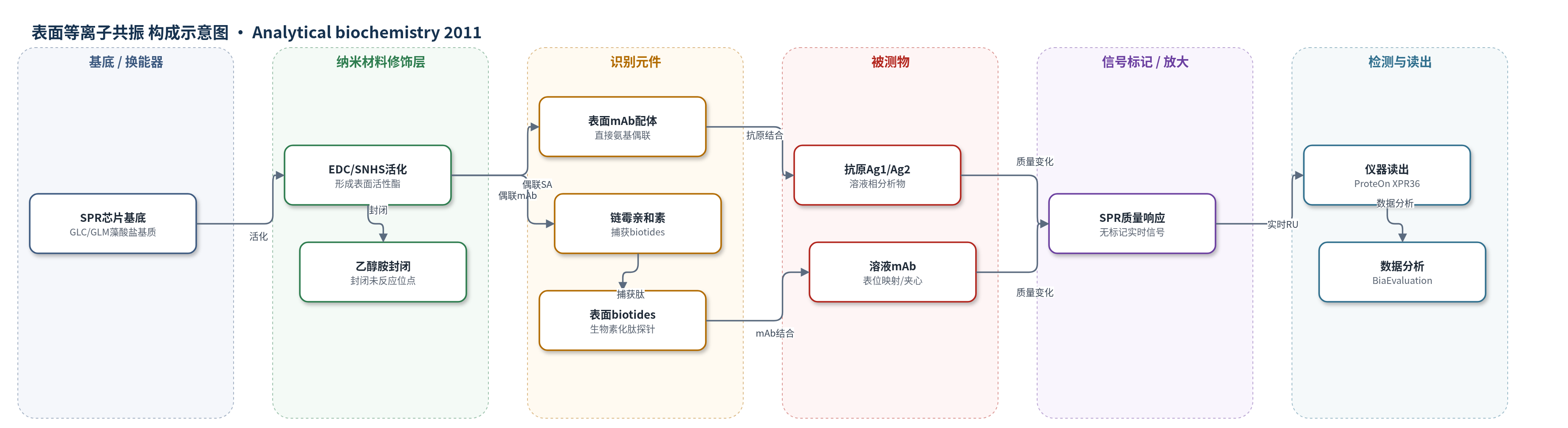
点击图片查看大图 · 依据论文自动绘制
传感器类型
表面等离子共振(SPR)生物传感器
检测对象
抗原 Ag1(13 kDa monomeric antigen)、抗原 Ag2(60 kDa monomeric antigen)、单克隆抗体 mAbs(IgG)、生物素化肽 biotides;样品基质:HBST(10 mM Hepes、150 mM NaCl、0.05% Tween 20)或 PBS/0.05% Tween 20/1 mg/mL BSA 缓冲液
检测原理
该传感器采用无标记表面等离子共振(SPR)原理。首先用 EDC/SNHS 活化 ProteOn GLC/GLM 芯片表面,将单克隆抗体(mAb)直接氨基偶联,或将链霉亲和素偶联后捕获生物素化肽(biotides),再用乙醇胺或生物素封闭。当溶液相抗原(Ag1/Ag2)或 mAb 流过反应点并与表面配体结合时,界面质量增加,改变表面等离子体共振条件,产生以 RU 表示的实时响应。结合/解离曲线随分析物浓度变化,通过 kinetic titration 连续注入递增浓度而不再生,可拟合 ka、kd 和 KD;夹心分箱通过抗原捕获后第二抗体结合判断表位竞争;biotides 阵列用于线性表位映射。系统采用局部参考和双参考扣除非特异信号,无外源标记放大。
检测灵敏度
相关系数:R^2 = 0.80(ka)、R^2 = 0.87(kd)
效应效果
ProteOn 36 配体阵列与 Biacore 2000 的动力学参数高度相关,ka 的 R^2 为 0.80,kd 的 R^2 为 0.87;ProteOn GLC 藻酸盐芯片的绝对参数更接近 Biacore C1,ka 与 C1 相差 1.4 倍、与 CM4 相差 3.2 倍。36×36 表位分箱矩阵覆盖 1296 个相互作用,约 9 h 完成,识别出 13 个表位 bins;与 Octet QK384 的 16×16 分箱结果总体一致,且 ProteOn 信噪比更高。表位映射中 12 个 mAb 对 36 个 biotides 约 5 h 完成,而 Biacore 2000 需超过 2 天。空白点和阴性对照无非特异结合,重复点与重复循环显示良好重现性,作者认为该方法可加速抗体药物发现。
传感器的构成
- 基底/换能器:ProteOn XPR36 SPR 芯片(GLC/GLM),藻酸盐基表面基质,提供 36 个反应点与局部参考
- 活化修饰层:EDC/SNHS(1-ethyl-3-(3-dimethylaminopropyl)-carbodiimide hydrochloride / sulfo-N-hydroxysuccinimide)活化表面氨基,形成活性酯用于偶联
- 识别元件:单克隆抗体(mAbs/IgG)直接氨基偶联至各反应点,或链霉亲和素(streptavidin)捕获生物素化肽(biotides)
- 封闭层:乙醇胺(ethanolamine)封闭未反应活性酯;生物素(biotin)封闭链霉亲和素剩余位点
中文摘要
本文展示了提高 ProteOn XPR36 生物传感器通量的方法,使其能够同时表征多种多路复用格式,例如 36 个靶向同一抗原的不同单克隆抗体,并支持详细的表位分箱与表位映射研究。采用这些方法测得的动力学速率常数与 Biacore 2000 的结果高度相关;ProteOn 藻酸盐基 GLC 芯片获得的绝对参数值与 Biacore 平面 C1 芯片更接近,而与葡聚糖基 CM4 芯片差异更大。ProteOn 36 配体阵列格式得到的成对表位分箱数据与正交阵列式生物传感器 Octet QK384 的结果相似。在使用生物素化肽进行表位映射的研究中,三种生物传感器平台识别结合线性表位抗体的能力相近。作者应用了 ProteOn 阵列的多种替代格式,使该平台可同时开展的检测数量显著高于此前预期。
英文摘要
Here we demonstrate methods to expand the throughput of the ProteOn XPR36 biosensor allowing for the simultaneous kinetic characterization of several multiplexed formats, such as 36 disparate antibodies targeting the same antigen, and facilitating detailed epitope binning and mapping studies. The kinetic rate constants determined by these methods correlated with those obtained on Biacore 2000 and the absolute parameter values obtained on the ProteOn's alginate-based GLC chip agreed closer with those from Biacore's flat C1 chip than Biacore's dextran-based CM4 chip. Pairwise epitope binning data from the ProteOn 36-ligand array format and those generated on an orthogonal array-based biosensor, the Octet QK384, gave similar results. In an epitope mapping study using biotinylated peptides, all three biosensor platforms were similar in their ability to identify antibodies that bound to linear epitopes. We apply alternative formats of the ProteOn array that enable a significantly higher number of assays to be conducted simultaneously than previously anticipated on this platform.